




























Views
Downloads
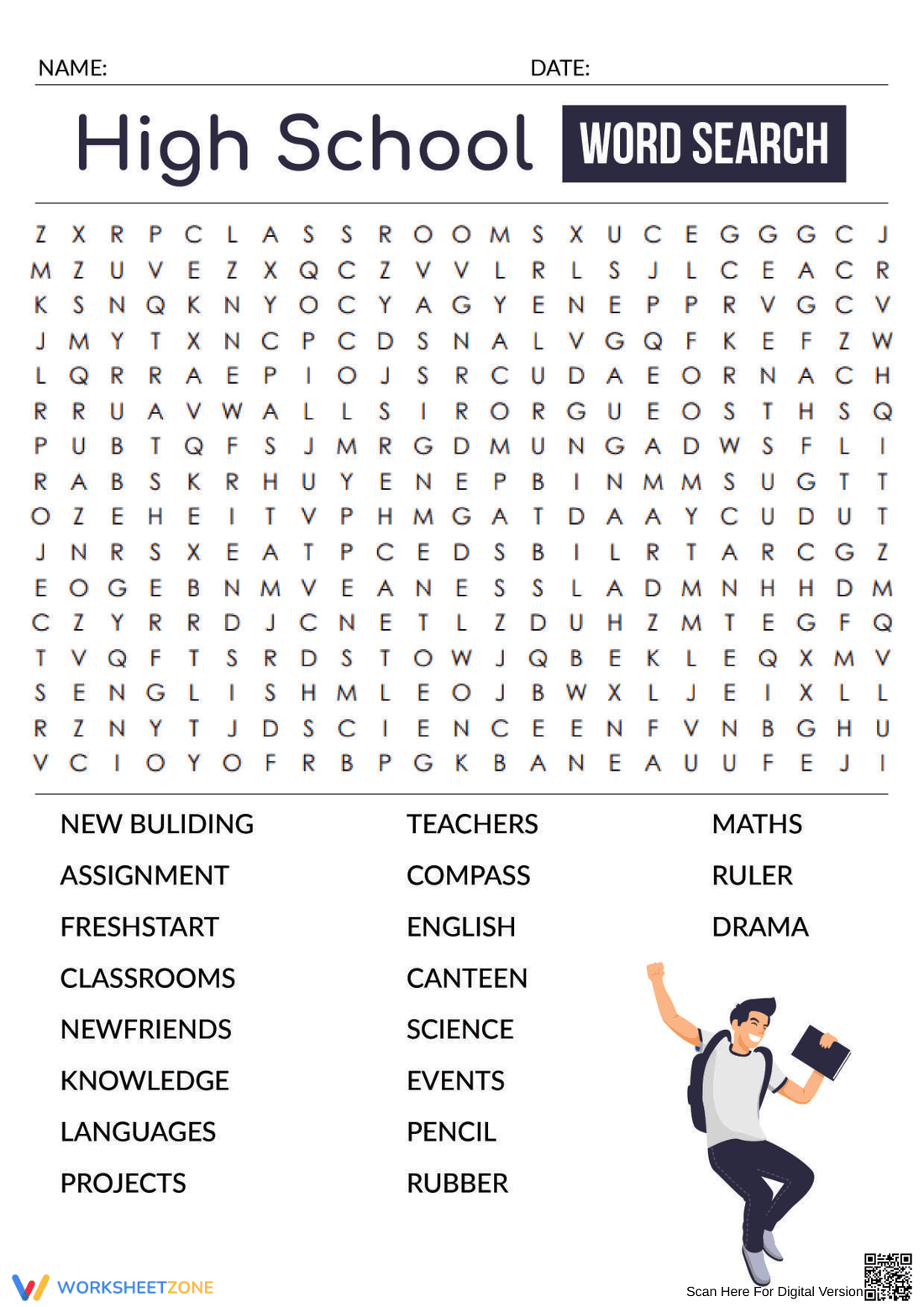

High School Word Search: Printable Vocabulary Activity

Paste this activity's link or code into your existing LMS (Google Classroom, Canvas, Teams, Schoology, Moodle, etc.).
Students can open and work on the activity right away, with no student login required.
You'll still be able to track student progress and results from your teacher account.
This printable vocabulary worksheet reinforces school-themed terminology for high school students. Learners identify and locate nineteen key academic and campus-related terms within the grid to strengthen word recognition and spelling. This activity supports vocabulary acquisition and provides an engaging, independent task for secondary English language arts classrooms.
At a Glance
- Grade: 9 · Subject: ELA
- Standard:
CCSS.ELA-LITERACY.L.9-10.6— Acquire and use academic words- Skill Focus: Word recognition and spelling
- Format: 1 page · 19 problems · Answer key not included · PDF
- Best For: Fast finishers and sub plans
- Time: 15–20 minutes
This single-page PDF features a grid containing nineteen school-related vocabulary words. The word list includes terms like "knowledge," "languages," "projects," and "assignment." Students search horizontally, vertically, and diagonally to locate each term. The clean layout ensures readability, while the thematic focus helps students associate spelling patterns with common high school academic vocabulary.
This resource requires less than 2 minutes of total teacher preparation time. First, print the single-page PDF for your class size. Second, distribute the sheets directly to students at the start of the period or during transitions. Third, review the completed word searches or have students self-check their progress. This straightforward workflow makes the activity ideal for emergency sub plans or morning work.
This activity aligns with CCSS.ELA-LITERACY.L.9-10.6, which requires students to acquire and use accurately general academic and domain-specific words and phrases. By scanning the letter grid, students reinforce their visual memory of correct spelling configurations for secondary-level vocabulary. Both standard codes can be copied directly into lesson plans, IEP goals, or district curriculum mapping tools.
Use this worksheet as a warm-up activity at the beginning of a unit to introduce school-themed vocabulary, or assign it during the final fifteen minutes of class to keep fast finishers engaged. During the activity, observe which students struggle to locate words systematically, as this can indicate difficulties with visual scanning or spelling recognition. Expect completion within fifteen to twenty minutes.
This worksheet is designed for ninth-grade English language arts students, including English language learners who benefit from visual word reinforcement. To differentiate, pair this search with a vocabulary journal where students write definitions for five selected words from the list. It pairs naturally with an introductory lesson on academic goal-setting or high school transition discussions.
According to the ScienceDirect TpT Analysis, structured word puzzles like word searches support secondary vocabulary acquisition by reinforcing orthographic mapping and spelling patterns. This worksheet aligns with standard CCSS.ELA-LITERACY.L.9-10.6, focusing on the plain-English skill of acquiring and using academic words. Research indicates that engaging with word puzzles helps high school students build cognitive pathways for word recognition, which directly improves reading fluency and comprehension. By requiring students to scan letters systematically, the activity strengthens visual processing skills necessary for reading complex texts. Educators can utilize this tool to support spelling retention and vocabulary familiarity in diverse classrooms. The self-contained design allows for easy integration into daily routines, providing a reliable method for reinforcing key academic terms without requiring extensive direct instruction or teacher preparation.


