


























Views
Downloads
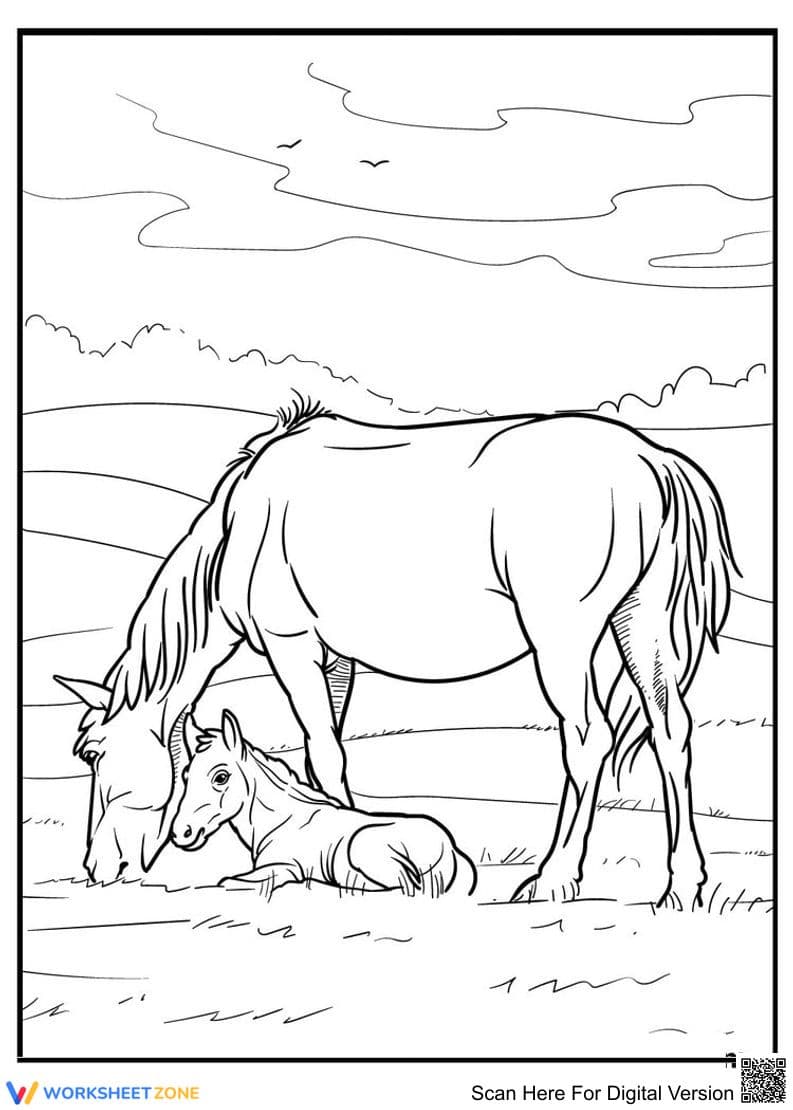

Mature Horse Feeding Coloring Page | Printable Art
Paste this activity's link or code into your existing LMS (Google Classroom, Canvas, Teams, Schoology, Moodle, etc.).
Students can open and work on the activity right away, with no student login required.
You'll still be able to track student progress and results from your teacher account.
This printable horse feeding coloring page provides elementary students with a creative way to explore animal biology and life cycles. By focusing on the relationship between a mature horse and its foal, students practice fine motor control while making quiet observations about how animals interact with their environment. It is an effective tool for reinforcing science concepts through artistic expression.
At a Glance
- Grade: 1-5 · Subject: Arts & Science
- Standard:
1-LS3-1— Make observations to construct an evidence-based account that young animals are like their parents- Skill Focus: Fine motor skills and biological observation
- Format: 1 page · 1 task · No answer key needed · PDF
- Best For: Early finishers and science center extensions
- Time: 15–20 minutes
Inside this resource, you will find a high-quality, single-page illustration featuring a mare grazing alongside her young foal. The line art is clean and detailed, offering various sections for students to practice shading and color blending. There are no complex instructions, making it an ideal choice for independent work or as a calming activity during stressful testing weeks.
The zero-prep design of this worksheet ensures it can be integrated into any lesson plan in under two minutes. First, print the single-page PDF for your entire class or keep a stack in an early finisher bin. Second, distribute the pages during a transition period or as a quiet-time activity following a lesson on animal life cycles. Finally, review the students' work by asking them to point out one physical trait the foal shares with the mature horse. This workflow minimizes teacher labor while maximizing student engagement.
This resource aligns with 1-LS3-1: "Make observations to construct an evidence-based account that young plants and animals are like, but not exactly like, their parents." While primarily an art activity, it supports the observation of physical traits and behaviors in a natural setting. Both standard codes can be copied directly into lesson plans, IEP goals, or district curriculum mapping tools.
Use this worksheet as a formative assessment tool during a unit on mammals. As students color, circulate the room and ask them to describe the differences in size and posture between the two horses. It also works perfectly as a quiet morning work activity to settle the class as they arrive, requiring approximately 15 to 20 minutes for completion.
This worksheet is designed for students in Kindergarten through Grade 5, with particular relevance for first graders studying heredity. It is an excellent resource for English Language Learners (ELLs) to build vocabulary related to animals and nature. Pair this with a non-fiction text about horses or an anchor chart detailing animal needs for a complete lesson.
The use of coloring activities in early elementary education serves as a vital bridge between creative expression and scientific observation. According to Fisher & Frey (2014), visual representations allow students to anchor complex biological concepts, such as the relationship between parent organisms and their offspring, in a tangible format. This worksheet aligns with standard 1-LS3-1 by providing a clear visual of a mature horse and its foal, prompting students to notice similarities and differences in physical traits. Research indicates that fine motor engagement through coloring supports the development of hand-eye coordination necessary for writing. By integrating this printable into a broader life science unit, educators provide a multi-sensory approach to learning that caters to diverse needs. The 1-LS3-1 standard is essential for building the foundational knowledge required for later genetics and heredity studies in middle school.


