


























Views
Plays

HS-PS2-4 Worksheet: Gravitation — Essential Grade 9 Science
Paste this activity's link or code into your existing LMS (Google Classroom, Canvas, Teams, Schoology, Moodle, etc.).
Students can open and work on the activity right away, with no student login required.
You'll still be able to track student progress and results from your teacher account.
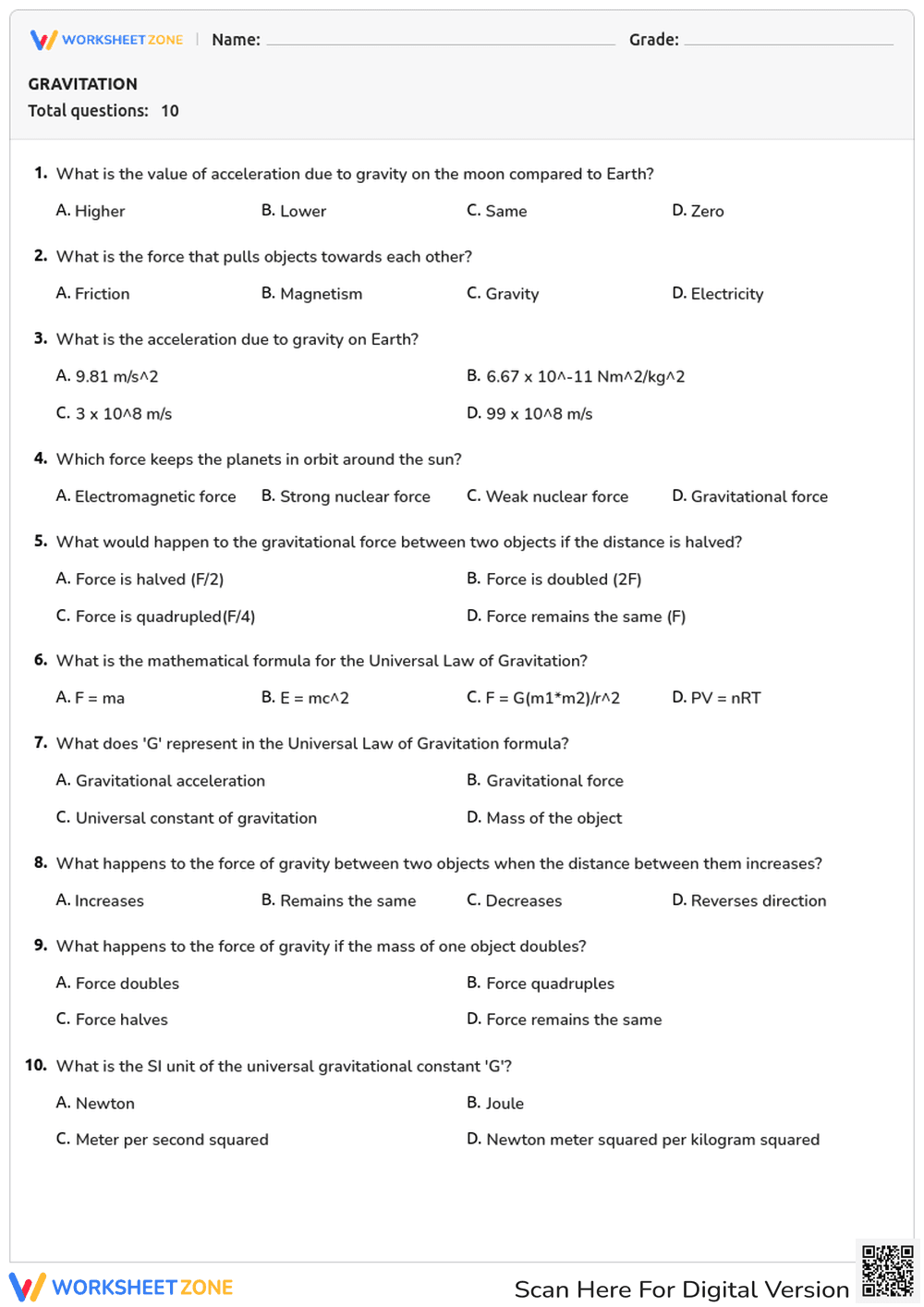
This Grade 9 gravitation worksheet provides a comprehensive assessment of Newton's Law of Universal Gravitation. Students analyze the relationship between mass, distance, and gravitational force through 10 targeted multiple-choice questions. By identifying the mathematical formula and units for the universal constant, learners demonstrate a firm grasp of fundamental physical science principles and orbital mechanics.
At a Glance
At a Glance
- Grade: 9 · Subject: Science
- Standard:
HS-PS2-4— Use Newton’s Law of Gravitation to describe and predict gravitational forces- Skill Focus: Universal Law of Gravitation
- Format: 1 page · 10 problems · Answer key included · PDF
- Best For: Formative assessment or unit review
- Time: 15–20 minutes
What's Inside
This single-page PDF features 10 high-quality multiple-choice questions designed to test conceptual understanding and mathematical literacy. The worksheet covers the value of acceleration due to gravity, the inverse square law relationship, and the specific units for the universal gravitational constant (G). A clear layout ensures students can focus on the physics without visual distraction.
Mastery Evidence
The assessment is structured to categorize student performance into clear tiers. Questions 1-4 evaluate foundational knowledge of gravitational effects, while questions 5-10 require higher-order analysis of the mathematical relationships within the Universal Law of Gravitation. Teachers can use the results to identify students who are approaching, meeting, or exceeding the HS-PS2-4 standard, allowing for immediate entry into gradebooks or IEP progress monitoring tools.
Standards Alignment
The primary focus is `HS-PS2-4`: "Use mathematical representations of Newton’s Law of Gravitation and Coulomb’s Law to describe and predict the gravitational and electrostatic forces between objects." This resource specifically isolates the gravitational component of the standard. Both standard codes can be copied directly into lesson plans, IEP goals, or district curriculum mapping tools.
How to Use It
Use this worksheet as a "ticket out the door" after a lecture on Newton's laws to gauge immediate comprehension. Alternatively, assign it as a pre-lab activity before students use simulations to explore orbital mechanics. Teachers should observe whether students struggle with the inverse square law in question 5, as this often indicates a need for additional mathematical scaffolding. Completion typically takes 15 to 20 minutes.
Who It's For
This resource is ideal for Grade 9 Physical Science or introductory Physics students. It provides necessary support for learners who benefit from structured multiple-choice options while maintaining the rigor required for high school standards. It pairs naturally with a classroom anchor chart detailing the difference between 'g' and 'G'.
Citation Capsule
This Grade 9 science resource is meticulously aligned with the HS-PS2-4 standard, focusing on the student's ability to describe and predict gravitational forces using Newton's Law of Universal Gravitation. According to the RAND AIRS 2024 report, high-quality formative assessments that isolate specific mathematical relationships—such as the inverse square law found in this 10-question quiz—significantly improve student retention of complex physical science concepts. By requiring students to distinguish between the universal constant (G) and local acceleration (g), the worksheet addresses common misconceptions identified in national science frameworks. The inclusion of SI unit identification and formulaic application ensures that learners meet the rigorous demands of college and career readiness standards. This assessment provides the quantitative data necessary for evidence-based instructional adjustments, making it a reliable tool for secondary science educators seeking to verify student mastery of fundamental forces and motion.


