


























Views
Plays
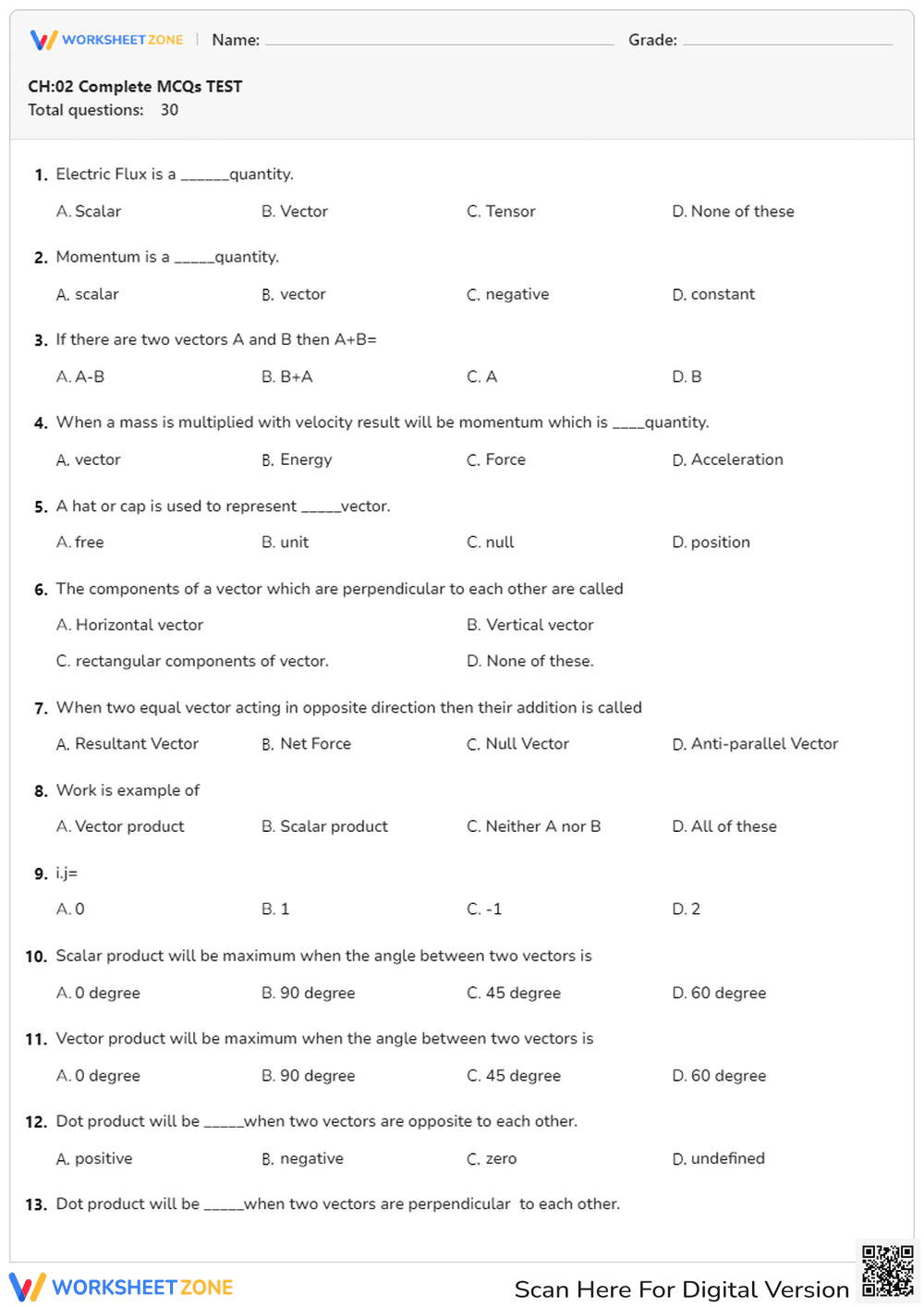
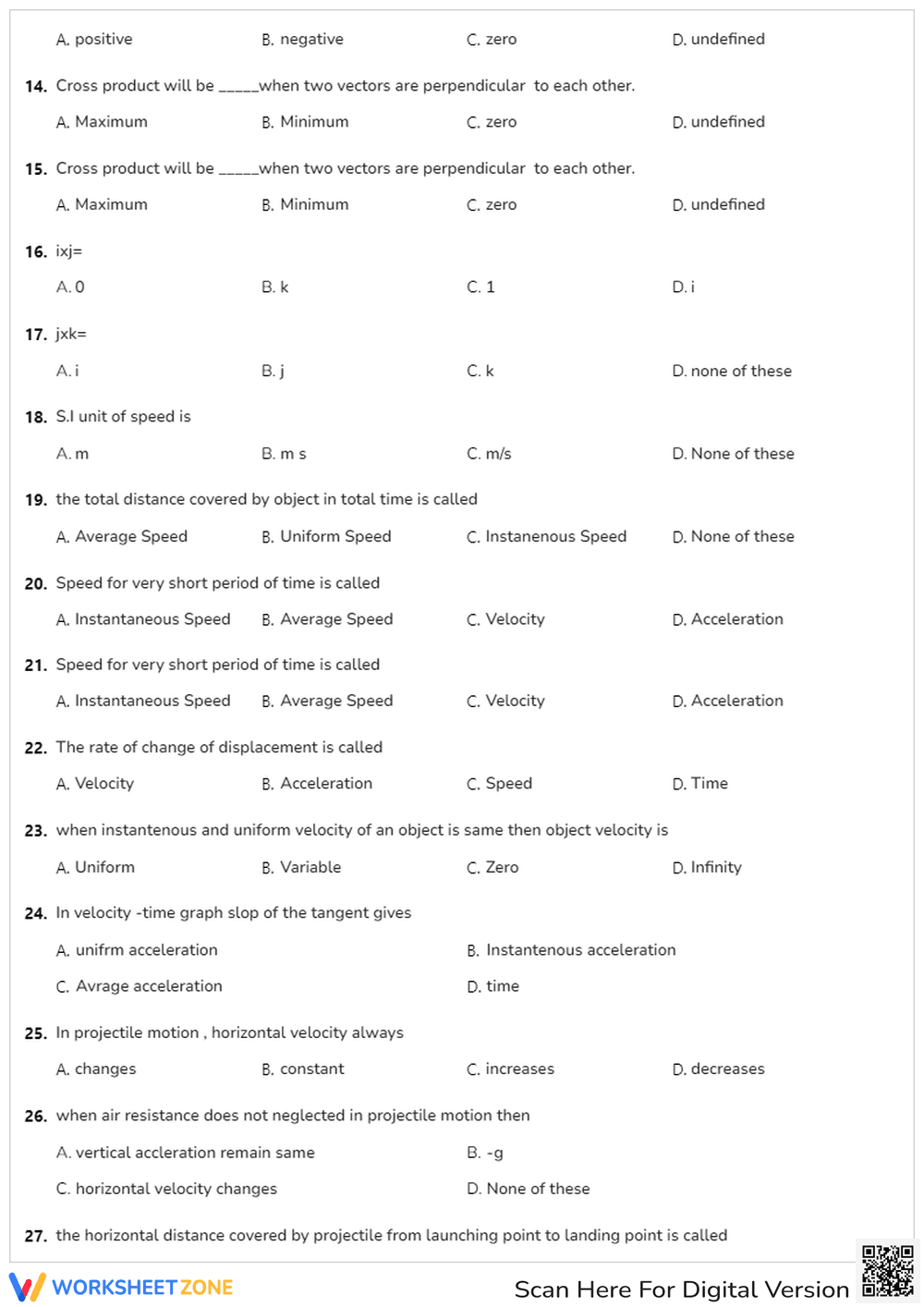
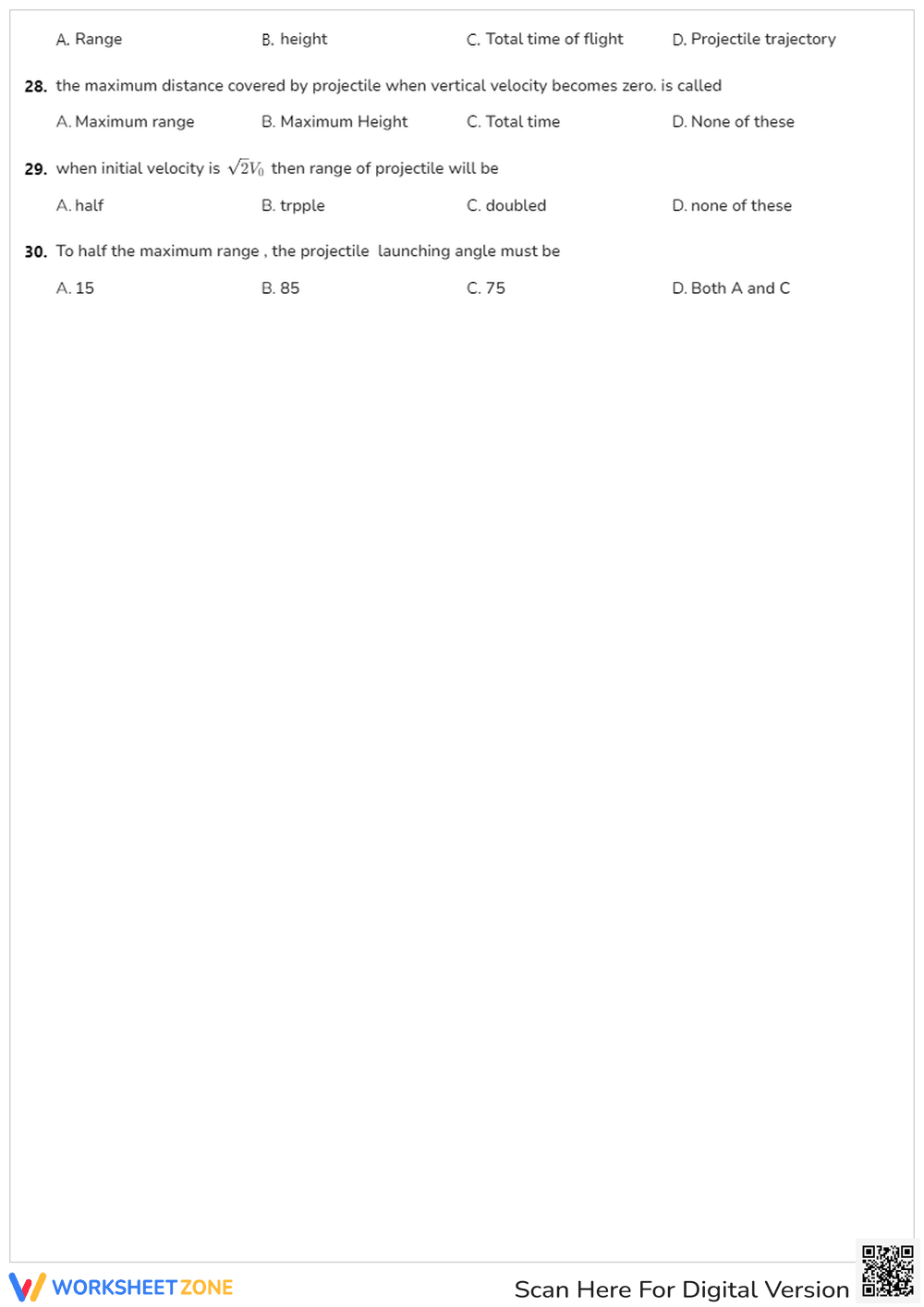

Grade 11 Physics: Essential Vectors & Motion Test
Paste this activity's link or code into your existing LMS (Google Classroom, Canvas, Teams, Schoology, Moodle, etc.).
Students can open and work on the activity right away, with no student login required.
You'll still be able to track student progress and results from your teacher account.
This Grade 11 Physics assessment provides a comprehensive evaluation of student understanding regarding vector operations and kinematics. Students demonstrate mastery by identifying scalar versus vector quantities, calculating dot and cross products, and analyzing projectile motion trajectories. It serves as a summative tool to ensure learners can mathematically describe motion in one and two dimensions before moving into complex dynamics.
At a Glance
- Grade: 11 · Subject: Physics
- Standard:
HS-PS2-1— Analyze mathematical relationships between force, mass, and acceleration in macroscopic systems- Skill Focus: Vectors, Kinematics, and Projectile Motion
- Format: 3 pages · 30 problems · Answer key included · PDF
- Best For: Summative unit assessment or final exam review
- Time: 45–60 minutes
The resource contains 30 high-quality multiple-choice questions distributed across three printable pages. The first section focuses on foundational vector theory, including unit vectors, rectangular components, and the properties of scalar products. The middle section transitions into kinematics, testing definitions of instantaneous speed, velocity-time graph slopes, and SI units. The final portion challenges students with projectile motion variables, such as range, maximum height, and launching angle calculations.
This assessment is designed for immediate classroom implementation with a total teacher prep time of under 2 minutes. First, print the three-page PDF for your class size. Second, distribute the test to students for a focused 50-minute session. Third, use the included answer key to rapidly grade submissions or facilitate a peer-review session to address misconceptions in real-time. It is an ideal resource for substitute plans or end-of-term evaluations.
Aligned to `HS-PS2-1`, this worksheet requires students to apply mathematical representations to describe the motion of objects. It also supports supporting standards regarding vector quantities and their components. Both standard codes can be copied directly into lesson plans, IEP goals, or district curriculum mapping tools to ensure compliance with state and national science frameworks.
Use this test as a summative assessment at the conclusion of a mechanics unit. Alternatively, assign it as a rigorous diagnostic tool before beginning advanced dynamics. During the test, observe if students struggle with the trigonometric aspects of vector products, which serves as a formative indicator for needed remediation in mathematical physics. Completion typically requires 45 to 60 minutes depending on student proficiency.
This resource is tailored for Grade 11 Physics students, including those in honors or AP-track pathways. It provides the necessary rigor for college-preparatory science while remaining accessible through clear, concise questioning. It pairs effectively with a vector addition anchor chart or a laboratory investigation on projectile launchers to reinforce the connection between theory and practice.
This Grade 11 Physics assessment on vectors and kinematics is built to meet the rigorous demands of the HS-PS2-1 standard. By focusing on the mathematical relationship between physical quantities, the 30-question MCQ format allows for a broad sampling of student knowledge across the mechanics curriculum. Research from EdReports 2024 emphasizes that high-quality, standards-aligned assessments are critical for identifying gaps in conceptual understanding before students progress to complex engineering applications. Furthermore, the inclusion of both scalar/vector theory and projectile motion calculations mirrors the balanced approach recommended by Fisher & Frey (2014) for checking for understanding in secondary science. This resource ensures that students can accurately define and calculate the rate of change of displacement and the nuances of cross-product maximums. It provides a reliable data point for educators to track mastery of essential physics competencies in a zero-prep, printable format.


