


























1 / 2
0
Views
0
Downloads

0.0
0
Save
0 Likes
Share
Acceleration Practice Worksheet
0 Views
0 Downloads
Paste this activity's link or code into your existing LMS (Google Classroom, Canvas, Teams, Schoology, Moodle, etc.).
Students can open and work on the activity right away, with no student login required.
You'll still be able to track student progress and results from your teacher account.
Information
Description
What It Is:
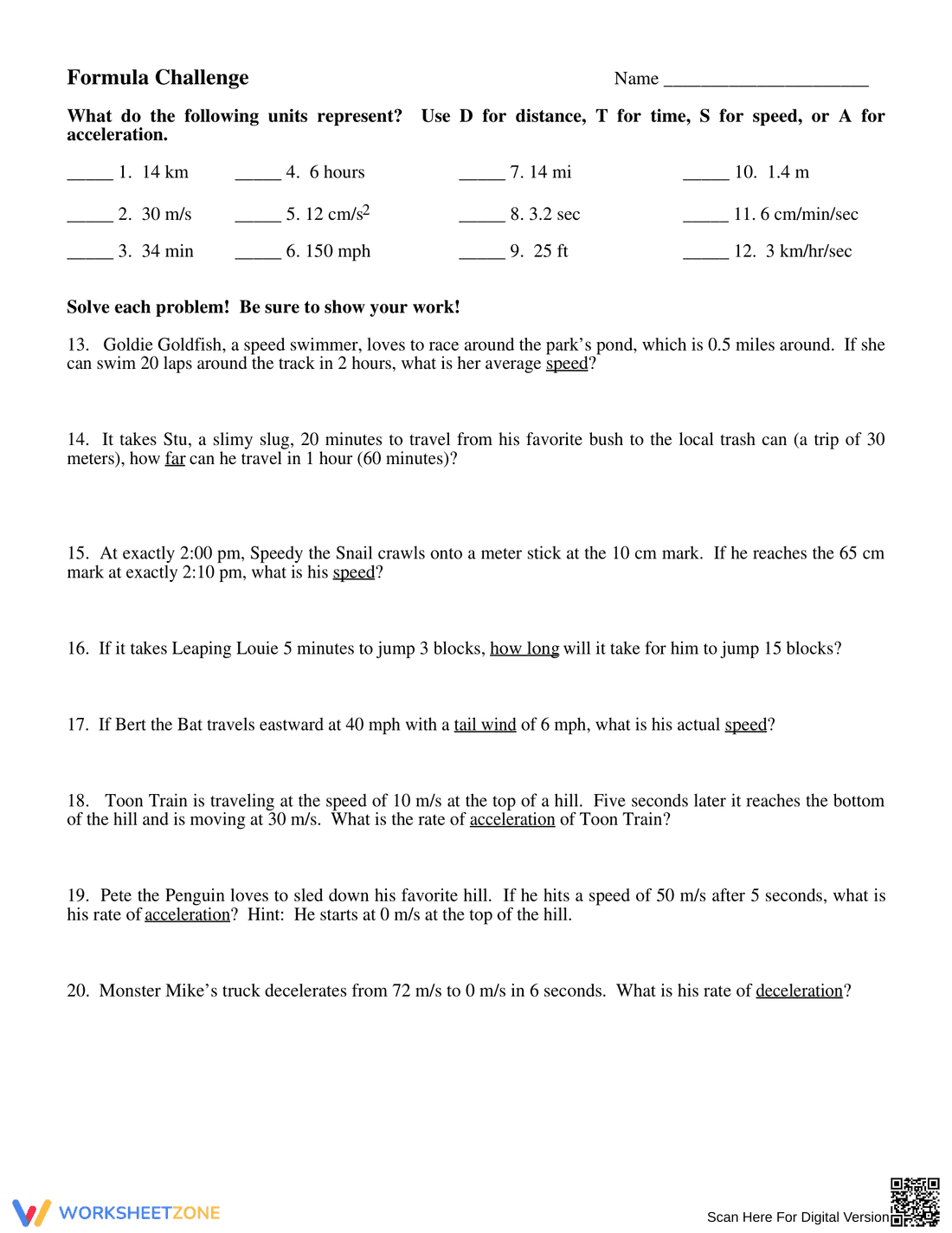
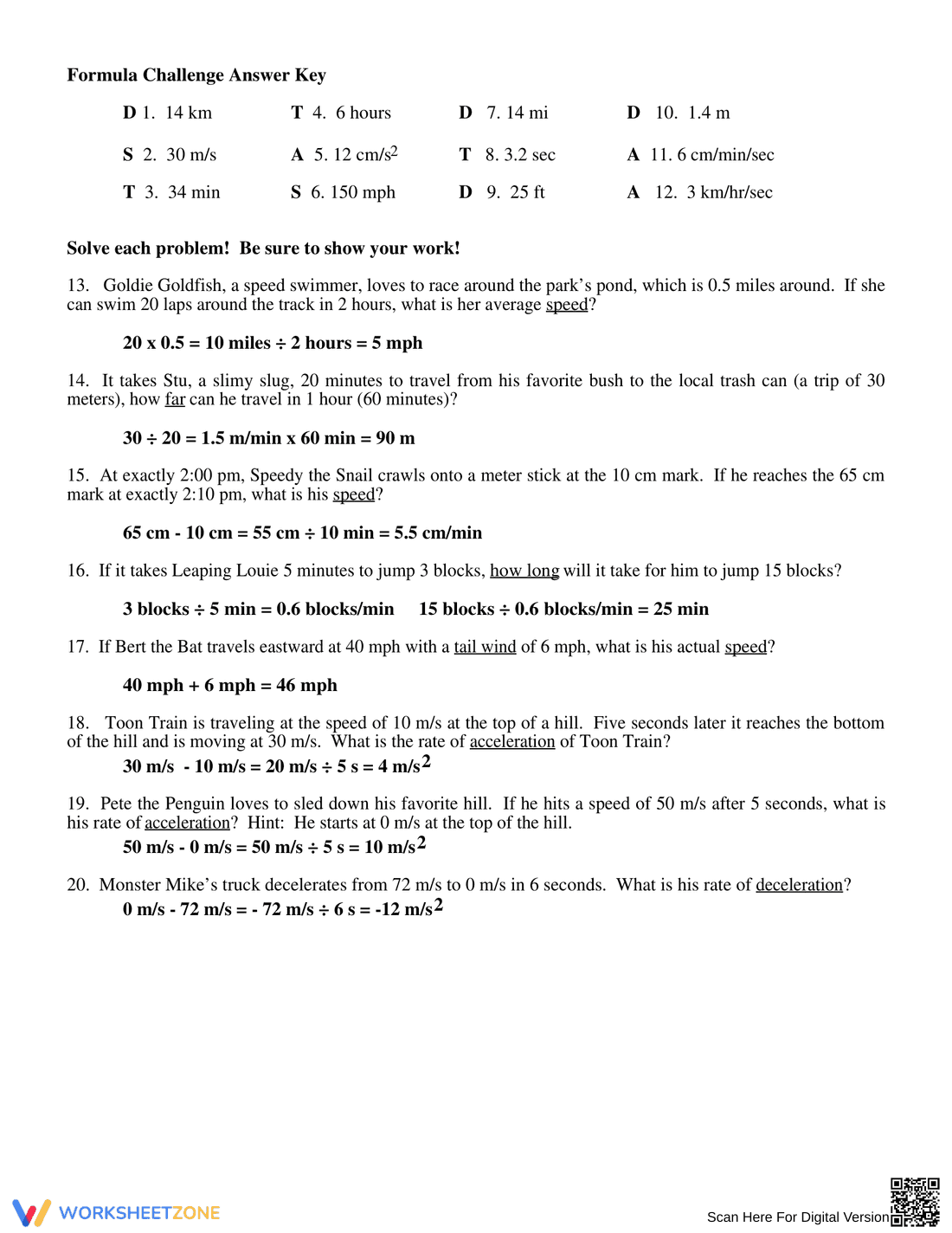
This is a physics worksheet titled 'Formula Challenge.' It includes two sections. The first section asks students to identify what units represent, using D for distance, T for time, S for speed, or A for acceleration. Examples include '14 km' and '30 m/s'. The second section contains word problems related to speed, acceleration, and deceleration, requiring students to solve for average speed, distance traveled, and rates of acceleration/deceleration.
Grade Level Suitability:
This worksheet is suitable for grades 8-10, particularly for students learning introductory physics concepts. The problems require understanding of units, formulas for speed, acceleration, and problem-solving skills involving unit conversions and application of formulas.
Why Use It:
This worksheet reinforces the understanding of units of measurement for distance, time, speed, and acceleration. It also provides practice in applying formulas to solve real-world problems related to motion and rates of change, enhancing critical thinking and problem-solving abilities in physics.
How to Use It:
Students should first review the definitions and formulas for distance, time, speed, and acceleration. They can then complete the first section by identifying what each unit represents. For the word problems, students should read carefully, identify the given information, select the appropriate formula, and solve for the unknown variable, showing all their work.
Target Users:
This worksheet is ideal for middle school and high school students studying introductory physics or physical science. It is also suitable for teachers looking for supplemental practice problems to reinforce concepts related to motion and rates of change.
This is a physics worksheet titled 'Formula Challenge.' It includes two sections. The first section asks students to identify what units represent, using D for distance, T for time, S for speed, or A for acceleration. Examples include '14 km' and '30 m/s'. The second section contains word problems related to speed, acceleration, and deceleration, requiring students to solve for average speed, distance traveled, and rates of acceleration/deceleration.
Grade Level Suitability:
This worksheet is suitable for grades 8-10, particularly for students learning introductory physics concepts. The problems require understanding of units, formulas for speed, acceleration, and problem-solving skills involving unit conversions and application of formulas.
Why Use It:
This worksheet reinforces the understanding of units of measurement for distance, time, speed, and acceleration. It also provides practice in applying formulas to solve real-world problems related to motion and rates of change, enhancing critical thinking and problem-solving abilities in physics.
How to Use It:
Students should first review the definitions and formulas for distance, time, speed, and acceleration. They can then complete the first section by identifying what each unit represents. For the word problems, students should read carefully, identify the given information, select the appropriate formula, and solve for the unknown variable, showing all their work.
Target Users:
This worksheet is ideal for middle school and high school students studying introductory physics or physical science. It is also suitable for teachers looking for supplemental practice problems to reinforce concepts related to motion and rates of change.


