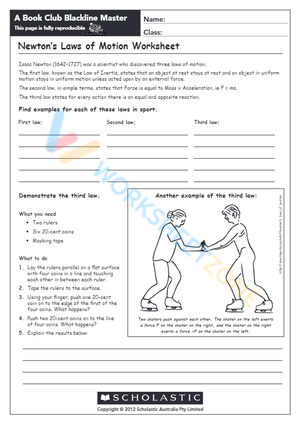
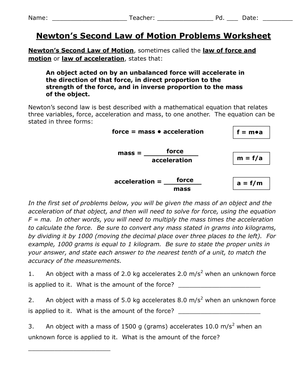
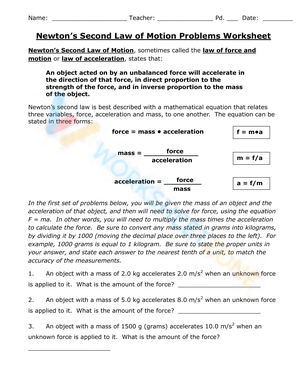
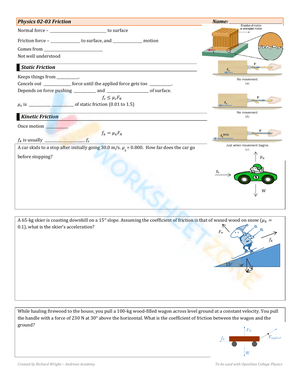
Every moving object has a story behind it. A cart speeds up when pushed harder, a heavy backpack is harder to lift, and a ball accelerates differently depending on the force applied. Second law of motion worksheets help students turn these everyday observations into clear science reasoning. By working with the formula F = ma, learners can see how force, mass, and acceleration connect in a measurable way.
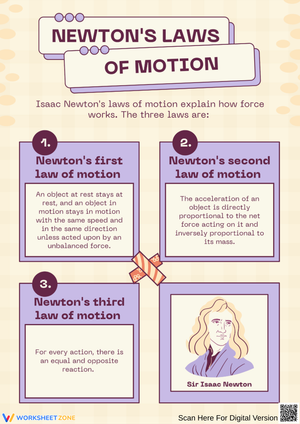
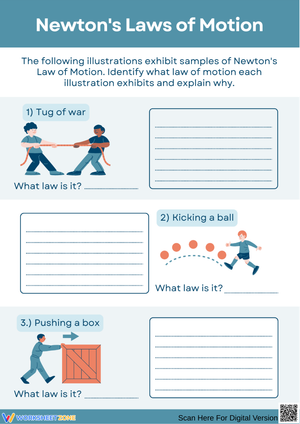
Newton’s second law explains that the acceleration of an object depends on both the net force acting on it and the object’s mass. If the force increases, acceleration increases. If the mass increases, acceleration decreases when the same force is applied. These worksheets guide students through this relationship using simple calculations, word problems, diagrams, and real-world motion examples. Before introducing this topic, teachers may also review inertia with this first law practice set so students understand how Newton’s laws build on one another.
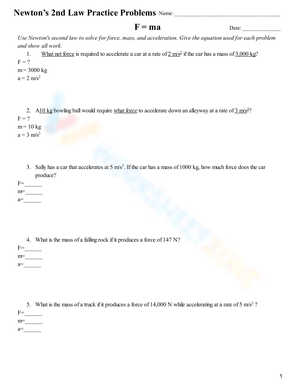
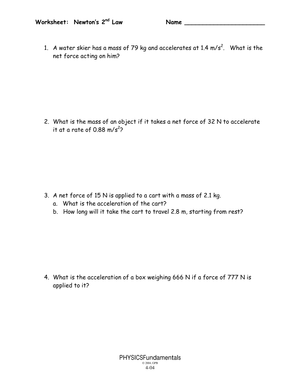
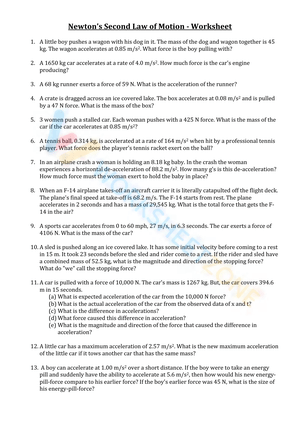
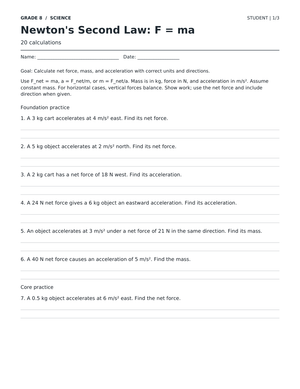
Second law of motion worksheets are useful because they combine science concepts with math practice. Students may calculate force when mass and acceleration are given, solve for acceleration when force and mass are known, or compare two objects experiencing different net forces. These activities help learners practice units such as newtons, kilograms, and meters per second squared. More importantly, they help students explain why a small object may accelerate quickly while a heavier object needs more force to move at the same rate.
Teachers can make the topic more memorable by pairing worksheet practice with simple classroom demonstrations. Students might push toy cars with different amounts of force, compare how empty and loaded carts move, or measure how ramps affect acceleration. For more hands-on ideas, this collection of middle school science experiments can help connect motion formulas to real observations. When students see the law in action first, the numbers on the worksheet feel more meaningful.
Worksheetzone’s second law of motion worksheets are designed to support middle school physical science, high school physics review, and homeschool science lessons. Teachers can use them as guided practice, homework, exit tickets, lab follow-ups, quiz review, or small-group support. With repeated practice, students become more confident using F = ma, interpreting motion scenarios, and explaining how force and mass affect acceleration. The result is a stronger foundation for later topics such as momentum, energy, friction, and balanced or unbalanced forces.
Frequently Asked Questions
Question 1: What do students learn from second law of motion worksheets?
Students learn how force, mass, and acceleration are related through Newton’s second law. They practice using the formula F = ma, solving for missing values, reading motion scenarios, and explaining how changing force or mass affects an object’s acceleration.
Question 2: What grade levels are these worksheets best for?
These worksheets are most useful for upper elementary, middle school, and introductory high school physics students. Younger learners can focus on basic cause-and-effect examples, while older students can complete calculations, interpret units, and apply the law to more complex motion problems.
Question 3: Why do students struggle with Newton’s second law?
Students often struggle because the concept requires both scientific understanding and math skills. They may confuse force with acceleration, forget to use correct units, or have trouble rearranging the formula. Structured practice helps them slow down, identify known values, and solve each problem step by step.
Question 4: How can teachers use second law of motion worksheets in class?
Teachers can use them after demonstrations, during guided lessons, as homework, for science centers, or as review before a quiz. They work especially well when paired with hands-on activities involving ramps, toy cars, carts, balls, or other objects that show force and acceleration clearly.












 Interactive Worksheet Maker
 Quiz Maker
 Word Search Maker
 Crossword Puzzle Maker
 Word Scramble Generator
 Sentence Scramble Generator
 Handwriting Worksheet Generator
 Name Tracing Generator
 Fill In The Blank Generator