


























Views
Downloads
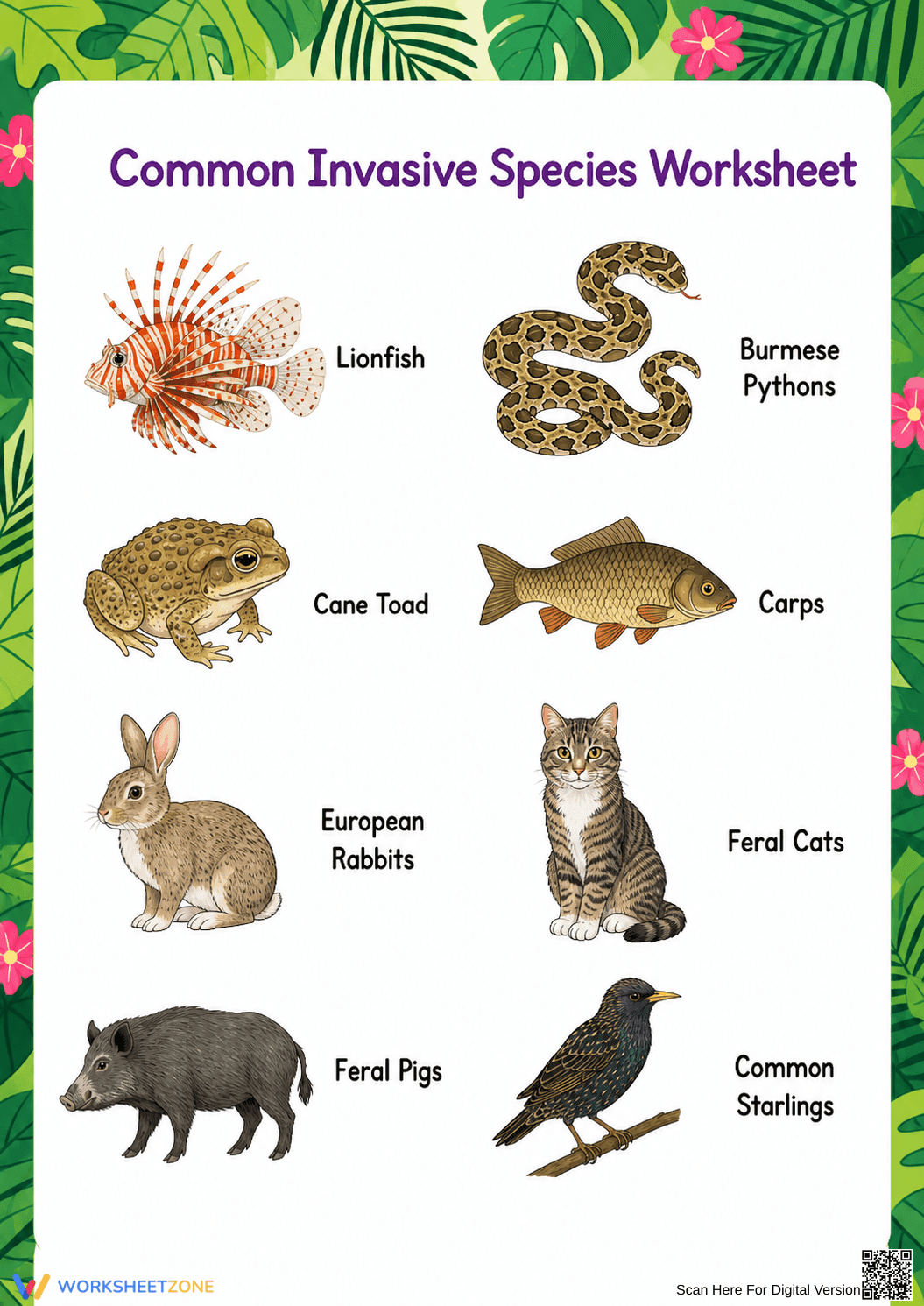

Grade 5-6 Invasive Species — Printable No-Prep Worksheet
Paste this activity's link or code into your existing LMS (Google Classroom, Canvas, Teams, Schoology, Moodle, etc.).
Students can open and work on the activity right away, with no student login required.
You'll still be able to track student progress and results from your teacher account.
This Grade 5 and Grade 6 science resource introduces students to common invasive species and their impact on local ecosystems. By studying these eight examples, learners build foundational knowledge about biodiversity, ecological threats, and how non-native organisms disrupt established food webs.
At a Glance
- Grade: 5-6 · Subject: Science
- Standard:
MS-LS2-4— Analyze how ecosystem changes affect populations- Skill Focus: Identifying invasive species
- Format: 1 page · 8 species · No answer key needed · PDF
- Best For: Visual reference and research
- Time: 10–15 minutes
This single-page visual guide features high-quality illustrations of eight well-known invasive species, including the lionfish, Burmese python, and cane toad. Each organism is clearly labeled, making it an excellent anchor chart for environmental science units. The straightforward layout removes visual clutter, allowing students to focus entirely on recognizing these animals.
This resource is designed for immediate classroom implementation.
- Print (1 minute): Print the single-page PDF for student binders.
- Distribute (1 minute): Hand out the reference sheet at the beginning of an ecosystem unit.
- Review (5 minutes): Introduce each animal and prompt students to hypothesize how they outcompete native wildlife.
Total teacher preparation requires under two minutes, making it an ideal print-and-go solution.
This resource aligns with MS-LS2-4, supporting students as they construct arguments that changes to biological components of an ecosystem affect populations. By identifying these invasive species, students understand how introduced organisms alter habitats. Both standard codes can be copied directly into lesson plans, IEP goals, or district curriculum mapping tools.
Educators can utilize this visual guide in multiple ways. Before direct instruction, use it as a hook by asking students why these animals are considered invaders. During independent work, assign each student one of the eight species to research, presenting findings on its ecological impact. Formative assessment can be conducted by observing which students connect physical traits to survival advantages. Expect the initial review to take 10 to 15 minutes.
This worksheet is designed for fifth and sixth-grade science students exploring ecosystems and conservation. It serves as an excellent visual accommodation for English Language Learners who benefit from clear illustrations. Pair this reference sheet with a direct instruction lesson on food webs or a reading passage detailing environmental damage caused by pythons.
Integrating visual identification tools into environmental science curricula significantly enhances student comprehension of complex ecological concepts. According to a recent ScienceDirect TpT Analysis, providing clear, labeled illustrations of organisms helps bridge the gap between abstract ecosystem dynamics and concrete biological examples. This resource directly supports MS-LS2-4 by enabling students to analyze how ecosystem changes affect populations. When learners can visually identify invasive species like the cane toad or feral pig, they are better equipped to construct evidence-based arguments regarding habitat disruption and biodiversity loss. Utilizing this targeted reference sheet ensures that students develop a robust foundational vocabulary before tackling higher-order analytical tasks.


