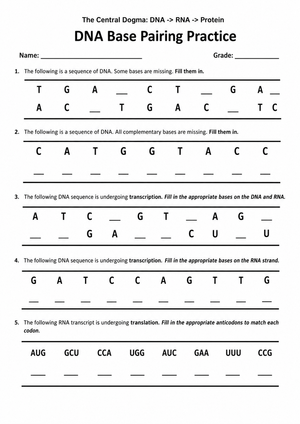
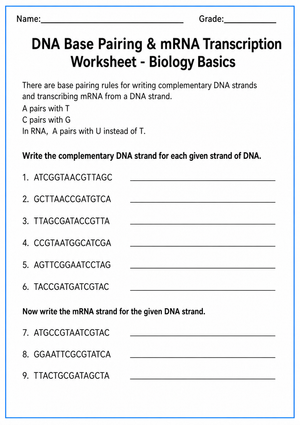
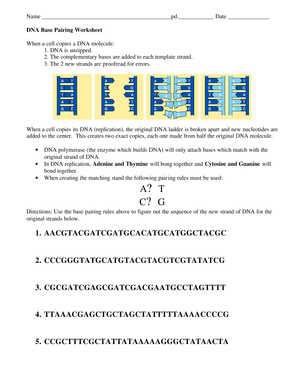
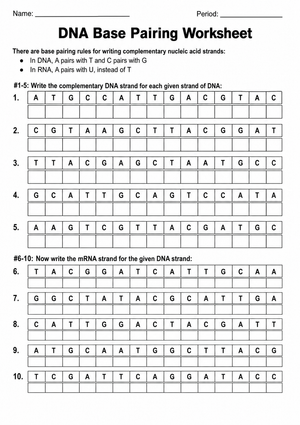
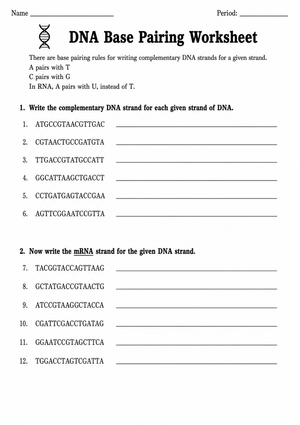
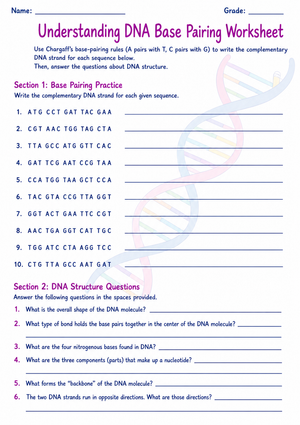
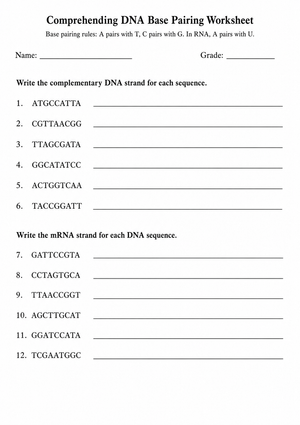
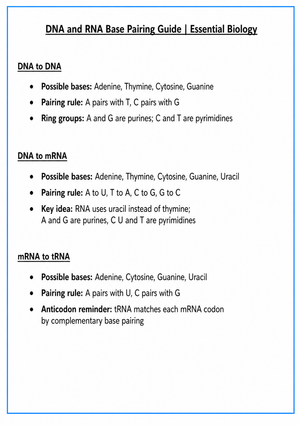
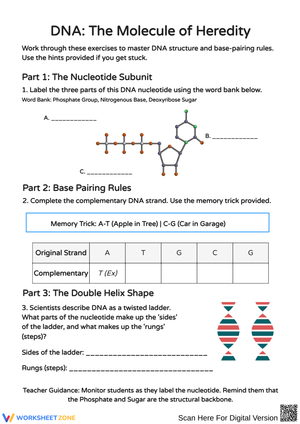
Complementary base pairing is the mechanical rule that makes DNA replication possible: adenine (A) pairs with thymine (T), and cytosine (C) pairs with guanine (G). Each strand of the double helix acts as a template, and the pairing rule determines exactly which nucleotide gets added to build the new strand. If students cannot reliably apply this rule, replication diagrams and transcription lessons become confusing rather than clarifying.
Base pairing worksheets solve this by isolating the skill. Students see a strand sequence and write the complementary strand, without the added cognitive load of enzymes, replication forks, or leading and lagging strands. Once that foundational matching is automatic, the more complex replication content has something solid to build on.
The Chemistry Behind A-T and C-G Pairs
Worksheets that ask students to count hydrogen bonds, not just match letters, push understanding a level deeper. A-T pairs are held together by two hydrogen bonds, while C-G pairs are held together by three. This difference is not a trivia point; it has real consequences for how DNA behaves.
Regions of DNA that are rich in cytosine and guanine require more energy to separate because of that extra hydrogen bond per pair, which makes them more thermally stable than adenine-thymine-rich regions. A worksheet question asking students to predict which of two given sequences would require more heat to fully separate its strands turns a memorization task into an applied reasoning task, and it previews concepts students will meet again in later units on DNA denaturation and PCR.
Aligning Base Pairing Worksheets with NGSS HS-LS3-1
NGSS HS-LS3-1 asks students to clarify the relationship between DNA, chromosomes, and the inheritance of traits. Base pairing is a prerequisite skill for meeting that standard, since students cannot reason about how DNA codes for traits if they cannot first track how a DNA sequence is structured and copied. Worksheets built around base pairing give teachers an easy way to document that prerequisite skill has been practiced and assessed before students are asked to apply it in a standards-aligned performance task.
Framing the worksheet this way also helps with lesson planning documentation. A short base pairing practice sheet, logged as a scaffold toward HS-LS3-1, gives curriculum leads a clear paper trail showing how foundational content ladders up to the standard, rather than existing as an isolated worksheet with no stated purpose.
Common Student Misconceptions Worksheets Can Catch Early
Several predictable errors show up on base pairing worksheets, and catching them early prevents bigger confusion during replication lessons. Students frequently reverse the rule and pair adenine with guanine or cytosine with thymine, especially when they are relying on memorized letter shapes rather than the actual pairing logic.
Another common mistake is forgetting to reverse the direction of the complementary strand, since DNA strands are antiparallel. A worksheet that explicitly asks students to write the complementary strand in the correct 5-prime to 3-prime orientation, not just match letters in the same order, surfaces this misunderstanding before it becomes a bigger obstacle in a replication unit.
Classroom Implementation
A practical sequence for using these worksheets looks like this: introduce the base-pairing rule with a short direct instruction segment, hand out a matching worksheet for guided practice, circulate to catch reversed pairs or direction errors in real time, then assign a second worksheet independently as a formative check. Reviewing the independent worksheet the same day, even briefly, keeps the feedback loop tight enough that misconceptions do not carry into the next lesson.
Pairing the worksheet with a hands-on model-building activity, such as using colored paper strips or bead-and-pipe-cleaner models to represent bases, gives kinesthetic learners a second entry point into the same content. Students who struggle with the abstract letter-matching format on paper often succeed once they can physically manipulate a model, and returning to the worksheet afterward often shows improved accuracy.
Frequently Asked Questions
1. What grade level is DNA base pairing typically taught in US classrooms?
DNA base pairing is most commonly taught in high school biology, often within a genetics or molecular biology unit that leads into DNA replication and protein synthesis lessons.
2. What is the base-pairing rule and why does it matter for DNA replication?
The rule states that adenine pairs with thymine and cytosine pairs with guanine. It matters because each DNA strand serves as a template during replication, and the pairing rule determines exactly which bases get added to build an accurate new strand.
3. How can teachers use base-pairing worksheets for formative assessment?
Because each answer is either correct or incorrect, these worksheets can be scored quickly and used as an exit ticket or quick check to see which students are ready to move into replication content.
4. How do these worksheets align with NGSS heredity standards?
Base pairing is a prerequisite skill for NGSS HS-LS3-1, which asks students to clarify how DNA and chromosomes code for inherited traits, so these worksheets function as a scaffold toward that standard.
5. What are common student mistakes when practicing base pairing?
Students often reverse pairs, matching adenine with guanine or cytosine with thymine, or they forget to write the complementary strand in the correct antiparallel direction.












 Interactive Worksheet Maker
 Quiz Maker
 Word Search Maker
 Crossword Puzzle Maker
 Word Scramble Generator
 Sentence Scramble Generator
 Handwriting Worksheet Generator
 Name Tracing Generator
 Fill In The Blank Generator