


























Views
Downloads

Grades 9-12 DNA Base Pairing — Printable No-Prep Worksheet
Paste this activity's link or code into your existing LMS (Google Classroom, Canvas, Teams, Schoology, Moodle, etc.).
Students can open and work on the activity right away, with no student login required.
You'll still be able to track student progress and results from your teacher account.
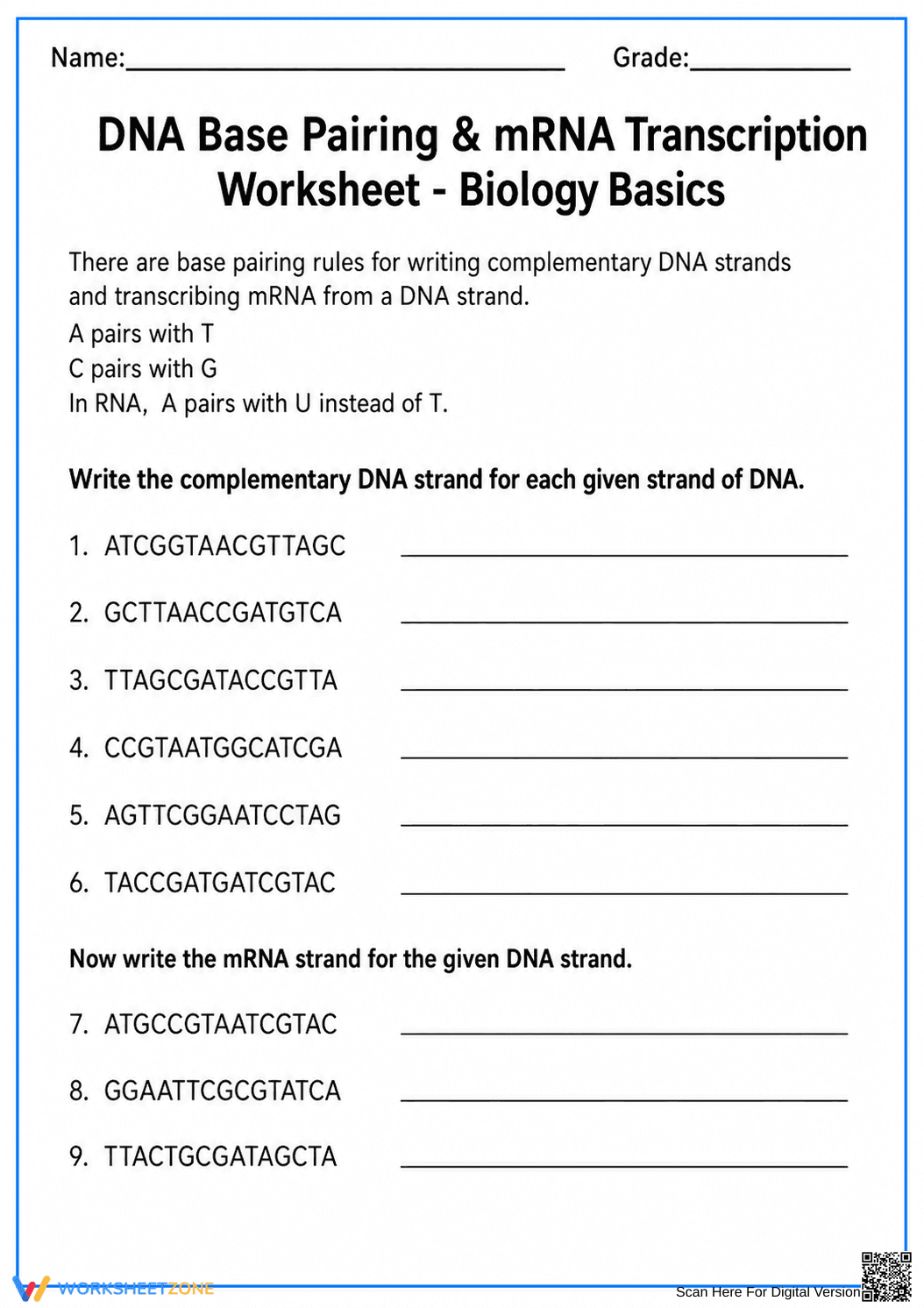
This high school biology worksheet provides students with targeted practice on DNA base pairing and mRNA transcription. By applying specific base pairing rules, students will accurately write complementary DNA strands and transcribe mRNA sequences, reinforcing their foundational understanding of molecular genetics and protein synthesis preparation.
At a Glance
- Grade: 9-12 · Subject: Biology
- Standard:
HS-LS1-1— Apply base pairing rules to model DNA replication and transcription.- Skill Focus: DNA Base Pairing & mRNA Transcription
- Format: 2 pages · 16 problems · Answer key included · PDF
- Best For: Independent practice or review
- Time: 15–20 minutes
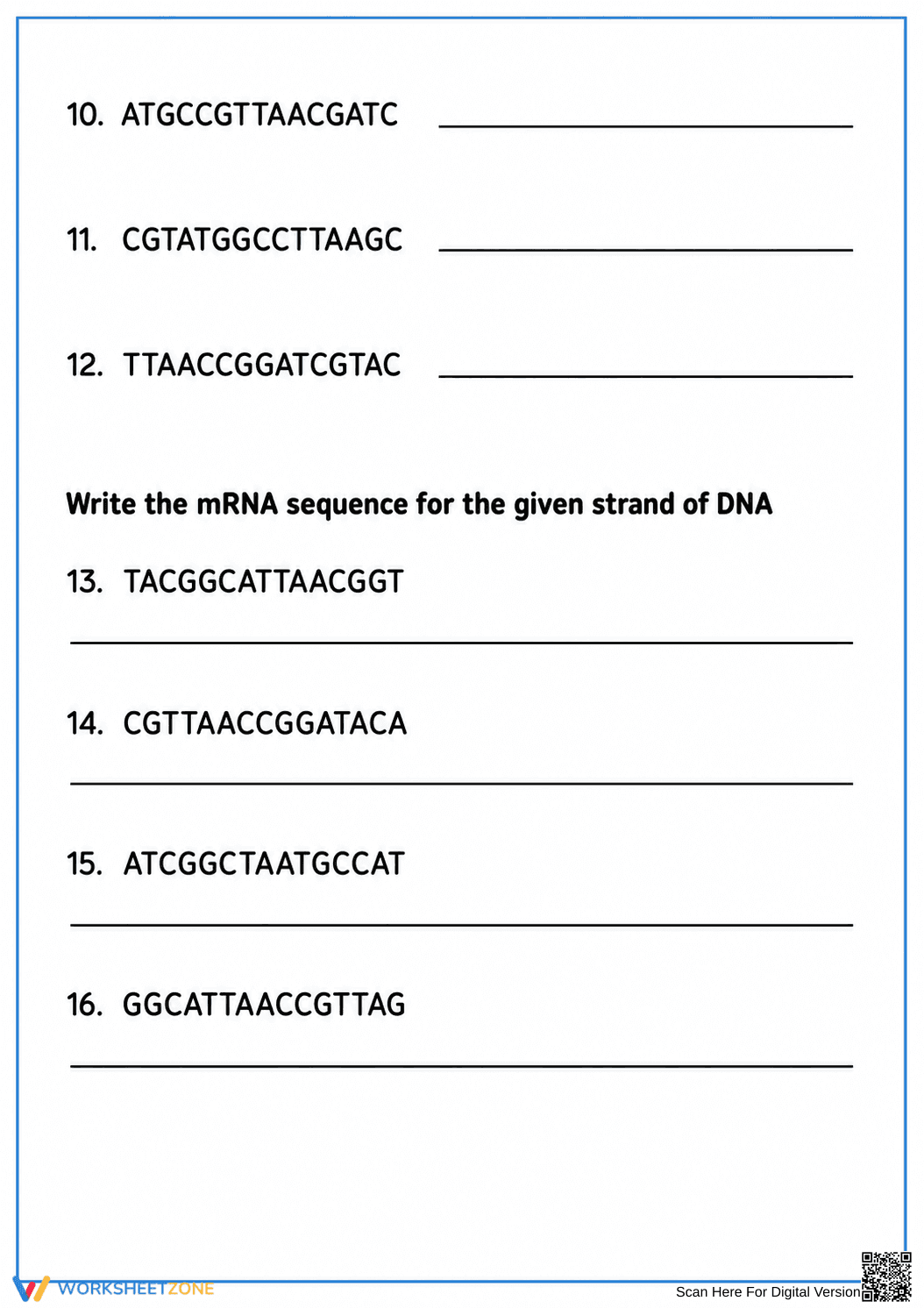
This two-page resource features a brief instructional header that reviews the essential rules for base pairing (A with T, C with G, and A with U in RNA). Following the review, students will tackle 16 straightforward practice problems. The first section requires them to determine the complementary DNA strand for six given sequences. The subsequent sections challenge them to transcribe ten different DNA sequences into their corresponding mRNA strands. A complete answer key is included to ensure accurate grading and immediate feedback.
Designed for maximum efficiency, this resource requires virtually no teacher setup.
- Print (1 minute): Simply download the PDF and print a class set. The instructions are built directly into the page.
- Distribute (1 minute): Hand out the copies at the start of class or assign them as a quick homework task.
- Review (3 minutes): Use the provided answer key to quickly check student work or project it for self-grading.
With under two minutes of total prep time, this activity is an excellent, reliable option for emergency sub plans or last-minute review sessions.
This activity aligns with HS-LS1-1, supporting students as they construct an explanation based on evidence for how the structure of DNA determines the structure of proteins. By mastering transcription, students build the necessary foundation to understand broader genetic functions. Both standard codes can be copied directly into lesson plans, IEP goals, or district curriculum mapping tools.
This worksheet is highly versatile in a high school biology classroom. Use it immediately after direct instruction on transcription to solidify the concept, or assign it as a focused homework activity to reinforce the day's lesson. As a formative assessment tip, walk around the room while students complete the first few mRNA transcription problems to ensure they are correctly substituting uracil (U) for thymine (T) before they finish the page. Expected completion time is 15 to 20 minutes.
This practice sheet is ideal for high school biology students learning the mechanics of molecular genetics. For students who need extra support, the built-in rule reminder at the top of the page serves as a helpful scaffold. It pairs perfectly with a visual anchor chart of the central dogma of biology or a 3D DNA modeling activity.
Mastering the mechanics of molecular genetics requires repeated, focused practice. Aligned with HS-LS1-1, this resource helps students apply base pairing rules to model DNA replication and transcription accurately. According to EdReports 2024, instructional materials that provide explicit, targeted practice on foundational scientific models significantly improve students' ability to grasp complex biological systems like protein synthesis. By isolating the specific skills of matching complementary bases and substituting uracil during mRNA transcription, this worksheet reduces cognitive overload and allows learners to build automaticity. This targeted approach ensures that students are fully prepared to tackle more advanced topics in genetics and cellular biology. The straightforward format supports immediate application of concepts, making it a highly effective tool for reinforcing essential high school science standards.


