


























Views
Downloads

DNA Base Pairing Worksheet | Essential Grade 9-12 Biology
Paste this activity's link or code into your existing LMS (Google Classroom, Canvas, Teams, Schoology, Moodle, etc.).
Students can open and work on the activity right away, with no student login required.
You'll still be able to track student progress and results from your teacher account.
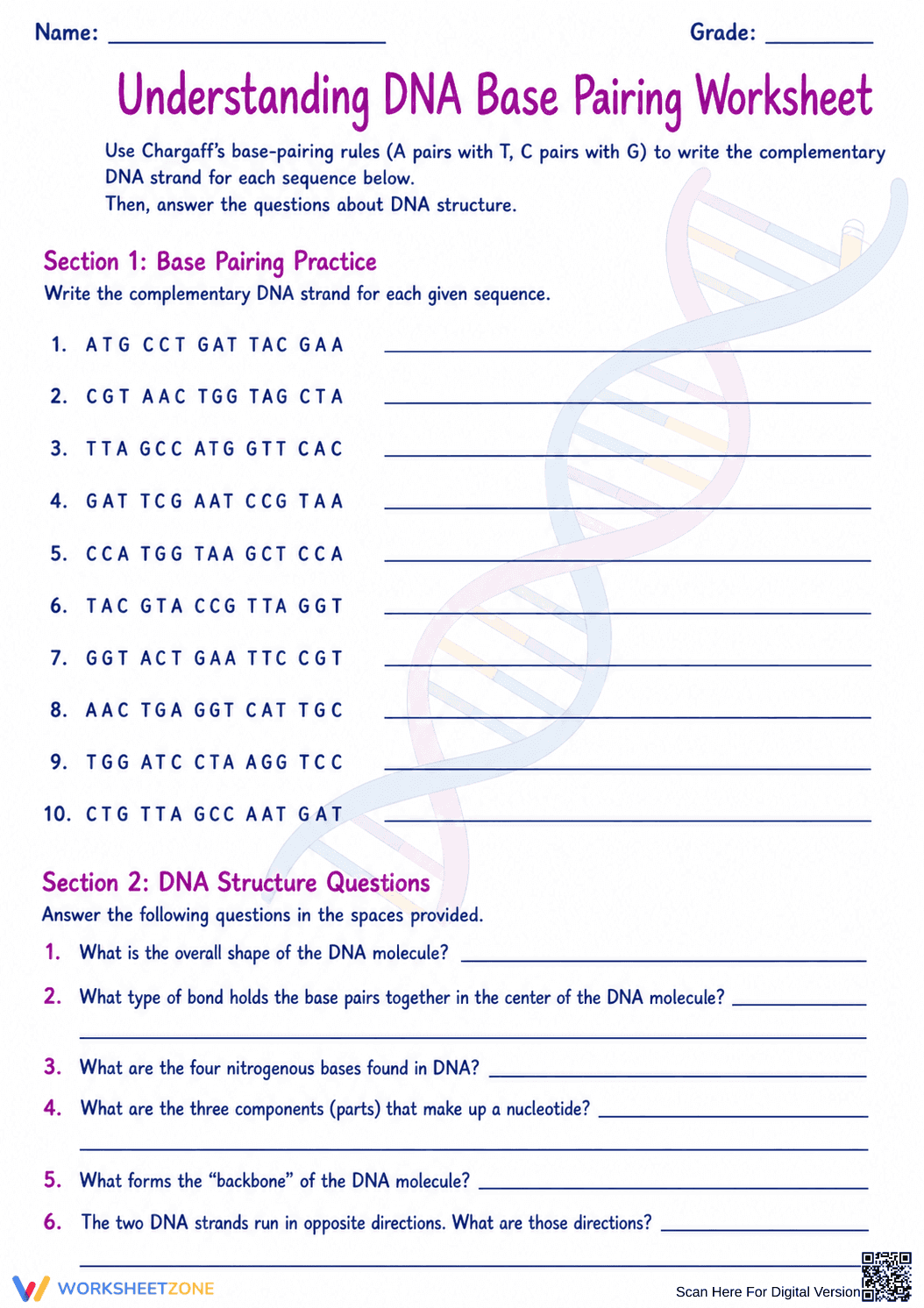
This DNA base pairing worksheet provides high school biology students with targeted practice in applying Chargaff's rules and identifying structural components of the double helix. By completing complementary sequences and answering conceptual questions, learners solidify their understanding of molecular genetics and the fundamental architecture of life.
At a Glance
- Grade: 9-12 · Subject: Biology
- Standard:
HS-LS1-1— Construct an explanation for how DNA structure determines protein synthesis- Skill Focus: DNA Base Pairing & Structure
- Format: 1 page · 16 problems · Answer key included · PDF
- Best For: Independent practice or formative assessment
- Time: 15–20 minutes
What's Inside: The worksheet is divided into two distinct pedagogical sections. Section 1 features 10 DNA template strands where students must write the corresponding complementary sequence using A-T and C-G pairing rules. Section 2 contains 6 short-answer questions focusing on the double helix shape, hydrogen bonding, nucleotide components, the sugar-phosphate backbone, and anti-parallel directionality.
Zero-Prep Workflow: This resource is designed for immediate classroom implementation. First, print the single-page PDF (30 seconds). Second, distribute the worksheet to students as a bell-ringer or reinforcement activity (1 minute). Third, review the answers using the provided key to identify common misconceptions regarding base pairing or molecular orientation (5 minutes). This makes it an ideal choice for busy teachers or emergency sub plans.
Standards Alignment: This resource aligns with `HS-LS1-1`, requiring students to understand the chemical structure of DNA. It specifically addresses the arrangement of nitrogenous bases and the structural integrity of the nucleotide chain. Both standard codes can be copied directly into lesson plans, IEP goals, or district curriculum mapping tools.
How to Use It: Use this worksheet as a mid-lesson check for understanding after introducing the Watson-Crick model. Teachers should observe if students correctly pair Adenine with Thymine versus Uracil to ensure they are not confusing DNA with RNA. It also serves as an excellent formative assessment tool to gauge readiness before moving into DNA replication or transcription units.
Who It's For: This is ideal for 9th-grade introductory biology students or 11th-grade AP Biology students needing a quick refresher on molecular basics. It pairs naturally with a DNA extraction lab or a 3D modeling activity to provide a theoretical foundation before hands-on application. The clear layout supports students who benefit from structured, repetitive practice.
This DNA base pairing worksheet is specifically engineered to support the HS-LS1-1 performance expectation by focusing on the molecular logic of the double helix. According to a Fisher & Frey (2014) analysis of scaffolded science instruction, providing discrete practice in base-pairing rules allows students to offload cognitive demand before tackling complex protein synthesis models. The 16 tasks included here move from rote application of Chargaff's rules to conceptual identification of the sugar-phosphate backbone and anti-parallel strands. Research from EdReports 2024 suggests that high-quality biology materials must bridge the gap between abstract chemical formulas and observable biological traits. By mastering these 10 sequences and 6 structural questions, students build the necessary fluency to predict genetic outcomes and understand mutations. This printable PDF serves as a reliable formative tool for secondary educators seeking to verify student mastery of DNA architecture without extensive preparation time.


