


























Views
Downloads

Essential DNA Base Pairing Worksheet | Grades 9-12
Paste this activity's link or code into your existing LMS (Google Classroom, Canvas, Teams, Schoology, Moodle, etc.).
Students can open and work on the activity right away, with no student login required.
You'll still be able to track student progress and results from your teacher account.
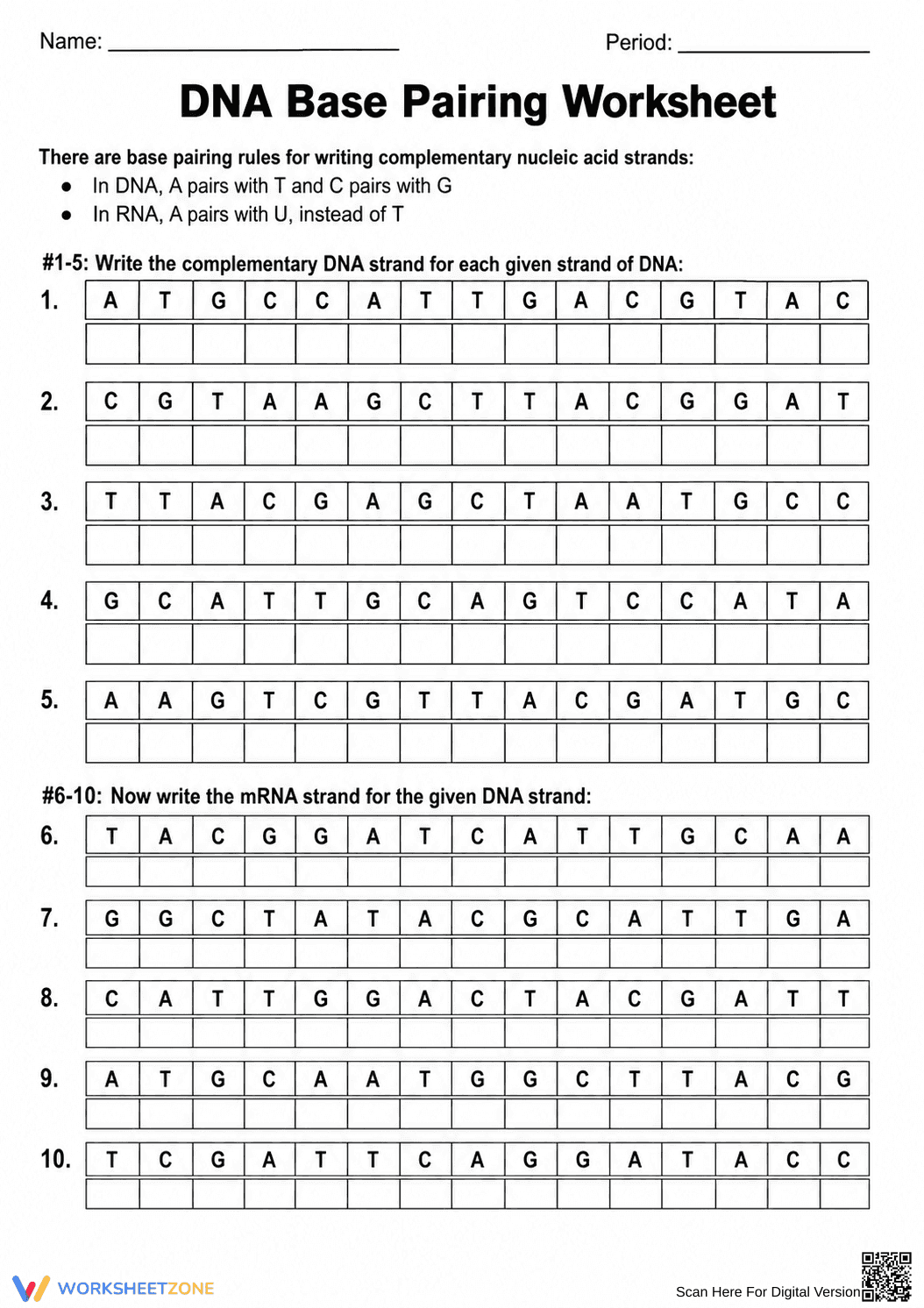
This DNA Base Pairing worksheet provides high school biology students with targeted practice in nucleic acid transcription and replication. By applying specific pairing rules to ten unique sequences, learners develop the procedural fluency required to understand genetic coding. This resource ensures students can accurately identify complementary bases before progressing to complex protein synthesis models.
At a Glance
- Grade: 9-12 · Subject: Biology
- Standard:
HS-LS1-1— Construct an explanation for how the structure of DNA determines the structure of proteins- Skill Focus: DNA and mRNA base pairing
- Format: 1 page · 10 problems · Answer key included · PDF
- Best For: Quick formative assessment or homework
- Time: 15–20 minutes
The worksheet features a clean, organized layout with two distinct sections. The first five problems focus on DNA replication, requiring students to provide the complementary DNA strand. The final five problems transition to transcription, where students generate mRNA sequences from a DNA template. Each problem includes a clear grid for letter placement, and the fundamental pairing rules are printed at the top for immediate reference.
Zero-Prep Workflow
This resource is designed for immediate classroom implementation with a total teacher prep time of under two minutes. Step 1: Print the single-page PDF for your class roster. Step 2: Distribute the sheets as a warm-up or exit ticket to gauge student understanding of base pairing rules. Step 3: Review the answers using the included key for instant feedback. It is an ideal sub-plan component.
Standards Alignment
Primary alignment: `HS-LS1-1`. Students construct an explanation based on evidence for how the structure of DNA determines the structure of proteins, which carry out the essential functions of life through systems of specialized cells. This worksheet specifically addresses the base-pairing mechanism essential for that structure. Both standard codes can be copied directly into lesson plans, IEP goals, or district curriculum mapping tools.
How to Use It
Use this worksheet during the independent practice phase of a lesson on molecular genetics. It works best after a direct instruction session on DNA structure. Teachers can use the completed grids as a formative assessment; if a student consistently misses the uracil substitution in mRNA, it indicates a need for targeted re-teaching. Expected completion time is 15 to 20 minutes.
Who It's For
This resource is tailored for Grade 9-12 biology students, including those in Honors or AP tracks who need a quick refresher. It is particularly helpful for visual learners who benefit from the grid-based layout. Pair this worksheet with a DNA model building activity or a transcription simulation to provide a comprehensive learning experience for the entire class.
This DNA base pairing resource aligns with the HS-LS1-1 standard, focusing on the structural components of nucleotides and the mechanical process of transcription. By requiring students to manually transcribe ten distinct sequences, the worksheet reinforces the chemical specificity of hydrogen bonding between adenine, thymine, cytosine, guanine, and uracil. According to the RAND AIRS 2024 report on secondary science instruction, repetitive procedural practice in molecular biology is a critical precursor to understanding higher-order concepts like protein synthesis and genetic mutation. The worksheet provides a structured environment for students to internalize Chargaff's rules before moving toward complex codon mapping. This resource serves as a foundational tool for high school biology curricula, ensuring that students can accurately predict complementary strands with high fidelity. The inclusion of both DNA and mRNA tasks ensures a comprehensive review of nucleic acid interactions necessary for state-level biology assessments and college readiness.


