


























Views
Downloads

Printable DNA Base Pairing Worksheet | High School
Paste this activity's link or code into your existing LMS (Google Classroom, Canvas, Teams, Schoology, Moodle, etc.).
Students can open and work on the activity right away, with no student login required.
You'll still be able to track student progress and results from your teacher account.
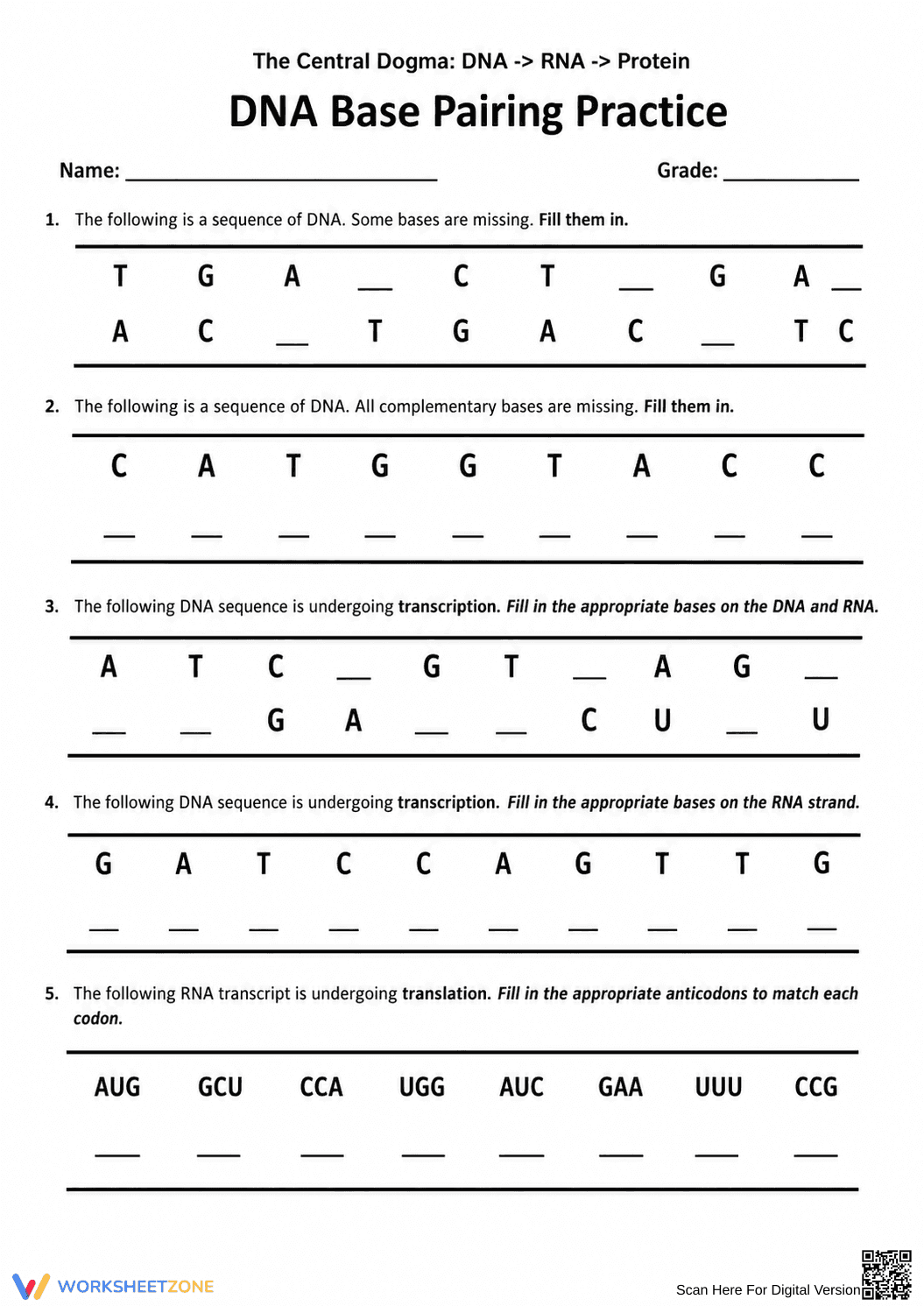
This high school biology worksheet provides focused practice on the central dogma of molecular biology, guiding students through DNA base pairing, transcription, and translation. By completing these structured sequence exercises, students will solidify their understanding of how genetic information flows from DNA to RNA to functional proteins.
At a Glance
- Grade: 9-12 · Subject: Biology
- Standard:
HS-LS1-1— Explain how DNA structure determines protein structure- Skill Focus: Base pairing, transcription, and translation
- Format: 2 pages · 6 problems · Answer key included · PDF
- Best For: Independent practice and review
- Time: 20–30 minutes
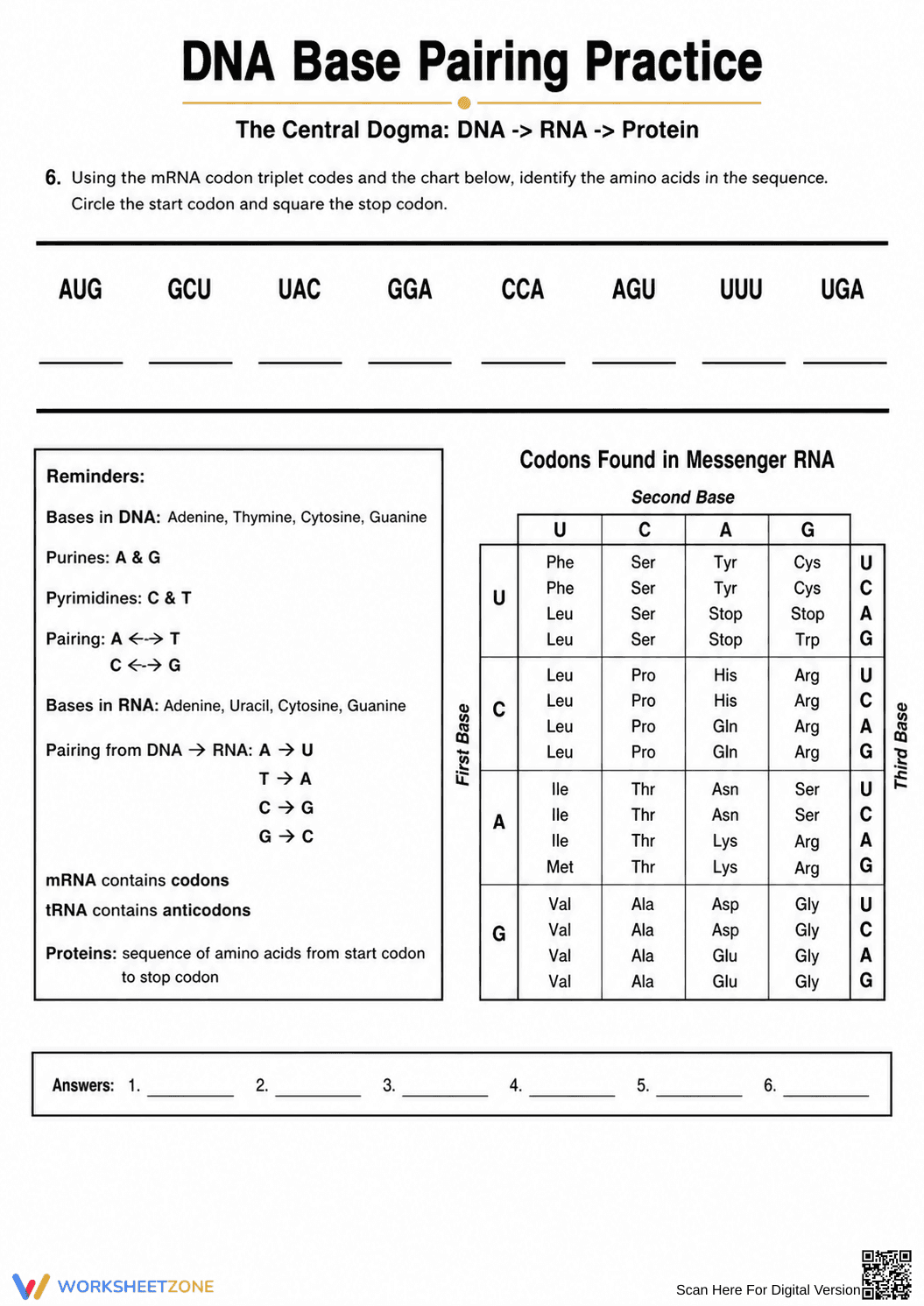
This two-page resource features six multi-part tasks that take students step-by-step through genetic processes. The first page focuses on completing missing nucleotide bases in DNA sequences and transcribing DNA into mRNA. The second page introduces translation, requiring students to match anticodons and use a provided messenger RNA codon chart to identify specific amino acid sequences. A built-in reminder box reviews purines, pyrimidines, and pairing rules. A complete answer key is included.
The problem set is designed with a clear structure to build student confidence:
- Guided practice: Tasks one and two provide partial DNA sequences where students fill in missing complementary bases, reinforcing basic pairing rules.
- Supported practice: Tasks three and four introduce transcription, prompting students to convert DNA strands into RNA.
- Independent practice: The final tasks require students to translate RNA transcripts into anticodons and use a codon chart to determine the amino acid chain.
This gradual-release, I Do, We Do, You Do approach ensures students master each step of the central dogma.
Aligned to primary standard HS-LS1-1 (Construct an explanation based on evidence for how the structure of DNA determines the structure of proteins). By practicing transcription and translation, students build the foundational knowledge required to explain protein synthesis. Both standard codes can be copied directly into lesson plans, IEP goals, or district curriculum mapping tools.
Assign it as independent practice immediately following direct instruction on the central dogma to reinforce the mechanical steps of protein synthesis. Alternatively, use it as a formative assessment during a genetics review unit; observe whether students correctly substitute uracil for thymine to quickly gauge comprehension. Expected completion time is 20 to 30 minutes.
Designed for high school biology students in grades 9 through 12. The built-in reference chart makes it accessible for students who need additional scaffolding or IEP accommodations for memory recall. It pairs perfectly with 3D DNA modeling activities.
Mastering the central dogma of molecular biology requires repeated, structured practice with nucleotide sequences. This resource directly supports HS-LS1-1 by helping students explain how DNA structure determines protein structure through the specific mechanisms of transcription and translation. According to a ScienceDirect TpT Analysis, providing students with integrated reference tools—such as the embedded codon chart and base pairing reminders found in this activity—significantly reduces cognitive overload and allows learners to focus on the procedural application of genetic rules rather than rote memorization. By breaking down the complex flow of genetic information into discrete, manageable tasks, educators can better isolate student misconceptions, particularly the common error of failing to substitute uracil during RNA synthesis. This targeted approach ensures a stronger conceptual foundation for advanced genetics topics.


