


























Views
Downloads

DNA Base Pairing Worksheet (3 Levels) | Grade 9-11 Ready
Paste this activity's link or code into your existing LMS (Google Classroom, Canvas, Teams, Schoology, Moodle, etc.).
Students can open and work on the activity right away, with no student login required.
You'll still be able to track student progress and results from your teacher account.
This high school biology worksheet provides targeted practice on DNA and RNA base pairing rules, ensuring students can accurately transcribe genetic sequences. By converting given DNA strands into complementary DNA and mRNA sequences, learners solidify their foundational understanding of molecular genetics.
At a Glance
- Grade: 9-11 · Subject: Biology
- Standard:
HS-LS1-1— Construct an explanation for how DNA structure determines protein structure.- Skill Focus: DNA base pairing and mRNA transcription
- Format: 3 pages · 12 problems per page · Answer key included · PDF
- Best For: Independent practice and review
- Time: 15–20 minutes
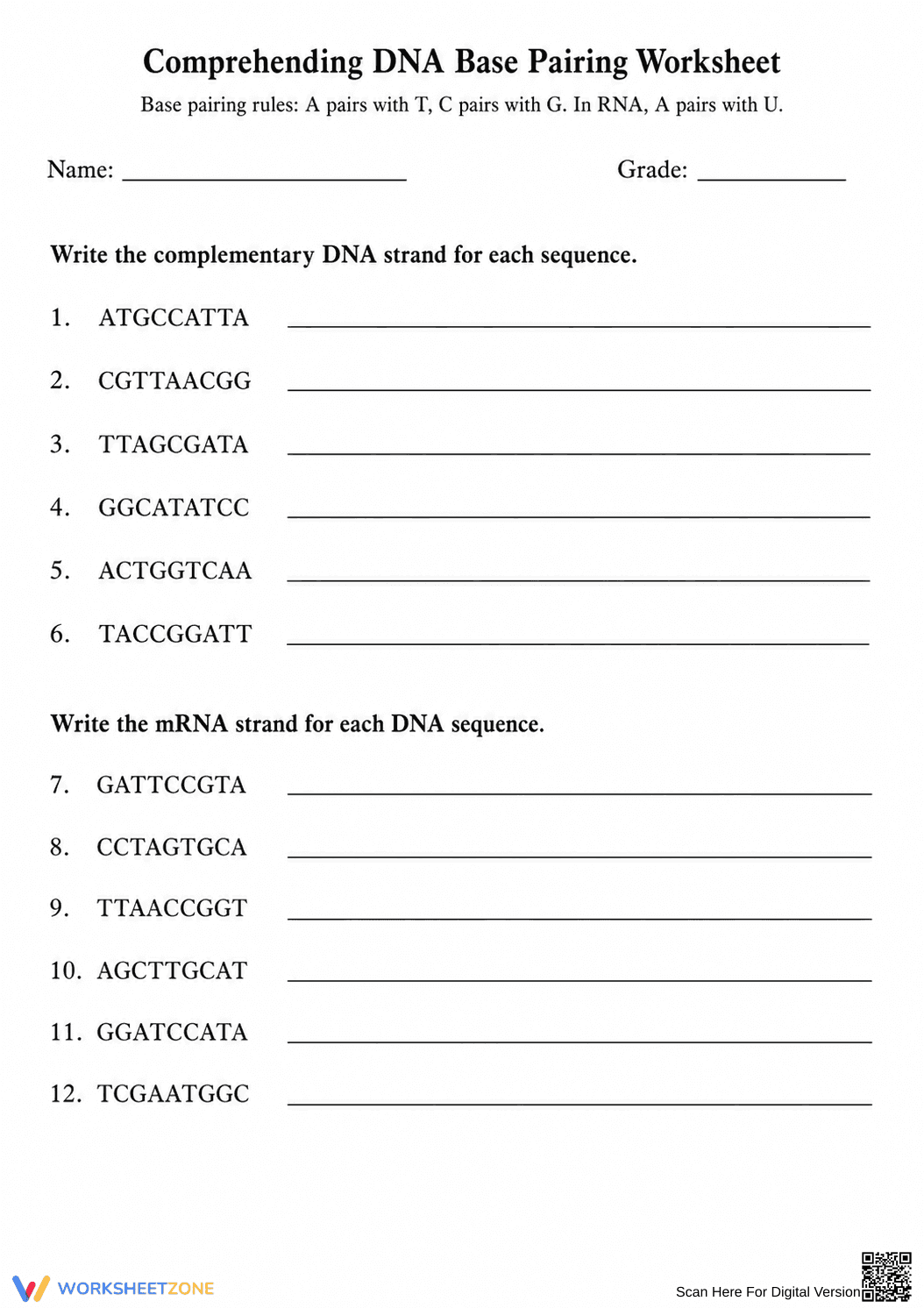
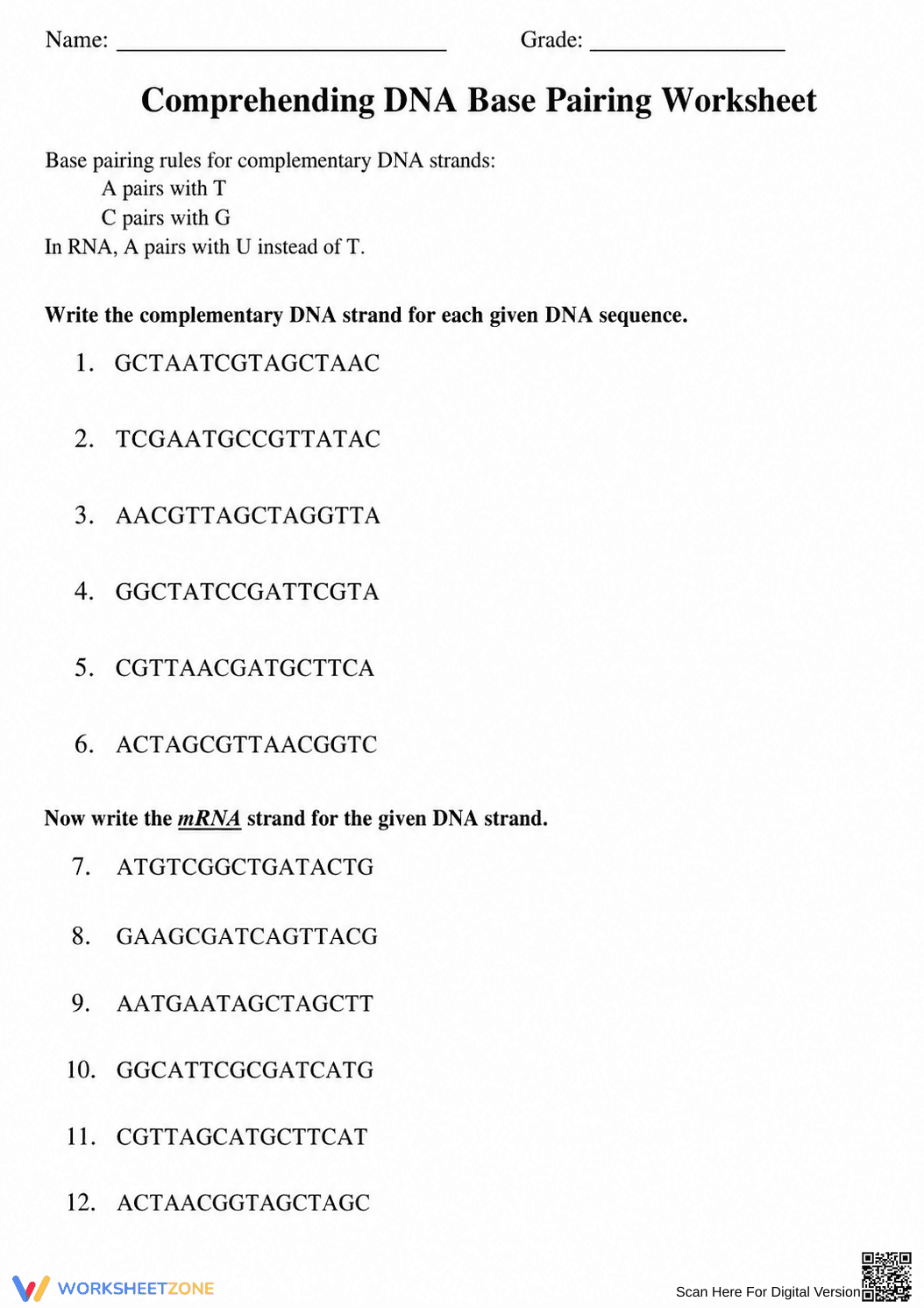
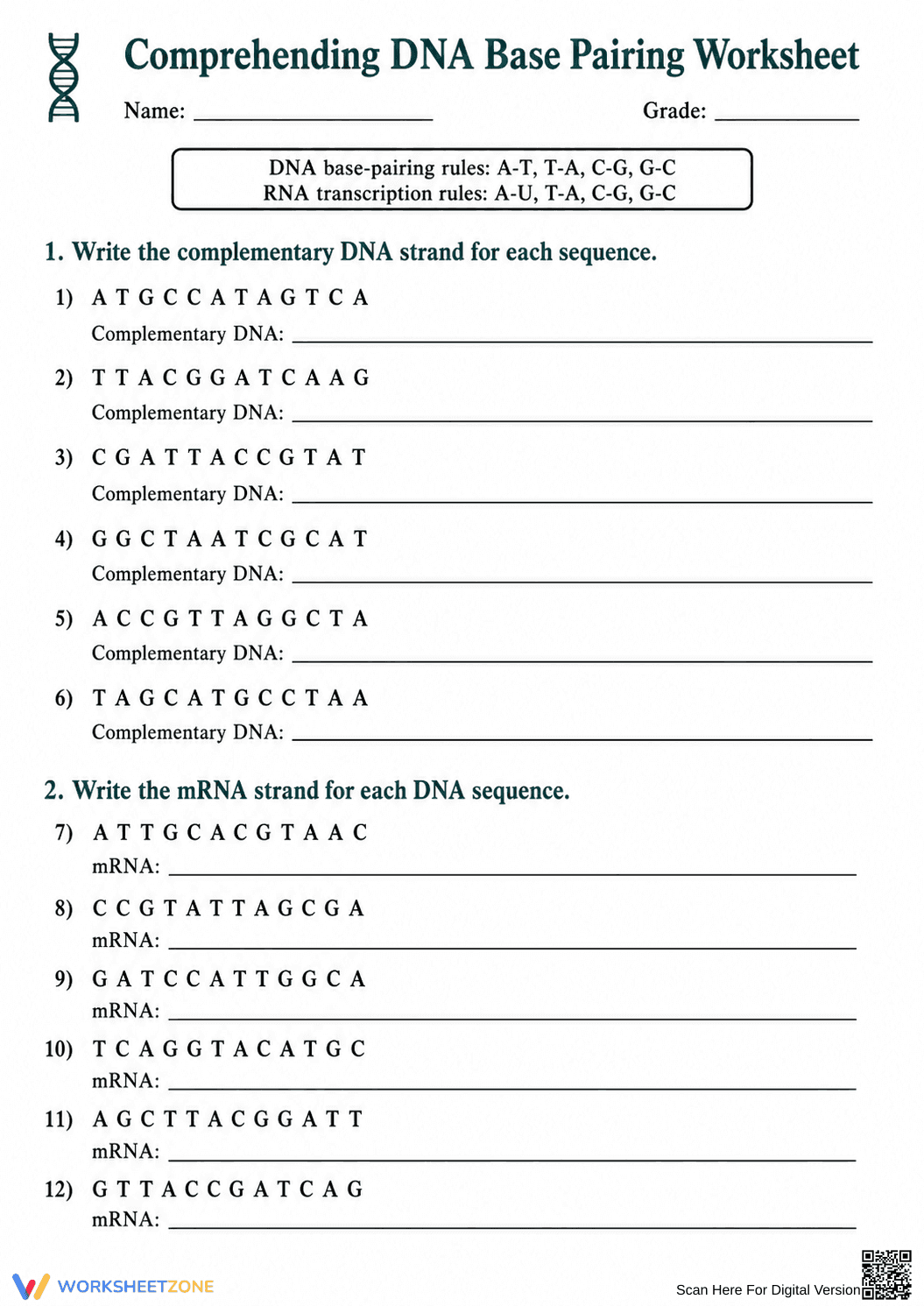
This resource includes three distinct versions of a base pairing practice sheet. Each page features a quick reference guide for base pairing rules, followed by six complementary DNA problems and six mRNA transcription problems. The sequences vary in length across the pages, and a complete answer key is provided.
- Below Grade: Features shorter, 10-base DNA sequences. The simplified layout helps students focus purely on applying the A-T, C-G, and A-U rules without getting overwhelmed by long strings of letters.
- On Grade: Presents standard 14-base sequences with clear spacing between letters, mirroring typical textbook formatting and requiring sustained attention to detail during transcription.
- Above Grade: Challenges students with continuous, unspaced 16-base sequences, demanding higher focus and simulating more realistic, complex genetic data analysis. All three versions are included.
This worksheet is aligned to HS-LS1-1: Construct an explanation based on evidence for how the structure of DNA determines the structure of proteins. By mastering transcription, students build the foundation to understand translation. Both standard codes can be copied directly into lesson plans, IEP goals, or district curriculum mapping tools.
Deploy this worksheet immediately following direct instruction on DNA structure and RNA transcription. It serves as an excellent independent practice activity to solidify the mechanical rules of base pairing before moving on to translation and codon charts. As a formative assessment tip, walk the room while students complete the first mRNA section; check that they are correctly substituting Uracil (U) for Thymine (T), as this is the most common point of confusion. Expected completion time is 15 to 20 minutes per version.
This resource is designed for high school biology students in grades 9 through 11. The built-in differentiation makes it ideal for inclusive classrooms, allowing special education students to use the shorter sequences while advanced learners tackle the unspaced strands. It pairs perfectly with a visual anchor chart of a DNA double helix and a transcription diagram, giving students a concrete reference while they work through the abstract letter sequences.
Mastering the specific rules of genetic transcription is a critical step in high school biology. Aligned with HS-LS1-1, this resource helps students construct an explanation for how DNA structure determines protein structure by isolating the foundational skill of base pairing. According to ScienceDirect TpT Analysis, providing differentiated practice sets with varying levels of visual complexity significantly improves student retention of abstract molecular concepts. When learners can confidently transcribe DNA to mRNA without cognitive overload, they are better prepared for advanced topics like gene expression and mutations. By offering three distinct levels of sequence complexity, educators can ensure that all students build the automaticity required for success in molecular biology. This targeted approach bridges the gap between basic memorization and functional application in genetic science.


