


























Views
Downloads



DNA Base Pairing Worksheet | Essential Grade 9-12 Biology
Paste this activity's link or code into your existing LMS (Google Classroom, Canvas, Teams, Schoology, Moodle, etc.).
Students can open and work on the activity right away, with no student login required.
You'll still be able to track student progress and results from your teacher account.
This comprehensive DNA base pairing worksheet provides high school biology students with rigorous practice in the fundamental mechanics of genetics. By applying Chargaff's rules and the principles of transcription and translation, learners master the conversion of genetic information from DNA to functional amino acid sequences. This resource ensures students can accurately model the flow of genetic information.
At a Glance
- Grade: 9-12 · Subject: Biology
- Standard:
HS-LS1-1— Explain how DNA structure determines protein structure and essential life functions- Skill Focus: Transcription and Translation
- Format: 4 pages · 44 problems · Answer key included · PDF
- Best For: High school genetics unit reinforcement
- Time: 45–60 minutes
What's Inside
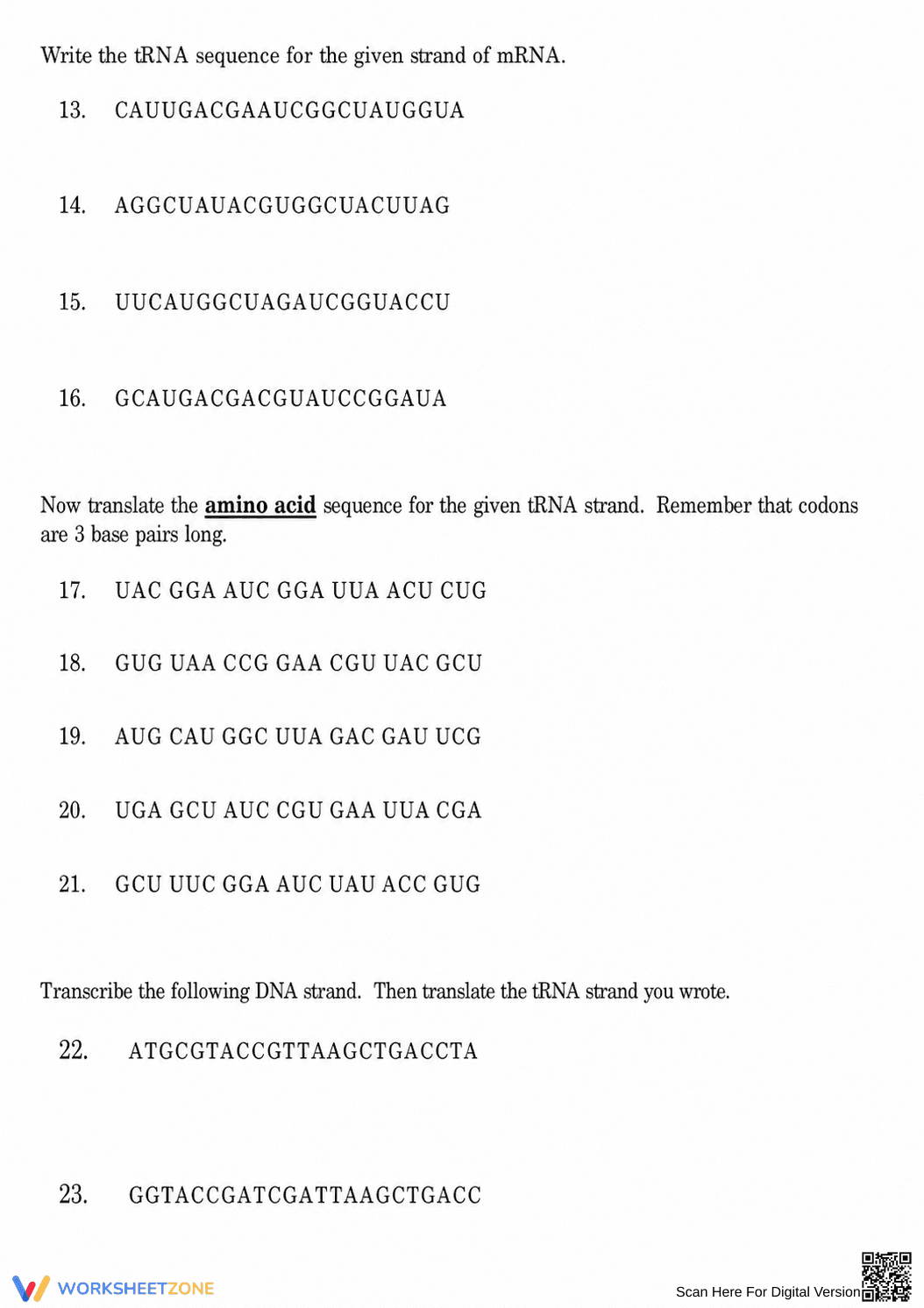
This 4-page packet contains a structured progression of molecular biology tasks. It begins with basic DNA-to-DNA complementary strand pairing, moves into mRNA transcription, and concludes with complex translation exercises. The worksheet includes a full-page universal codon chart and integrated tables that require students to synchronize DNA, mRNA, tRNA, and amino acid data points across 44 distinct practice items.
Zero-Prep Workflow
- Print: Select the 4-page PDF and print enough copies for your class in under 30 seconds.
- Distribute: Hand out the packets at the start of the independent practice phase of your lesson.
- Review: Use the provided answer key to conduct a rapid whole-class check or grade individual submissions in 5 minutes.
This resource is designed for immediate classroom implementation, requiring zero additional teacher preparation or external materials, making it an ideal sub plan.
Standards Alignment
This resource is specifically aligned to HS-LS1-1. Students must construct an explanation based on evidence for how the structure of DNA determines the structure of proteins which carry out the essential functions of life. By completing the sequences, students demonstrate the physical mechanism of this standard. This standard code can be copied directly into lesson plans, IEP goals, or district curriculum mapping tools.
How to Use It
Assign this worksheet during the independent practice phase of a gradual release lesson on protein synthesis. It serves as an excellent formative assessment tool; as students work through the codon chart on page 3, circulate to identify common errors in tRNA anticodon identification. The expected completion time is approximately 50 minutes, making it a perfect single-period activity for high school learners.
Who It's For
This packet is tailored for Grade 9-12 students in General Biology, Honors Biology, or AP Biology introductory units. It provides the necessary scaffolding for students who struggle with the multi-step nature of translation while offering enough volume for mastery. Pair this with a 3D DNA model or a transcription animation for a multi-modal learning experience that supports diverse learners.
The HS-LS1-1 standard requires students to understand the precise relationship between nucleotide sequences and protein synthesis. According to Fisher & Frey (2014), the use of structured practice in molecular biology helps bridge the gap between abstract chemical symbols and biological function. This worksheet provides 44 opportunities for students to engage in the gradual release instructional framework, ensuring that the complex rules of DNA base pairing and RNA transcription are internalized through repetitive, high-accuracy application. Research from the NAEP indicates that students who master these foundational genetics skills in high school are significantly more likely to succeed in post-secondary STEM coursework. This resource acts as a critical bridge for students moving from basic cell biology to advanced genomic studies. By focusing on the mechanical accuracy of base pairing, the worksheet prepares students for higher-order analysis of genetic mutations and phenotypic expression.


