


























Views
Downloads


Essential GCF Practice: Greatest Common Factor — Grade 6
Paste this activity's link or code into your existing LMS (Google Classroom, Canvas, Teams, Schoology, Moodle, etc.).
Students can open and work on the activity right away, with no student login required.
You'll still be able to track student progress and results from your teacher account.
Mastering greatest common factors is a foundational requirement for middle school mathematics. This comprehensive practice packet provides a structured pathway for students to calculate GCFs using listing factors or prime factorization. By moving from procedural fluency to word problem application, students develop the mental flexibility needed for higher-level fraction operations and algebraic expressions.
At a Glance
- Grade: 6 · Subject: Mathematics
- Standard:
CCSS.MATH.CONTENT.6.NS.B.4— Find the greatest common factor of two whole numbers up to 100- Skill Focus: Greatest Common Factor (GCF)
- Format: 5 pages · 28 problems · Answer key included · PDF
- Best For: Independent practice and number sense mastery
- Time: 45–60 minutes
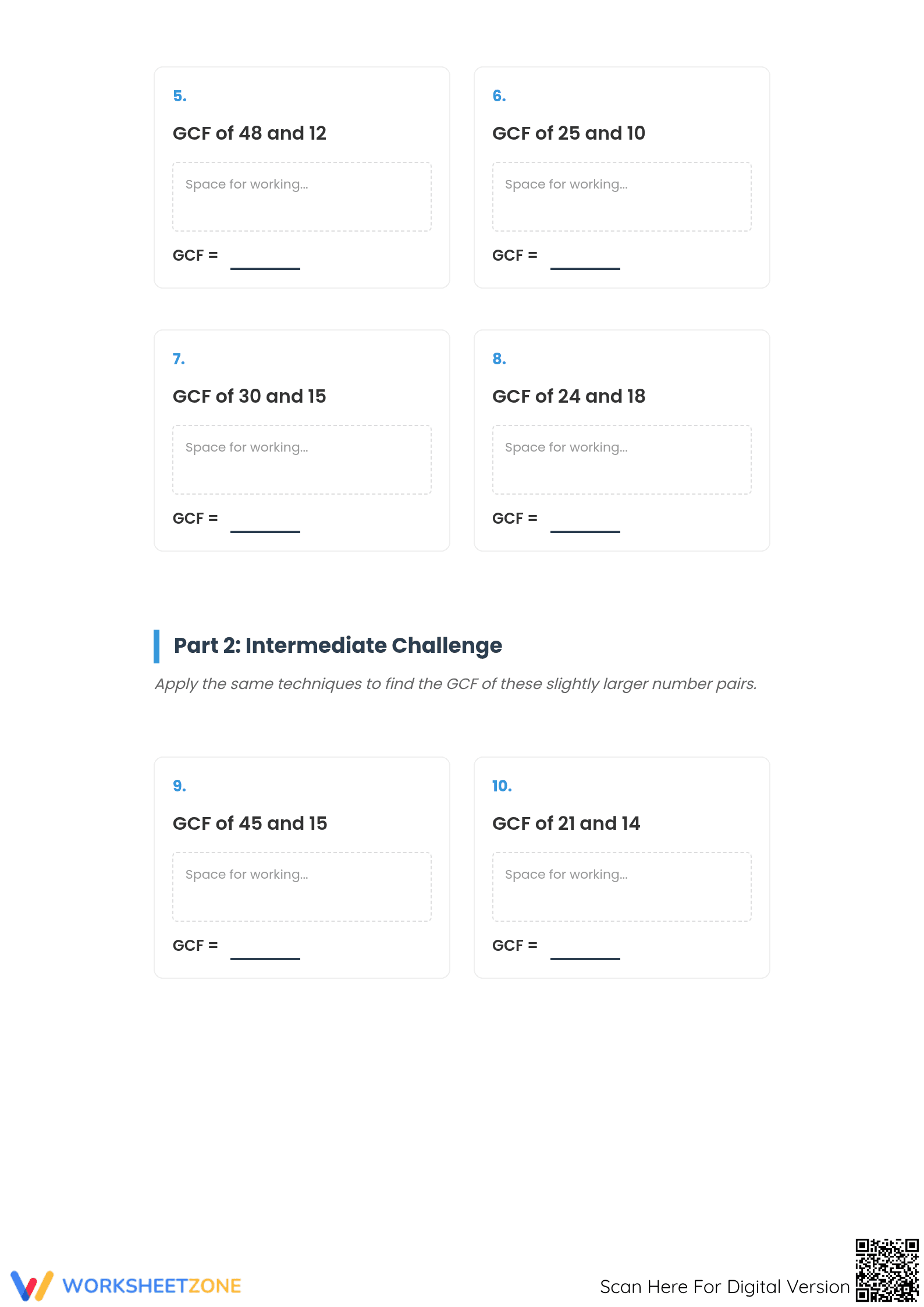
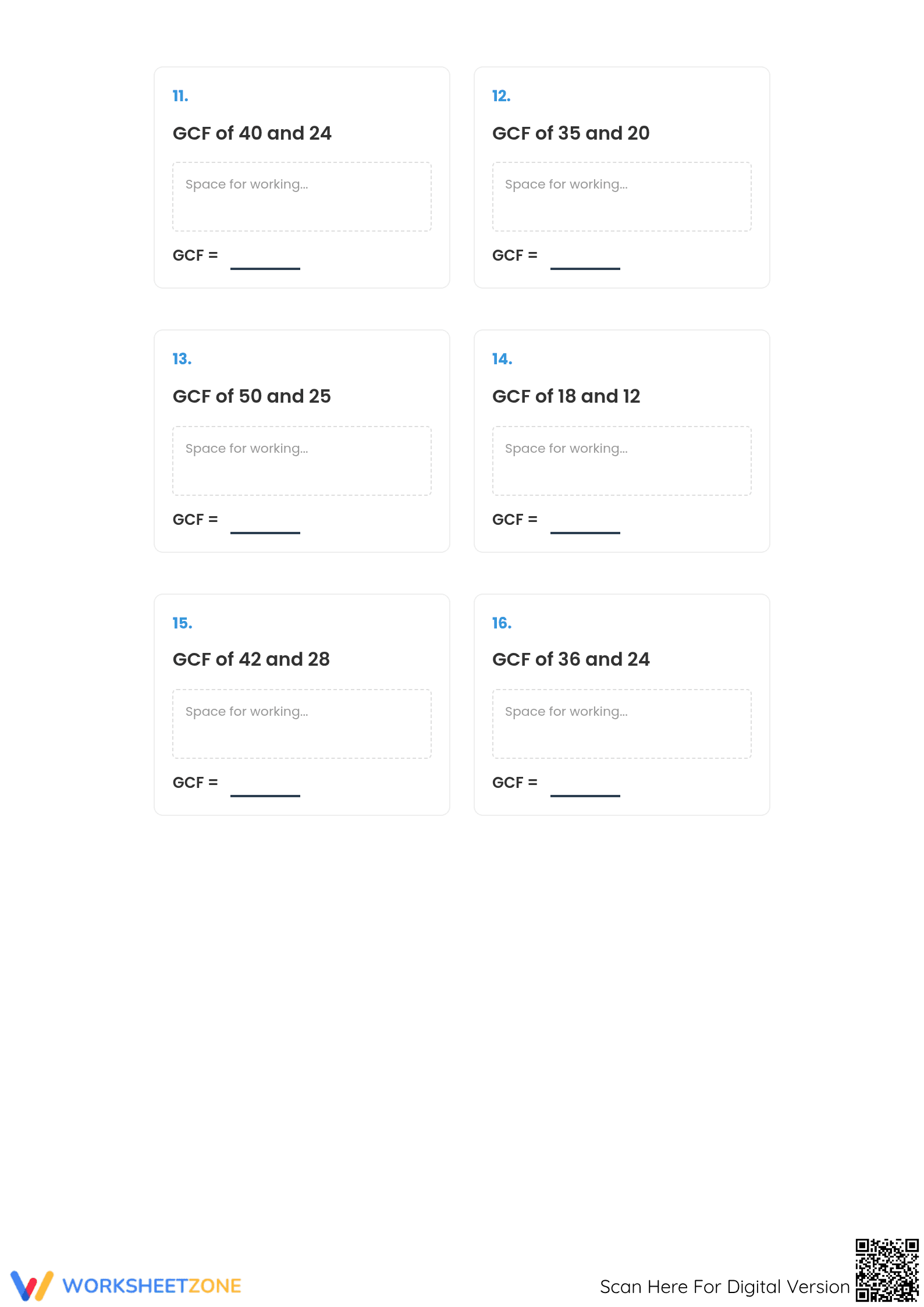
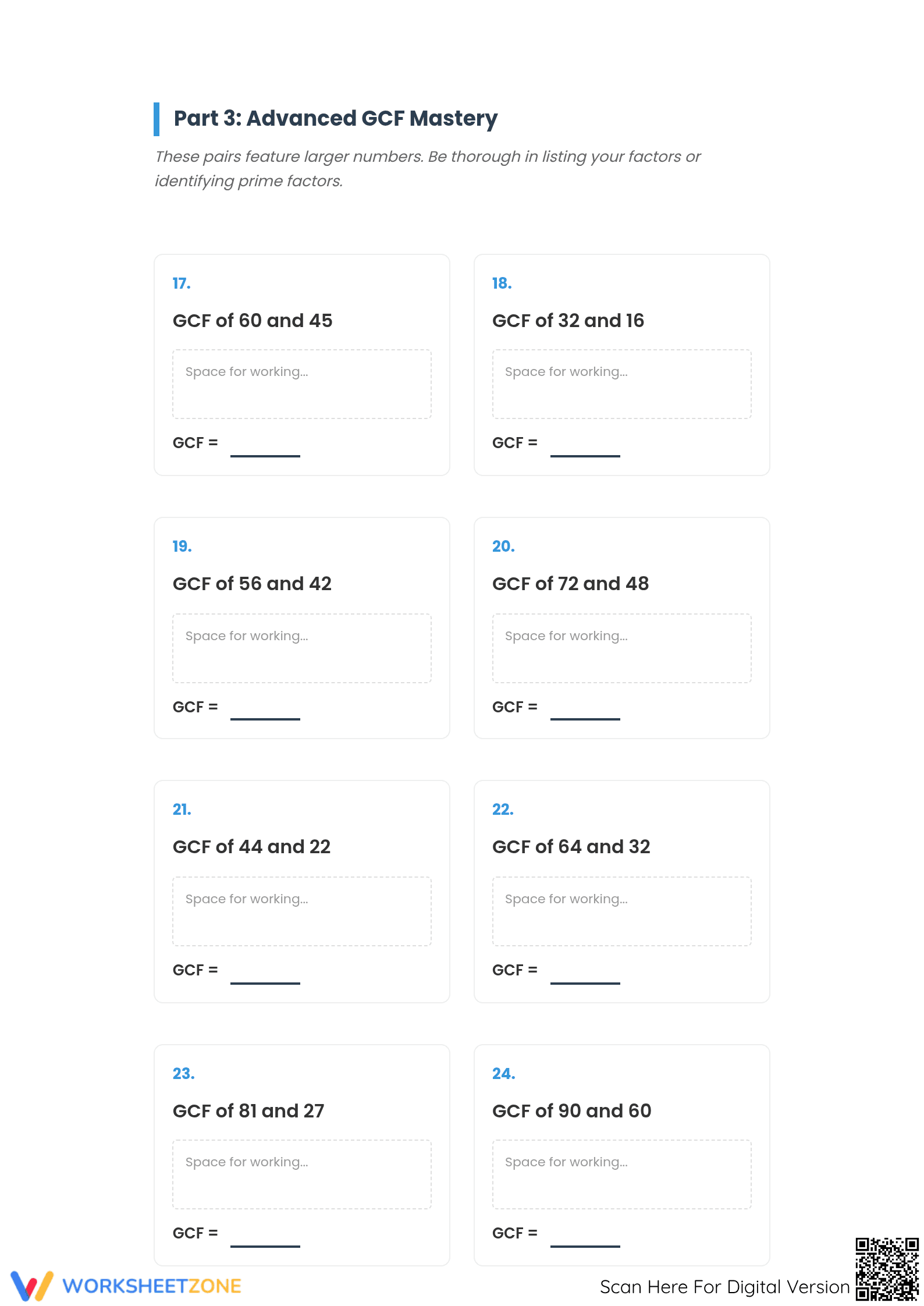
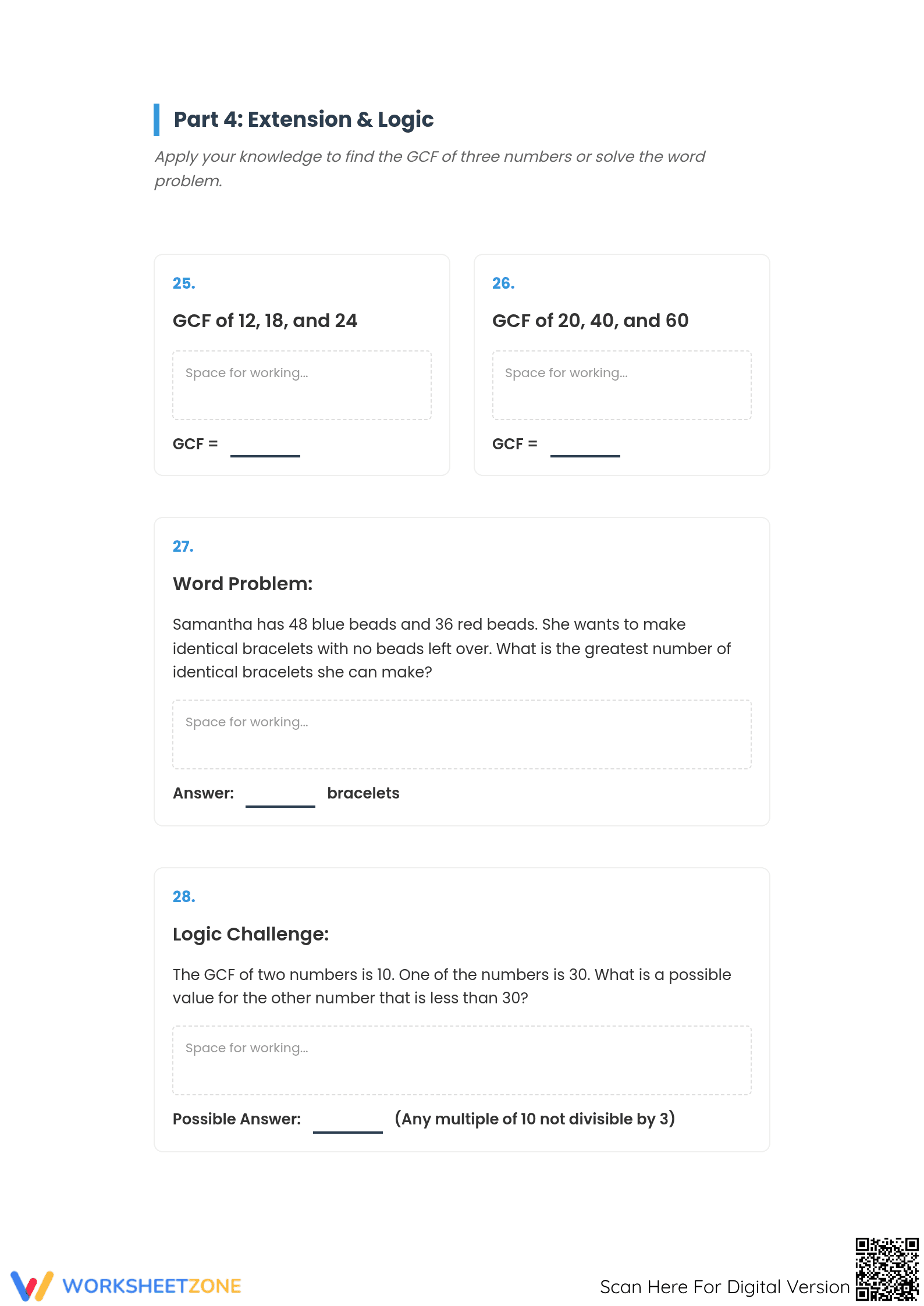
What's Inside: This 5-page PDF contains 28 unique tasks organized into four distinct parts. Each page provides generous 'Space for working' boxes, allowing students to show their prime factorization trees or factor lists. The packet includes foundational pairs, intermediate challenges with larger numbers, advanced mastery sets, and a final section dedicated to multi-number GCFs and real-world logic challenges.
Zero-Prep Workflow
- Step 1: Print the 5-page PDF (30 seconds).
- Step 2: Distribute to students for independent or partner work (1 minute).
- Step 3: Review the answers using the provided key (5 minutes).
Total teacher preparation time is under two minutes, making this an ideal solution for emergency sub plans or busy mornings when you need high-quality instructional materials without the setup hassle.
Standards Alignment
This resource is aligned to CCSS.MATH.CONTENT.6.NS.B.4: "Find the greatest common factor of two whole numbers less than or equal to 100 and the least common multiple of two whole numbers less than or equal to 12." The focus here is strictly on GCF mastery. This standard code can be copied directly into lesson plans, IEP goals, or district curriculum mapping tools.
How to Use It
Use this as a summative assessment after a unit on number theory to verify mastery. The tiered sections allow you to observe where students struggle—whether with basic factor pairs or complex word problems. Another effective use case is as a collaborative station activity where students rotate through the four parts, discussing their prime factorization strategies as they move toward the logic challenge.
Who It's For
This worksheet is designed for Grade 6 students but serves as an excellent review for Grade 7 or an enrichment activity for advanced 5th graders. It pairs naturally with anchor charts showing factor trees and provides the necessary scaffolds for students who benefit from structured workspace and clear, sequential task progression.
The CCSS.MATH.CONTENT.6.NS.B.4 standard requires students to find the greatest common factor of two whole numbers less than or equal to 100. This worksheet facilitates this through a structured four-part progression that builds from foundational listing to complex logic challenges. According to the ScienceDirect TpT Analysis (2024), math worksheets that incorporate varying cognitive demands—such as the transition from procedural pairs to multi-number logic tasks seen here—significantly improve long-term retention of number theory concepts. By providing dedicated 'Space for working' boxes, the material encourages students to visualize prime factorization and factor trees, which are essential scaffolding techniques for middle school numeracy. This resource is designed to bridge the gap between simple calculation and the application of factors in real-world scenarios, such as the bracelet-making word problem included on the final page. It serves as a comprehensive tool for both initial instruction and mastery verification.


