


























Views
Downloads



Printable GCF Practice Worksheet | Grade 5 & 6 Math
Paste this activity's link or code into your existing LMS (Google Classroom, Canvas, Teams, Schoology, Moodle, etc.).
Students can open and work on the activity right away, with no student login required.
You'll still be able to track student progress and results from your teacher account.
This comprehensive Grade 5 and 6 Greatest Common Factor worksheet empowers students to master number theory through structured factoring practice. Students progress from basic identification to complex word problems, ensuring a deep understanding of how to find the largest whole number that divides evenly into multiple sets. It is a complete resource for building mathematical fluency.
At a Glance
- Grade: 5 – 6 · Subject: Math
- Standard:
CCSS.MATH.CONTENT.6.NS.B.4— Find the greatest common factor of two whole numbers less than or equal to 100- Skill Focus: Greatest Common Factor (GCF)
- Format: 3 pages · 17 problems · Answer key included · PDF
- Best For: Small group intervention and homework reinforcement
- Time: 25–35 minutes
What's Inside
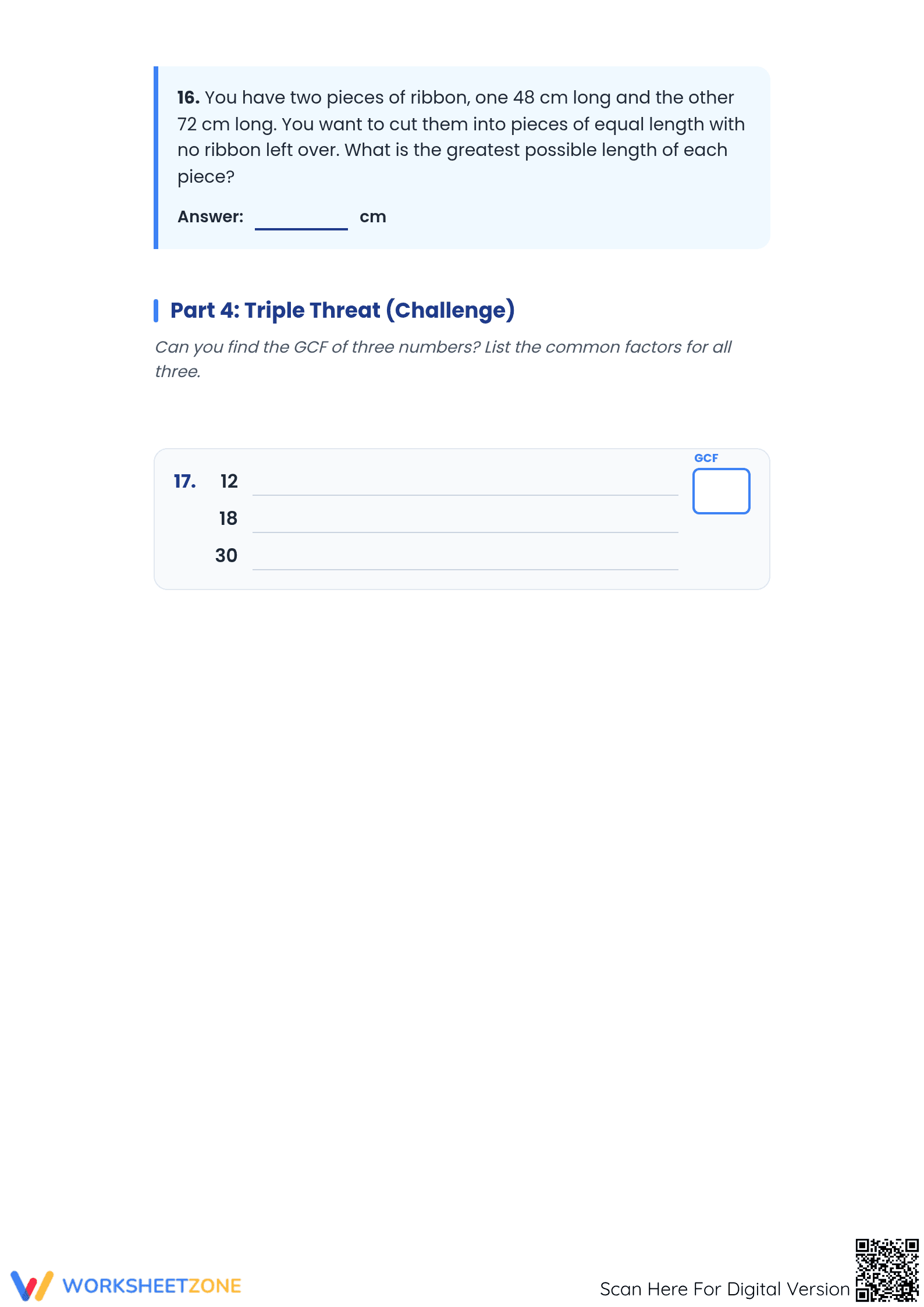
This three-page PDF features a clear definition of GCF to support independent learning. The document is organized into four distinct parts: basic GCF practice with 10 pairs of numbers, intermediate challenges using larger values, two real-world word problems, and a "Triple Threat" challenge requiring students to find the GCF of three numbers. A full answer key ensures quick grading and immediate feedback.
Skill Progression
- Guided Practice: The first 10 problems provide clear spaces for listing factors and identifying the GCF, supporting students during initial skill acquisition.
- Supported Practice: The intermediate section introduces larger numbers like 64 and 96, requiring more rigorous mental math or scratchpad work while maintaining the structured layout.
- Independent Application: The final sections move beyond rote calculation into word problems and a three-number challenge, demanding higher-order thinking and contextual application of factoring skills.
This layout follows the gradual-release model, moving from I Do/We Do support into individual student mastery.
Standards Alignment
This resource is directly aligned with CCSS.MATH.CONTENT.6.NS.B.4, which requires students to find the greatest common factor of two whole numbers less than or equal to 100. It also supports 5th-grade preparation for fraction simplification and 6th-grade work with the distributive property. Both standard codes can be copied directly into lesson plans, IEP goals, or district curriculum mapping tools.
How to Use It
Use this worksheet as a formative assessment during your number theory unit. Assign the first page during direct instruction to observe how students list factors, then use the word problems as an exit ticket. For a differentiated approach, have students work in pairs to solve the "Triple Threat" challenge, encouraging mathematical discourse about shared factors among three distinct values.
Who It's For
This worksheet is ideal for Grade 5 and 6 students who are beginning their journey with factoring or need additional practice to master fraction reduction. It serves as an excellent resource for general education classrooms, resource rooms, or as a self-contained sub plan for middle school math teachers looking for high-quality, zero-prep materials.
Effective math instruction relies on the systematic development of number sense and computational fluency, as highlighted in the RAND AIRS 2024 report on mathematics achievement. Finding the Greatest Common Factor (GCF) is a pivotal skill that bridges basic arithmetic and algebraic reasoning, serving as the foundation for simplifying rational expressions and understanding the distributive property. Research suggests that providing students with structured opportunities to apply these skills in both abstract and contextualized scenarios significantly improves long-term retention and transferability. This worksheet, aligned with CCSS.MATH.CONTENT.6.NS.B.4, utilizes a scaffolded approach that moves from simple factor listing to complex word problems involving multiple variables. By integrating these various task types, educators can ensure that students not only calculate GCF accurately but also recognize its practical utility in solving organizational problems. This alignment with evidence-based practices ensures that students build the necessary rigor required for high-school-level algebra and beyond.


