


























Views
Downloads
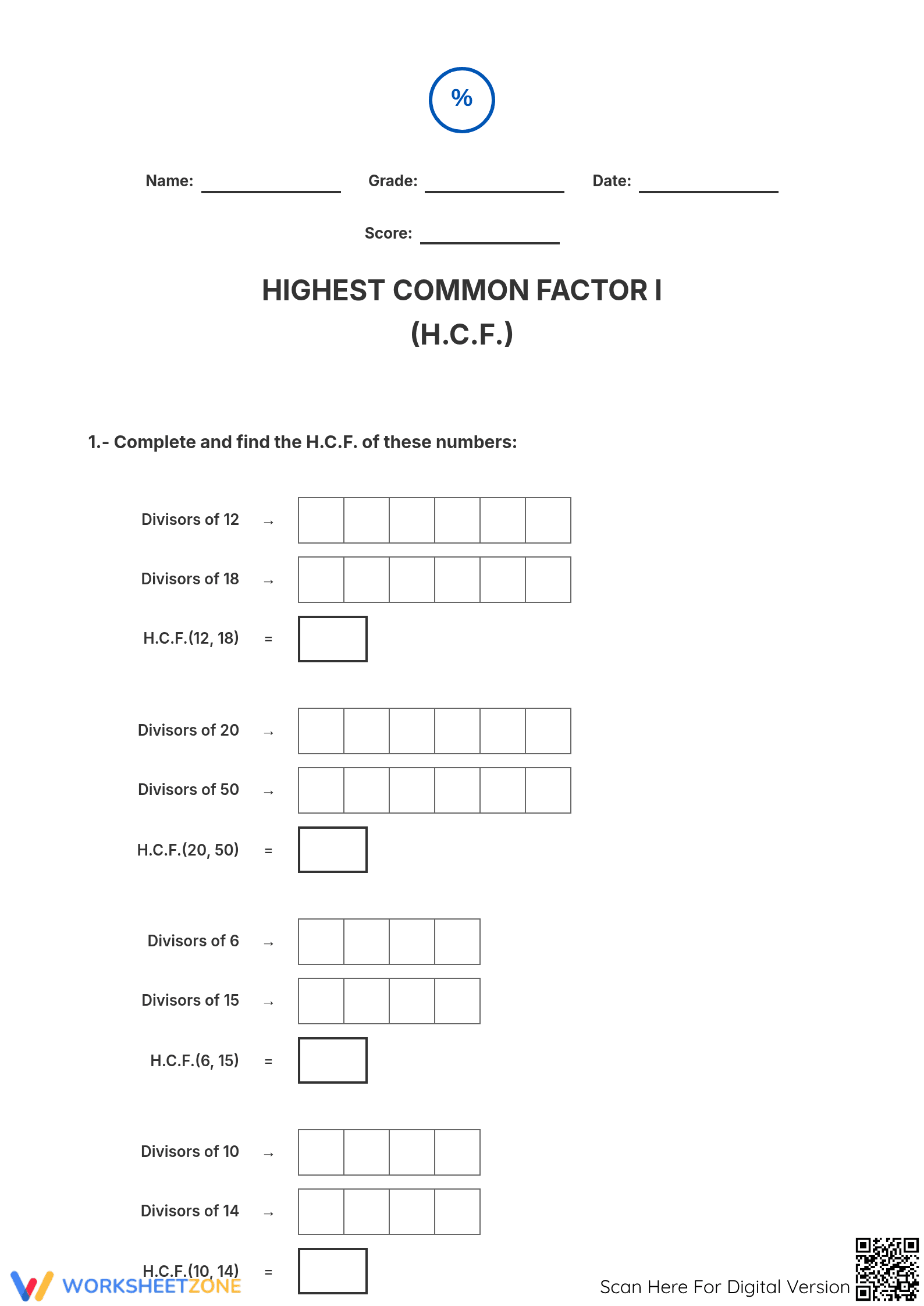



Essential Highest Common Factor Worksheet | Grade 7 Math
Paste this activity's link or code into your existing LMS (Google Classroom, Canvas, Teams, Schoology, Moodle, etc.).
Students can open and work on the activity right away, with no student login required.
You'll still be able to track student progress and results from your teacher account.
Finding the highest common factor is essential for simplifying fractions and solving algebraic equations. This worksheet provides structured practice for Grade 7 students to identify common divisors between pairs and trios of numbers. By listing factors, learners build the conceptual understanding of divisibility required for advanced middle school mathematics.
At a Glance
- Grade: 7 · Subject: Math
- Standard:
CCSS.MATH.CONTENT.6.NS.B.4— Find the greatest common factor of two or three whole numbers.- Skill Focus: Identifying Highest Common Factors (HCF)
- Format: 3 pages · 9 problems · Answer key included · PDF
- Best For: Independent practice or small group review
- Time: 20–30 minutes
What's Inside
This three-page PDF features nine multi-step problems designed to guide students through the factor-listing process. Each section presents integers and provides dedicated space for students to write out divisors. After listing divisors, students identify shared values in a "Common Divisors" box before determining the Highest Common Factor. The consistent layout ensures that students focus on the logical progression of the task rather than complex formatting or teacher-led setup.
Skill Progression
- Guided Practice: Early problems use smaller integers like 10 and 15, allowing students to practice the list-and-compare method using familiar multiplication facts.
- Supported Practice: Mid-range problems introduce larger values and sets of three numbers, requiring more exhaustive factor searches while maintaining the same supportive scaffold.
- Independent Practice: Final tasks challenge students with complex sets like 14, 21, and 28, where missing a single divisor could lead to an incorrect HCF.
This worksheet follows a gradual-release model, building student confidence through structured repetition and increasing numerical complexity.
Standards Alignment
Primary alignment is to `CCSS.MATH.CONTENT.6.NS.B.4`, which involves finding the greatest common factor of whole numbers. Mastery is essential for Grade 7 students transitioning into algebraic expressions and equations. This resource reinforces the relationship between division and factor pairs. Standard codes can be copied directly into lesson plans, IEP goals, or district curriculum mapping tools for easy documentation.
How to Use It
Use this worksheet during the "You Do" portion of a lesson or as a station activity. For formative assessment, observe students as they complete the "Common Divisors" section; mistakes here usually indicate incomplete divisor lists. Completion typically takes 20 to 30 minutes, making it a perfect fit for a standard instructional block or homework assignment.
Who It's For
This resource is ideal for Grade 7 students requiring number sense reinforcement or those preparing for units on fraction reduction. It provides scaffolding for students with IEPs who benefit from discrete steps. It pairs naturally with a classroom anchor chart detailing divisibility rules for 2, 3, 5, and 10 to support independent work.
According to the NAEP framework, a robust understanding of factors is a predictor of success in algebra. This worksheet addresses these requirements by utilizing divisor-listing, which research from Fisher & Frey (2014) identifies as a critical scaffolding technique for procedural fluency. By requiring students to explicitly list divisors before identifying commonalities, the resource ensures students engage in active mathematical reasoning. The inclusion of three-number sets extends cognitive demand, aligning with rigorous standards that require students to apply divisibility concepts across varied contexts. Educators can use the resulting data to identify specific gaps in multiplication recall or conceptual understanding of shared factors. This document provides a reliable, evidence-based method for tracking progress toward CCSS.MATH.CONTENT.6.NS.B.4 mastery, offering clear evidence of student growth in identifying relationships between integers and their shared divisors.


