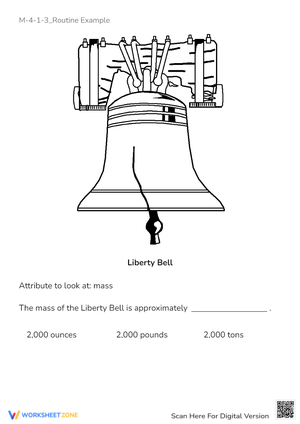
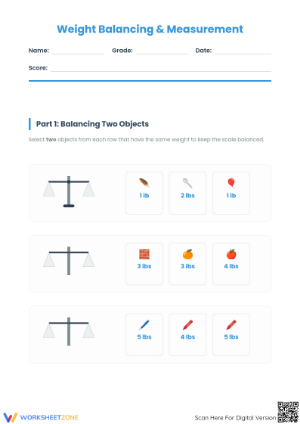
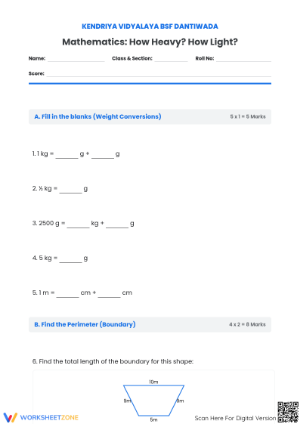
These measuring weight worksheets move students through the full arc of weight instruction — from lifting two objects and deciding which is heavier to converting between pounds and ounces in multi-step word problems. Each page targets a specific skill at a specific point in that progression, so teachers can pull exactly what a lesson needs rather than adapting something designed for a different grade.
The Progression These Pages Follow
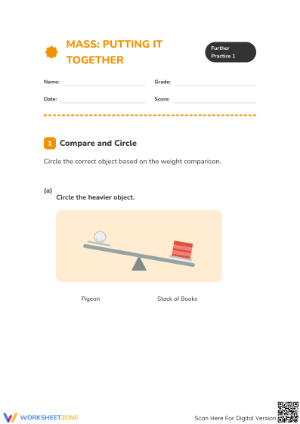
Weight instruction doesn't start with scales. In kindergarten and first grade, students build a vocabulary of comparison — heavier, lighter, about the same — by working with balance scales and real objects before they ever encounter a number line or a unit name. The worksheets for these grades reflect that: students look at illustrated balance scales, identify which side dips lower, and circle the heavier object or draw a line to the lighter one. The skill is conceptual, not computational, and the pages treat it that way.
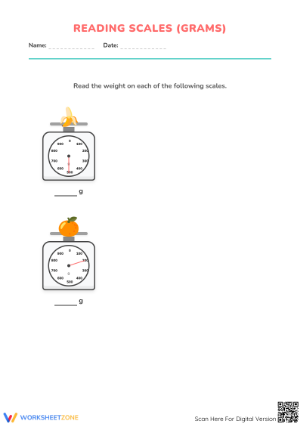
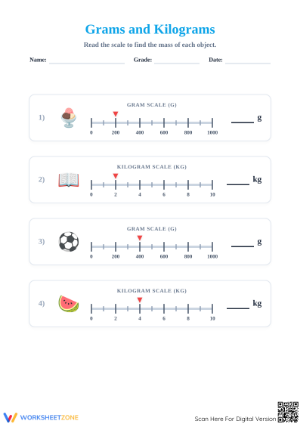
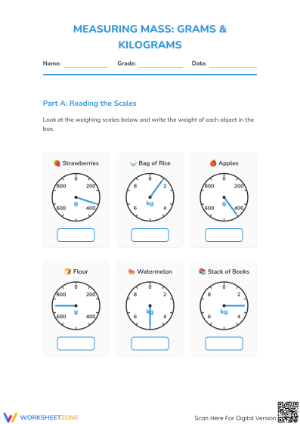
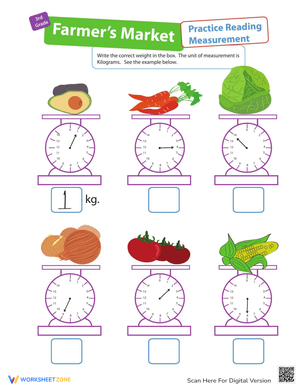
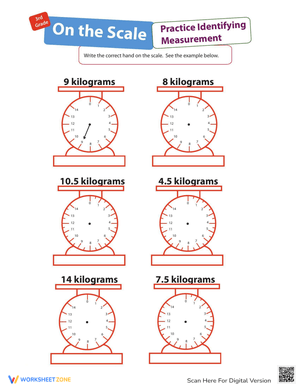
Second and third grade is where standard units enter the picture. Students encounter ounces and pounds in the US customary system alongside grams and kilograms in the metric system. Reading a scale becomes the central skill — specifically, understanding the intervals between labeled tick marks. A dial that goes from 0 to 10 pounds with marks every half-pound requires students to count spaces and calculate what each subdivision represents, and that's where many of them slow down. Pages at this level include analog dial scales, digital readout illustrations, and spring scale drawings, so students see multiple representations of the same measurement.
By fourth and fifth grade the work shifts to conversion and problem-solving. Students calculate how many ounces are in a given number of pounds, figure out whether a package weighs more in grams or kilograms when the number is expressed differently, and work through multi-step scenarios — a crate of books, a recipe doubled, a shipping manifest. These pages require students to hold unit relationships in memory while doing arithmetic, which is a meaningful increase in cognitive load from simply reading a scale.
What To Practice Using These Measuring Weight Worksheets
Across this worksheet collection, students practice these specific operations:
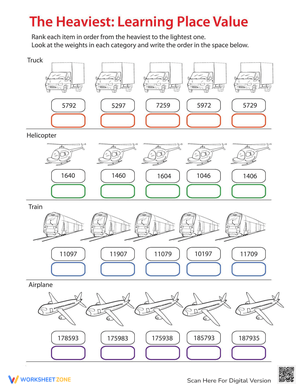
- Comparing and ordering objects by weight — arranging illustrated items from lightest to heaviest, or drawing an arrow to show which side of a balance scale would drop. Early grades only.
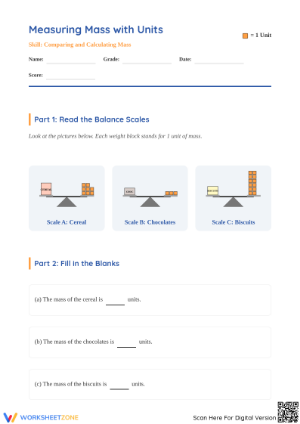
- Reading analog and digital scales — interpreting dial scales, spring scales, and digital readouts. Includes practice with scales that mark every ounce, every two ounces, or every quarter-pound, so students learn to read the interval rather than memorize a single format.
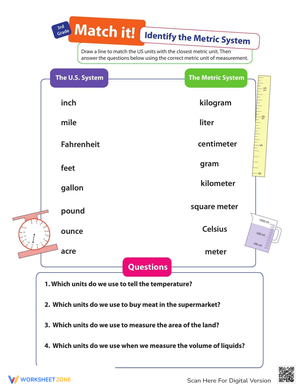
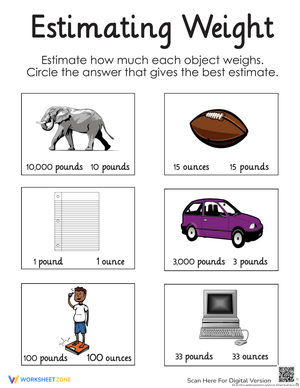
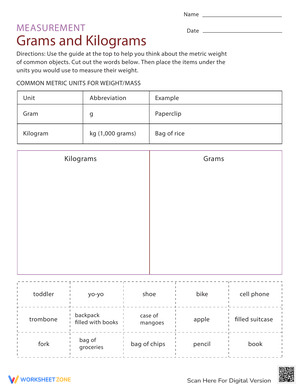
- Selecting appropriate units — deciding whether a strawberry is measured in ounces or pounds, whether a car is measured in grams or kilograms. This is often underemphasized, but students who skip it later write answers like "the dog weighs 40 grams" without flagging the absurdity.
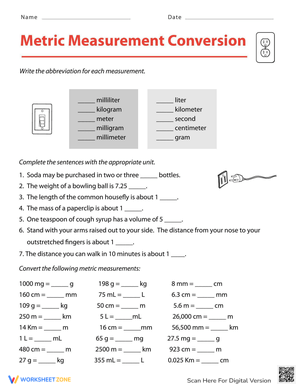
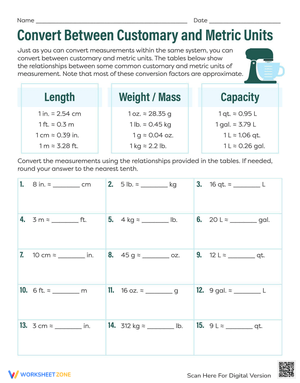
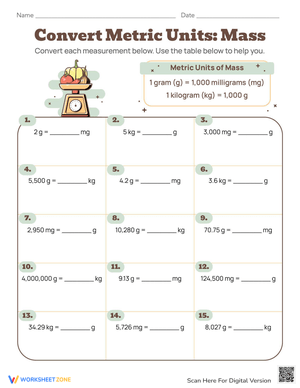
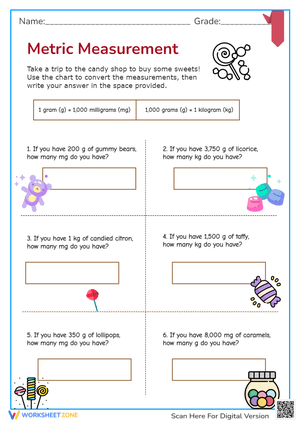
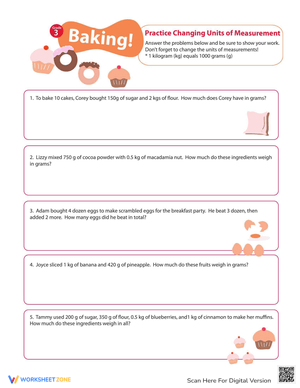
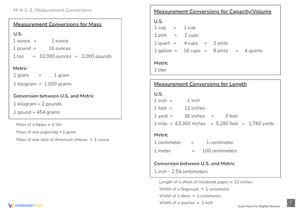
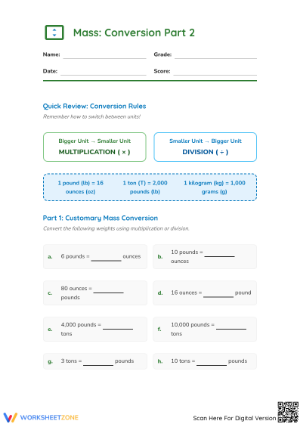
- Unit conversion — pounds to ounces, kilograms to grams, and back. Pages include both direction: given pounds, find ounces; given total ounces, find pounds and remaining ounces.
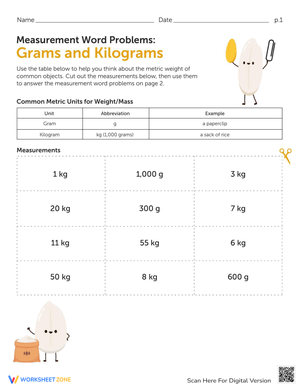
- Weight word problems — one-step and multi-step problems set in grocery, cooking, shipping, and science contexts. Students add, subtract, multiply, and divide with units attached.
Standards Alignment
The Common Core standard most directly addressed by this set is 3.MD.A.2, which asks students to measure and estimate liquid volumes and masses of objects using grams, kilograms, and liters, and to solve one-step word problems involving these units. The pages designed for second and third grade map to this standard, with the scale-reading and unit-selection work providing the foundational practice the standard assumes.
Conversion work aligns with 4.MD.A.1 and 4.MD.A.2, which require students to know relative sizes of measurement units within a system and apply conversion reasoning to solve multi-step problems. These standards sit in fourth grade but the pages are usable in fifth-grade review and intervention contexts without modification.
Recommended Lesson Planning Strategies To Take Full Advantages Of These Worksheets
The most reliable use of these pages is as a bridge between a concrete activity and independent practice. Students who have spent ten minutes lifting objects and recording estimates on a balance scale are ready to transfer that experience to a printed scale diagram; students who haven't done the physical work first often treat the worksheet as a decoding puzzle rather than a measurement task. The sequencing matters.
Scale-reading pages work well as Monday warm-ups during a measurement unit — three problems projected, students write answers on a whiteboard, teacher scans the room before the lesson starts. Exit tickets work the same way in the opposite direction: a single scale illustration at the end of class tells you immediately who can read a half-pound interval and who is still rounding to the nearest labeled number. The single-problem format is deliberate; a five-question exit ticket on a Friday afternoon produces guessing, not evidence.
For small-group instruction, the comparison and ordering pages give struggling students a concrete anchor while the rest of the class works on conversion. The visual format — illustrated objects, balance scales, clear line weight on the tick marks — reduces the cognitive overhead enough that students can focus on the measurement reasoning rather than decoding a cluttered page.
Common Mistake Of Students That Teachers Should Aware and Address
The most consistent error pattern appears on scale-reading problems where the interval between tick marks isn't one unit. A scale labeled 0 and 5 with four marks between them trips up students who assume each mark equals one pound. They read a pointer sitting on the third mark as "3 pounds" rather than working out that each interval represents 1.25 pounds. The fix isn't more practice on the same page — it's slowing down to teach interval-counting explicitly on a whiteboard before the worksheet appears.
Unit selection errors follow a predictable pattern, too. Students who know that a paperclip weighs about one gram will still write "kilogram" if the problem mentions a science lab, because they're pattern-matching to a science context rather than reasoning about the actual object. Word problem pages include a mix of contexts for exactly this reason — familiarity with context shouldn't substitute for thinking about the unit.
Conversion problems surface a different issue. Students who have memorized "16 ounces in a pound" will correctly convert 3 pounds to 48 ounces and then fail to convert 3 pounds 7 ounces, because they treat the "7 ounces" as a separate object rather than part of the total. Pages include both forms so this gap shows up in practice rather than on an assessment.
Frequently Asked Questions
Do these pages address both customary and metric units?
Yes. Pages are available for ounces and pounds, for grams and kilograms, and for mixed practice comparing across both systems. Most state standards expect students to work in both systems, and the pages treat them as parallel tracks rather than teaching one as primary.
How do I use these with students who haven't worked with real scales yet?
Start with the comparison pages even if your students are older — they establish the physical logic that scale-reading depends on. If you can pair even one session with an actual balance scale and classroom objects before moving to printed scales, the worksheet problems land more concretely. Students who have never felt the difference between a textbook and a pencil in their hands often treat scale illustrations as abstract symbols rather than representations of something physical.
What's the right page for a student who can read a scale but falls apart on word problems?
Use the single-skill word problem pages rather than the mixed reviews. A student who reads scales accurately is likely losing the thread when units appear inside sentences — they're managing reading comprehension and measurement reasoning at the same time. Isolating the word problem format while keeping the numbers simple lets you see whether the breakdown is in the unit reasoning or in parsing the problem structure.













 Interactive Worksheet Maker
 Quiz Maker
 Word Search Maker
 Crossword Puzzle Maker
 Word Scramble Generator
 Sentence Scramble Generator
 Handwriting Worksheet Generator
 Name Tracing Generator
 Fill In The Blank Generator