


























Views
Downloads

Mass in Grams & Kilograms Worksheet | Grade 4 Printable
Paste this activity's link or code into your existing LMS (Google Classroom, Canvas, Teams, Schoology, Moodle, etc.).
Students can open and work on the activity right away, with no student login required.
You'll still be able to track student progress and results from your teacher account.
This printable mass worksheet helps Grade 4 students master reading analog scales and converting between grams and kilograms. By working through visual models and direct conversions, learners develop a practical understanding of metric weight, ensuring they can accurately interpret real-world measurements and apply conversion rules.
At a Glance
- Grade: 4 · Subject: Math
- Standard:
CCSS.MATH.CONTENT.4.MD.A.1— Know relative sizes of measurement units and convert mass.- Skill Focus: Reading scales and mass conversions
- Format: 2 pages · 16 problems · Answer key included · PDF
- Best For: Independent practice or homework
- Time: 15–20 minutes
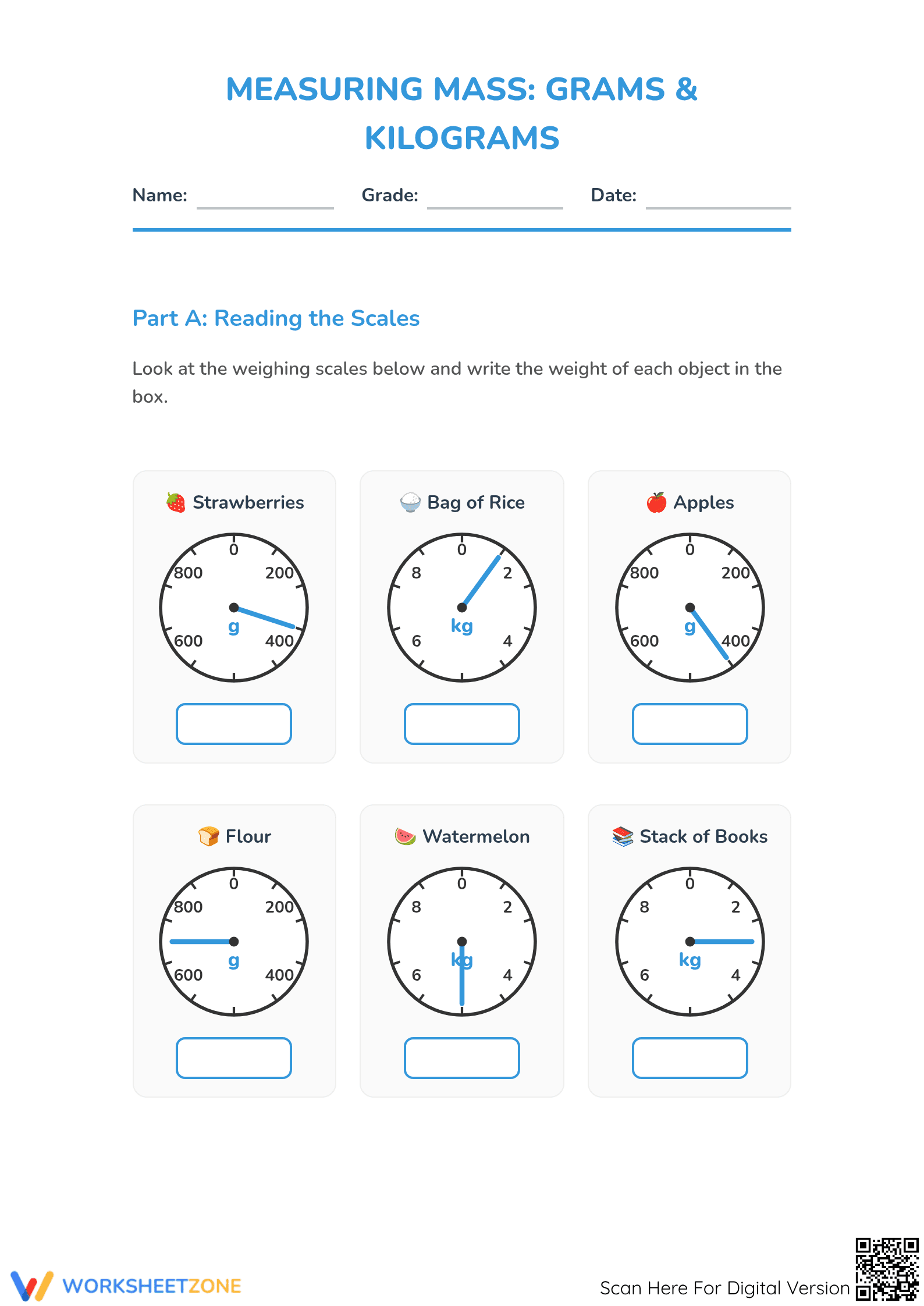
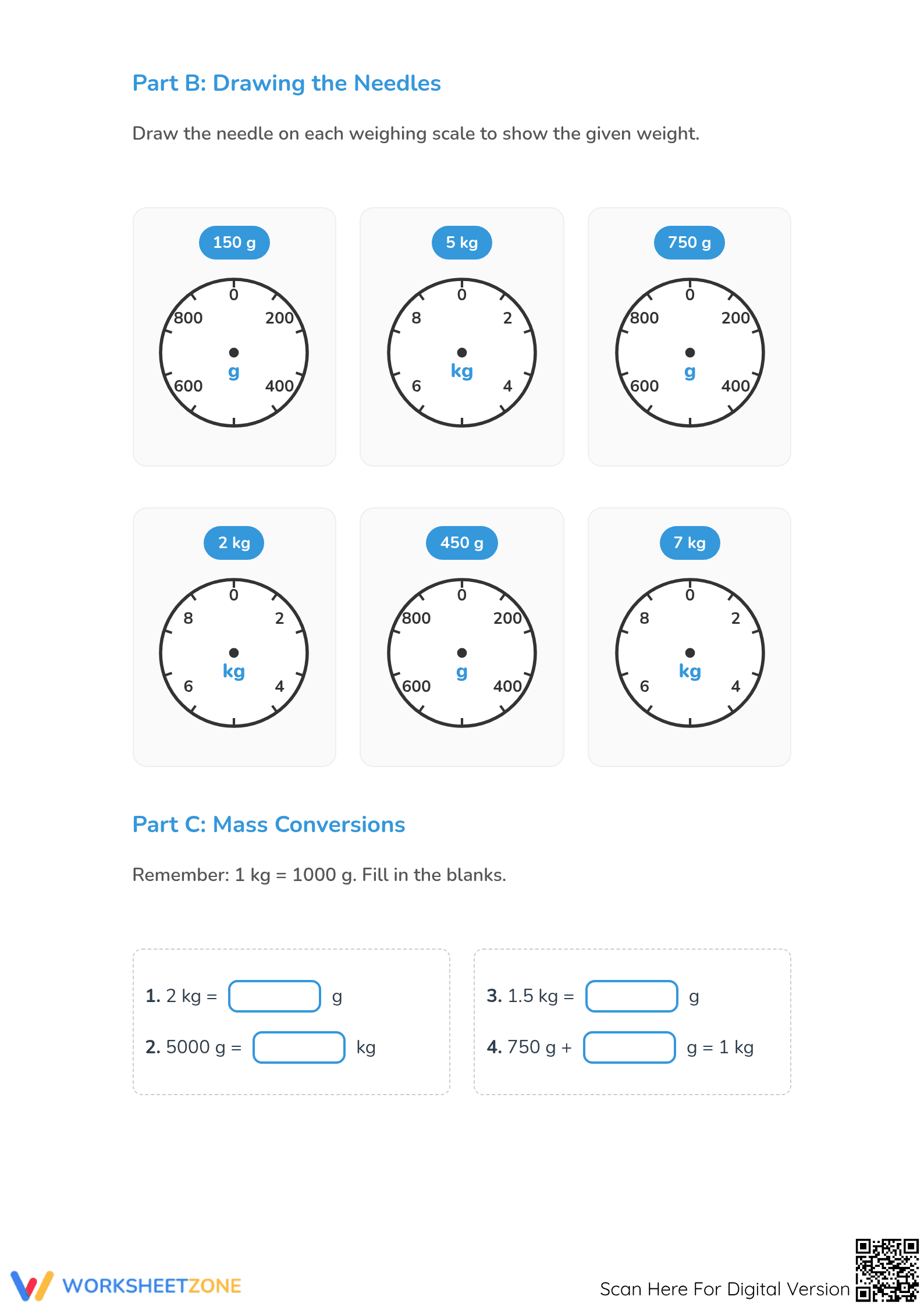
This two-page resource features 16 problems across three sections. Part A requires students to read analog scales and record mass in grams or kilograms. Part B asks students to draw the needle on a blank scale to represent a given weight. Part C provides direct mass conversion equations. A complete answer key is included.
- Guided practice: The first 6 problems focus on visual interpretation, allowing students to read marked intervals on analog scales.
- Supported practice: The next 6 problems require students to apply their understanding by drawing needles to match specific measurements, reinforcing scale increments.
- Independent practice: The final 4 problems transition to abstract mathematical conversions, requiring students to convert between kilograms and grams without visual aids.
This gradual-release approach ensures students build confidence with visual models before tackling abstract numerical conversions.
Aligned to CCSS.MATH.CONTENT.4.MD.A.1, this worksheet requires students to know relative sizes of measurement units within one system of units (including kg and g) and express measurements in a larger unit in terms of a smaller unit. Both standard codes can be copied directly into lesson plans, IEP goals, or district curriculum mapping tools.
Deploy this worksheet during the independent practice phase of a measurement unit, immediately following direct instruction on reading scales and metric conversions. It also serves as an excellent homework assignment. As a formative assessment tip, observe how students handle the intervals on the scales in Part B; if they struggle to place the needle accurately, they may need a quick review of number lines. Most students will complete this activity in 15 to 20 minutes.
This resource is designed for fourth-grade general education students, though it serves as excellent review material for fifth graders. For students needing extra support, provide a printed conversion chart to reference while working through Part C. This worksheet pairs perfectly with hands-on classroom activities where students weigh actual objects before transitioning to these visual models.
Mastering metric measurement and unit conversions is a critical component of elementary mathematics that bridges the gap between abstract arithmetic and real-world application. Aligned with CCSS.MATH.CONTENT.4.MD.A.1, this resource ensures students can know relative sizes of measurement units and convert mass accurately. According to EdReports 2024, instructional materials that connect visual representations—such as analog scales—to abstract numerical conversions significantly improve students' conceptual understanding of measurement systems. By requiring learners to both interpret visual data and generate their own representations by drawing scale needles, this worksheet reinforces the dual coding of mathematical concepts. This structured practice helps solidify the foundational knowledge required for more complex algebraic reasoning and scientific data analysis in later grades, ensuring students are fully prepared for advanced STEM coursework.


