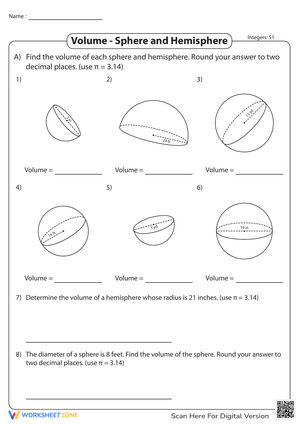
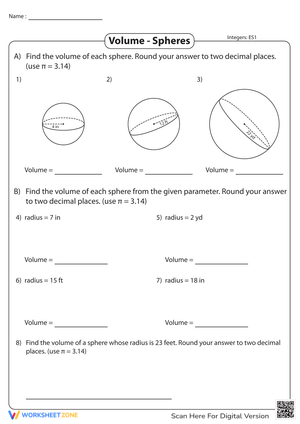
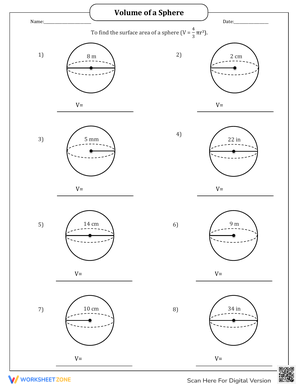
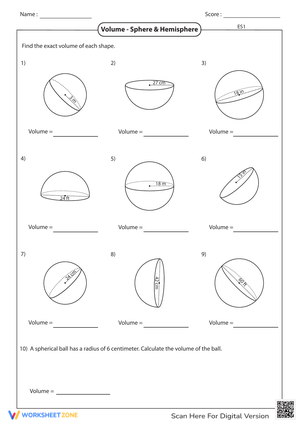
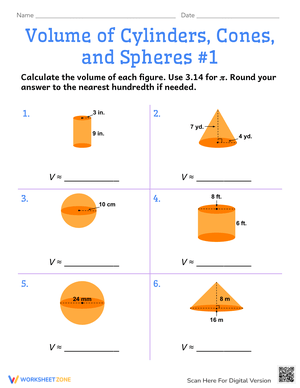
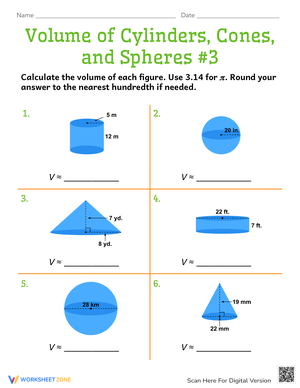
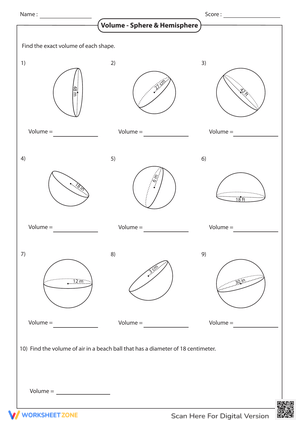
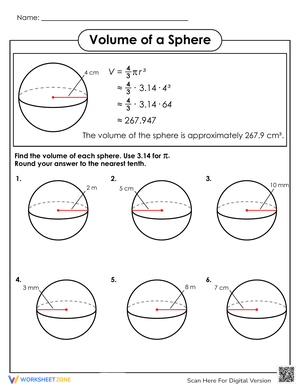
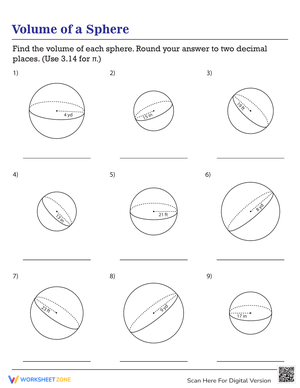
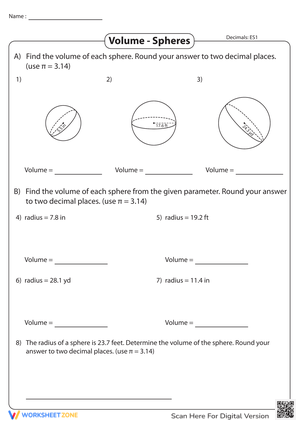
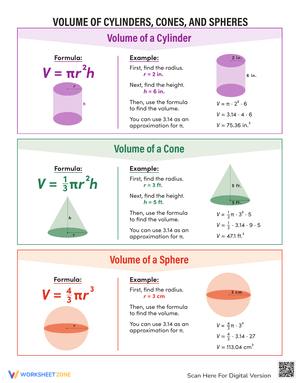
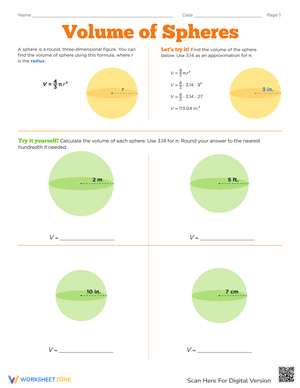
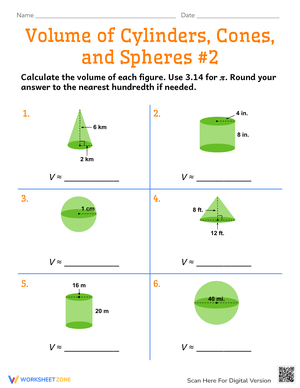
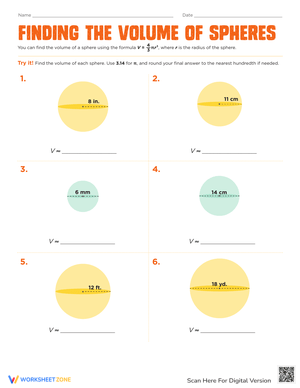
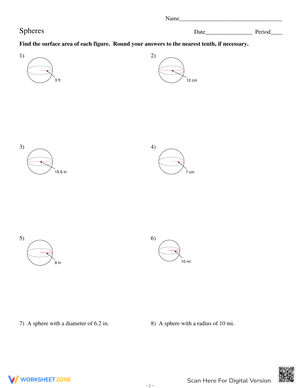
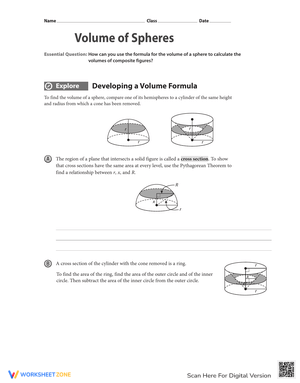
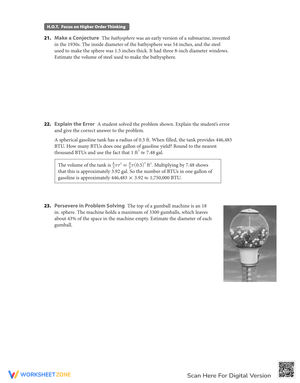
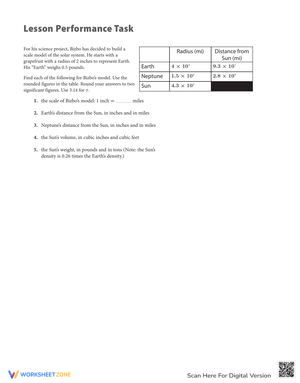
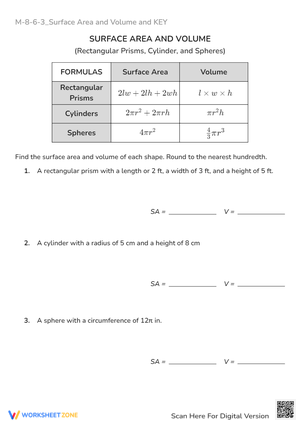
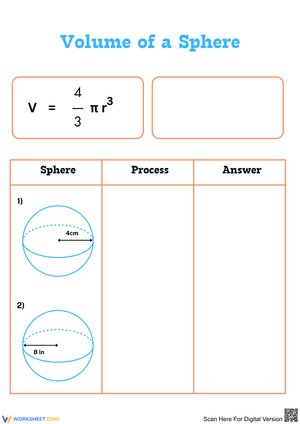
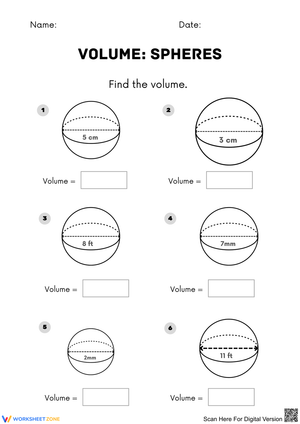
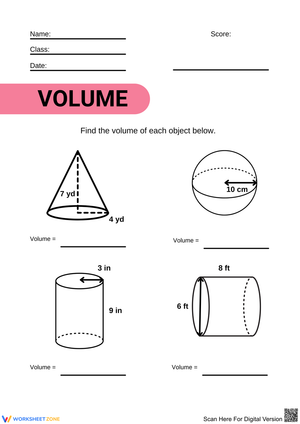
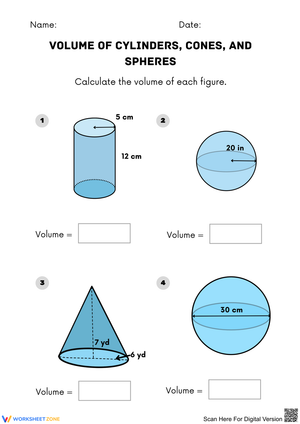
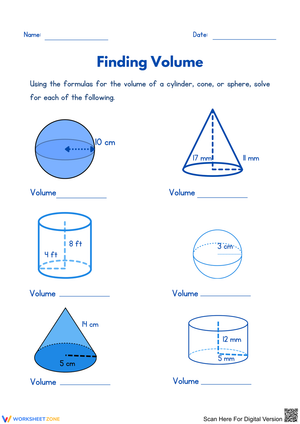
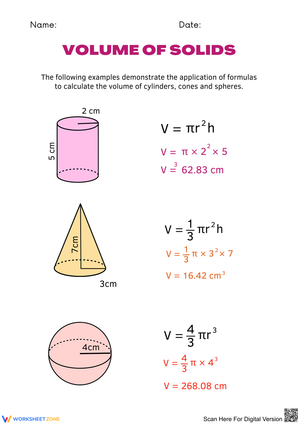
These volume of a sphere worksheets move 8th graders through the full range of what CCSS.Math.Content.8.G.C.9 actually demands — from the first careful substitution into V = 4/3 π r³ all the way to reverse-engineering a radius from a given volume. Each page is built around the kinds of errors and hesitations that show up in real classrooms, not a tidy idealization of how students engage with a new formula.
What Area Of Knowlegde These Worksheets Targets
These worksheets span five problem types, arranged by cognitive demand rather than arbitrary difficulty labels. Entry-level problems supply the radius and ask for a straightforward calculation — the kind of problem a student needs to solve correctly eight or ten times before the formula stops feeling fragile. The next tier switches to diameter-only prompts. That single change catches students who read the label "radius" onto any measurement, and it reinforces a conceptual distinction that matters again when the class moves to cylinders.
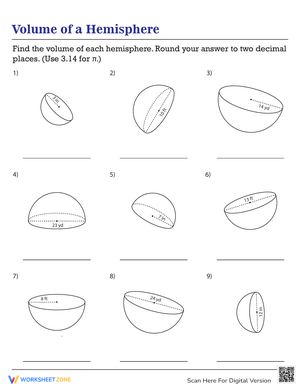
Mid-set problems introduce real-world contexts: a water storage tank, a decorative glass globe, the approximate volume of a planet given its diameter in kilometers. These aren't decorative dressing — they require students to extract a usable measurement from a sentence before any arithmetic begins, which is exactly the skill that separates a student who can execute a formula from one who can apply it. The final tier asks students to work backward from a volume to find the radius, which means dividing by 4/3 π and then taking a cube root. Hemisphere problems appear as extensions, pairing naturally with the composite figures that show up in the second half of the unit.
Standards Alignment
CCSS.Math.Content.8.G.C.9 groups spheres with cones and cylinders intentionally — the standard treats all three as a cluster of related formulas students should be able to apply, not memorize and forget. In most 8th grade pacing guides, this cluster lands in late winter or early spring, after students have worked through the Pythagorean theorem and are moving toward high school geometry readiness. The sphere is typically taught last within the cluster because it has no flat face and no height dimension, making spatial visualization harder. Dedicated worksheet practice on the sphere alone — rather than rotating quickly through all three solids — gives students the repetitions they need to stabilize the formula before comparison problems ask them to hold all three simultaneously.
Where These Fit in Teachers' Lesson Planning
Most teachers introduce this formula after cylinders and cones, so students arrive with some comfort handling π and labeling cubic units. Even so, the sphere formula lands differently — the 4/3 coefficient has no intuitive parallel in cylinder work, and cubing the radius produces numbers that feel unexpectedly large. The early pages in this set work well the day after initial instruction, assigned in pairs so students can talk through the arithmetic before working independently. The word-problem pages fit naturally mid-unit, once the mechanical steps are solid but conceptual flexibility is still being built. Backward-solving problems belong toward the end of the unit or as challenge work during a review block.
Exit tickets drawn from these pages take about four minutes — one problem, one calculation, radius provided — and give enough information to sort the class into three groups before the next day: students who have the formula sequence right, students who are squaring instead of cubing, and students who are dropping the 4/3 entirely.
Frequent Errors That Students Often Make
The two errors that appear most consistently in student work are not random — they follow a clear logic. When a student writes V = π r² instead of π r³, they are usually importing the area-of-a-circle formula, which they practiced heavily in 7th grade. The exponent error isn't carelessness; it's interference from a well-learned prior skill. Seeing that pattern in a student's work tells you something specific about what reteaching needs to address.
The diameter problem is equally diagnostic. A student who calculates V = 4/3 × π × 14³ when the diameter is 14 cm hasn't misunderstood the formula — they've misread the setup. Diameter-labeled problems throughout the set give multiple opportunities to catch and correct this before a unit test. A third error pattern appears on the backward-solving problems: students who correctly isolate r³ and then divide instead of taking the cube root. That step requires explicit instruction; it rarely transfers automatically from squaring and square roots.
Adjusting for the Range of Readiness in the Room
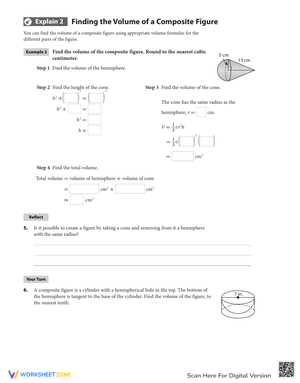
Students who are still uncertain about cubing numbers benefit from keeping a small reference column on their paper — r, then r², then r³ — so the arithmetic stays visible and checkable. This reduces cognitive load on the computation side and keeps attention on the formula structure. For students working ahead, the hemisphere and composite problems extend the same standard without requiring separate materials. A hemisphere problem that combines with a cone base, for instance, calls on three formulas and demands careful tracking of which dimension belongs to which solid — that's meaningful extension work, not busywork.
One technique worth building into whole-class instruction before independent practice: ask students to estimate whether a sphere with a 9 cm radius holds more or less than 3,000 cm³, then calculate. Students who estimate first catch their own calculator errors because a result of 30,517 cm³ triggers immediate skepticism. That metacognitive habit transfers to timed assessments where a misplaced decimal can go unnoticed under pressure
Frequently Asked Questions
Should students leave answers in terms of π or use 3.14?
Both conventions appear across this set, with the instruction stated explicitly in each problem. Leaving answers in terms of π — writing 288π cm³ rather than 904.78 cm³ — is actually the more algebraically sophisticated form and appears on many state assessments. Students should practice both, and the worksheets give roughly equal representation to each.
How do hemisphere problems differ from full-sphere problems structurally?
The calculation is the same formula halved, but the setup demands an extra decision: students must recognize they're dealing with half a sphere and build that step into their work explicitly. Where a full-sphere problem is a one-stage substitution, a hemisphere problem is a two-stage process. That distinction matters for students who are learning to show organized work — hemisphere problems are good practice for annotating each step rather than collapsing the arithmetic.
What if students don't have calculators for the cube root problems?
The backward-solving problems in this set use perfect cubes — radii of 3, 4, 5, or 6 — so students can work them by hand once they've isolated r³. That design choice is intentional: the goal on those problems is algebraic reasoning, not computational endurance.













 Interactive Worksheet Maker
 Quiz Maker
 Word Search Maker
 Crossword Puzzle Maker
 Word Scramble Generator
 Sentence Scramble Generator
 Handwriting Worksheet Generator
 Name Tracing Generator
 Fill In The Blank Generator