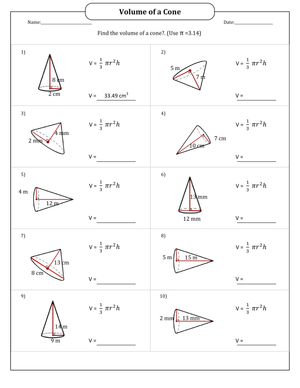
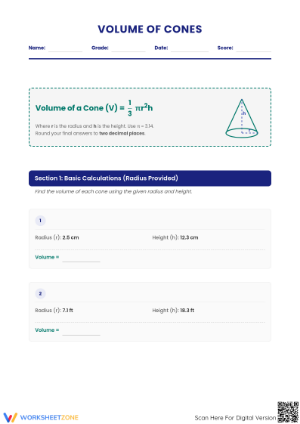
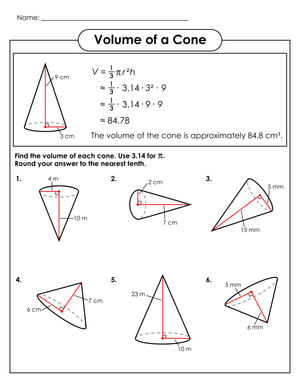
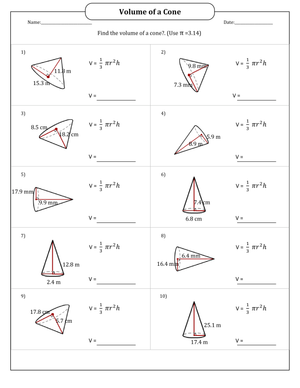
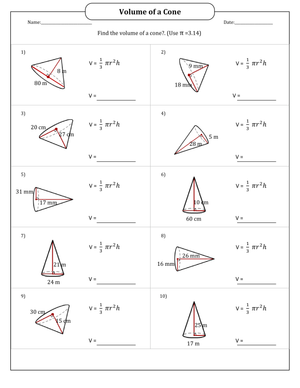
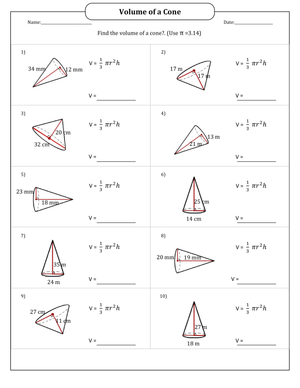
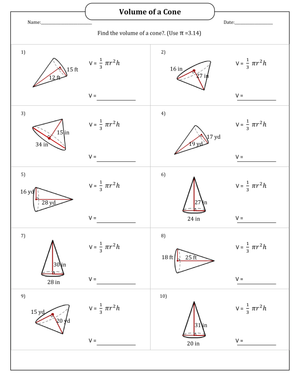
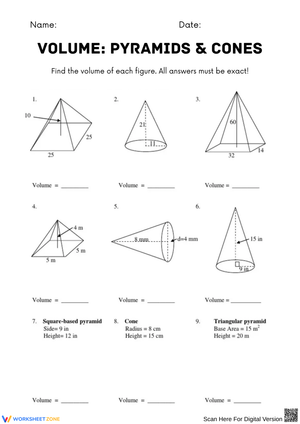
If you teach middle school geometry, you already know that volume of cones worksheets show up right when students are juggling three new formulas at once: cones, cylinders, and spheres. Pulling this specific link means you are likely planning a lesson, a review day, or an intervention block focused on the cone formula in isolation before students blend it with the other two shapes. That is a smart sequencing choice, since cone volume carries its own common error pattern that deserves dedicated practice time.
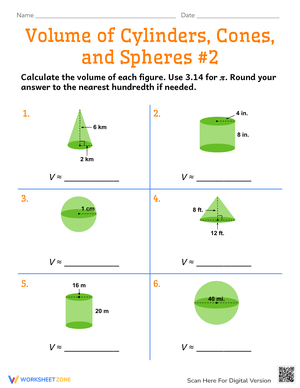
CCSS 8.G.C.9 asks students to know the formulas for volumes of cones, cylinders, and spheres and use them to solve real-world and mathematical problems. Worksheets built around this standard give you a low-prep way to move students from formula recall to applied reasoning without writing your own problem sets from scratch every week.
The Formula Students Need to Internalize
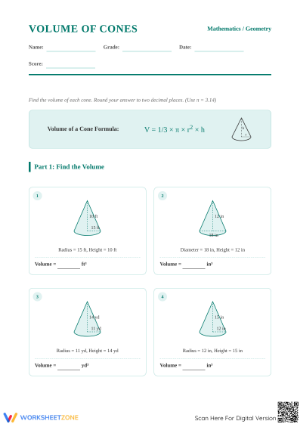
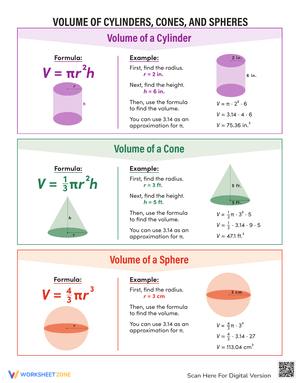
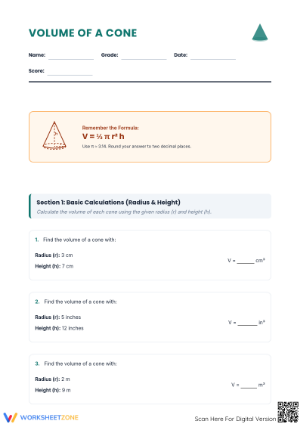
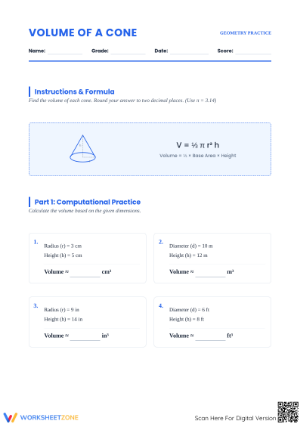
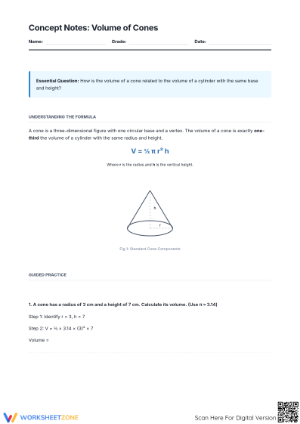
The volume of a cone formula is V = 1 divided by 3, times pi, times r squared, times h, where r is the radius of the circular base and h is the vertical height of the cone. Students who have already learned cylinder volume, V = pi r squared h, tend to grasp cone volume quickly once they see that a cone holds exactly one-third the volume of a cylinder with the same base and height. Worksheets that show this side-by-side comparison before moving into isolated cone problems help cement that relationship rather than treating the 1/3 factor as an arbitrary rule to memorize.
The most persistent error on cone volume problems is not a computation mistake, it is a conceptual skip: students plug in numbers correctly but drop the 1/3 factor entirely, effectively solving for a cylinder instead of a cone. A quick diagnostic move is to have students first estimate whether their answer should be smaller than the cylinder with matching dimensions, then check their final number against that estimate. This single habit catches the missing-factor error faster than reteaching the formula again.
Structuring a Practice Sequence Across Difficulty Tiers
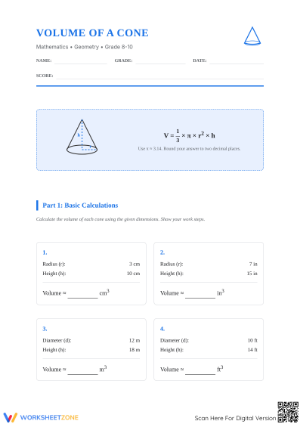
Worksheet publishers commonly tier cone volume practice into easy, moderate, and difficult levels. Easy sets use whole-number radius and height values with straightforward substitution. Moderate sets introduce decimals or fractions and sometimes give diameter instead of radius, forcing students to divide before they substitute. Difficult sets flip the problem around, giving the volume and one dimension and asking students to solve for the missing dimension, which requires isolating a variable inside a formula with three factors.
A practical sequence for a single class period or a short homework cycle looks like this:
- Start with 4-6 easy problems using whole-number radius and height to build formula fluency.
- Move to 4-6 moderate problems that mix radius and diameter, and introduce decimal dimensions.
- Finish with 2-4 missing-dimension problems where students solve for radius or height given the volume.
- Close with one or two applied word problems, such as finding how much sand fills a conical container or how much space is inside a funnel.
Common Student Errors and How Targeted Worksheets Address Them
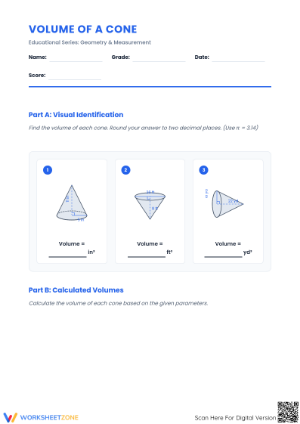
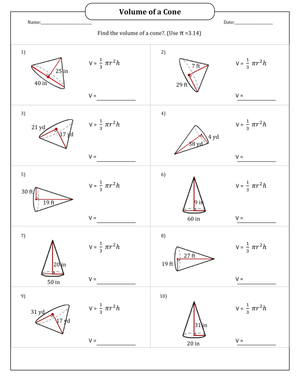
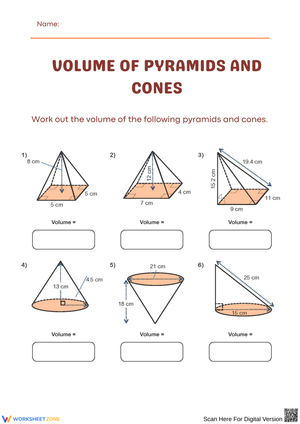
Beyond the missing 1/3 factor, two other errors show up consistently on cone volume worksheets. First, students confuse radius and diameter, especially when a word problem describes the width of a cone opening rather than stating radius directly. Second, students misidentify height in tilted or oblique-looking cone diagrrams, mistaking the slant length for the perpendicular height needed in the formula.
Worksheets that intentionally include diameter-labeled diagrams and at least one problem with a clearly marked slant height versus vertical height give you a built-in opportunity to address both errors before they surface on a test. If you notice a student consistently missing the same error type across a worksheet, that pattern is more diagnostic than a single wrong answer and worth a two-minute reteach at your small-group table.
Classroom Implementation
When you assign a volume of cones worksheet, consider having students underline or circle the radius and height values in each problem before they substitute into the formula. This small step slows down the process just enough to prevent radius-diameter mix-ups and gives you a visual way to check their work at a glance while circulating the room.
For homework, pair an easy-tier worksheet with one moderate problem rather than assigning a full mixed-difficulty set. Students are more likely to complete and understand a shorter, appropriately leveled assignment than to disengage from a worksheet that jumps too quickly into missing-dimension problems. Save the harder tiers for guided classwork where you can support students through the algebraic step of isolating a variable.
Frequently Asked Questions
1. What grade level typically covers volume of cones?
Volume of cones is typically covered in 8th grade math under CCSS 8.G.C.9, which groups cone, cylinder, and sphere volume together as a single standard.
2. What is the formula for volume of a cone and how should teachers introduce it?
The formula is V = 1/3 times pi times r squared times h. Many teachers introduce it by comparing it directly to cylinder volume, showing that a cone holds one-third the volume of a cylinder with matching radius and height.
3. How can teachers differentiate volume of cones practice for mixed-ability classes?
Use tiered worksheets that move from whole-number substitution problems, to decimal and diameter-based problems, to missing-dimension problems, and assign the tier that matches each student or group's current fluency level.
4. What are common student mistakes when calculating cone volume?
The most frequent mistakes are forgetting to multiply by 1/3, confusing radius with diameter, and using slant height instead of perpendicular height in the formula.
5. How do volume of cones worksheets connect to cylinder and sphere volume instruction?
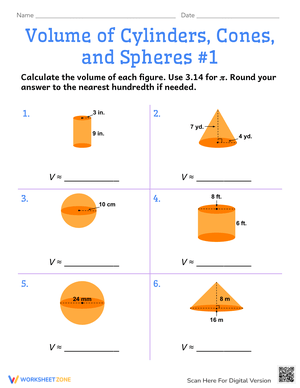
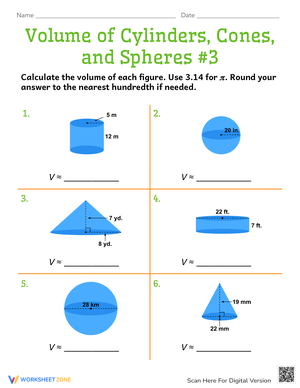
Because all three shapes fall under CCSS 8.G.C.9, cone worksheets are often followed by mixed practice sets that require students to select the correct formula for cones, cylinders, and spheres based on the shape shown rather than the order problems appear in.













 Interactive Worksheet Maker
 Quiz Maker
 Word Search Maker
 Crossword Puzzle Maker
 Word Scramble Generator
 Sentence Scramble Generator
 Handwriting Worksheet Generator
 Name Tracing Generator
 Fill In The Blank Generator