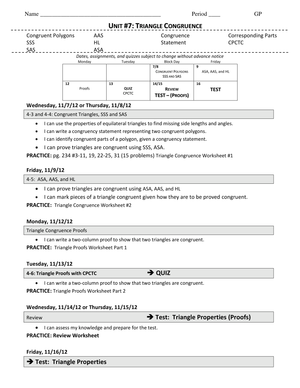
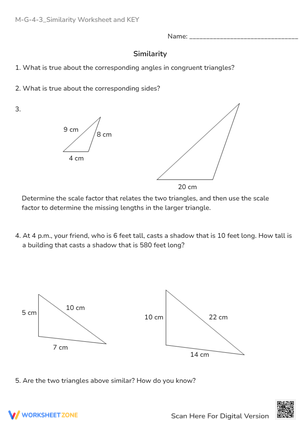
Triangle congruence proofs are often the first place geometry students meet formal, multi-step reasoning, and the first place many of them stall. A well-sequenced worksheet set turns that jump into manageable steps, moving learners from marking congruent parts on a diagram to writing complete two-column proofs. Here is how to choose and stage triangle congruence proofs worksheets for your grades 9-10 classroom.
Why Triangle Congruence Proofs Trip Up Students
The math itself is rarely the problem. Most students can spot two triangles that look identical. What breaks down is the reasoning chain: stating a claim, backing each statement with a valid reason, and ending at the exact conclusion the prompt asks for. A proof is a small argument, and students who have spent years computing single answers suddenly have to justify every line. Worksheets that isolate one skill at a time—identifying corresponding parts, then choosing a criterion, then ordering statements—let students build that argument-writing muscle without carrying the full cognitive load at once.
The Five Congruence Criteria Your Worksheets Should Cover
Strong practice sets give students repeated exposure to all five standard criteria taught in US geometry, so they learn to select the right tool rather than default to one. Look for worksheets that mix these cases:
- SSS (Side-Side-Side): all three pairs of sides are congruent.
- SAS (Side-Angle-Side): two sides and the included angle are congruent.
- ASA (Angle-Side-Angle): two angles and the included side are congruent.
- AAS (Angle-Angle-Side): two angles and a non-included side are congruent.
- HL (Hypotenuse-Leg): for right triangles only, the hypotenuse and one leg are congruent.
The best sets deliberately vary which criterion applies from problem to problem. When every item on a page is an SAS proof, students stop reasoning and start pattern-matching. Interleaving criteria forces the decision that matters most in geometry: which theorem justifies congruence for this figure.
Scaffolding From Marked Diagrams to Full Two-Column Proofs
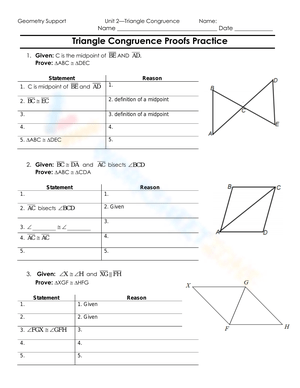
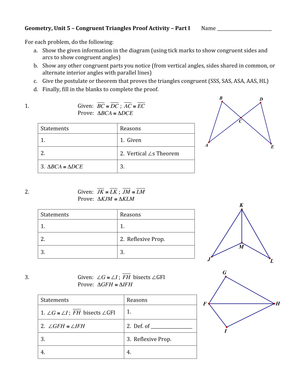
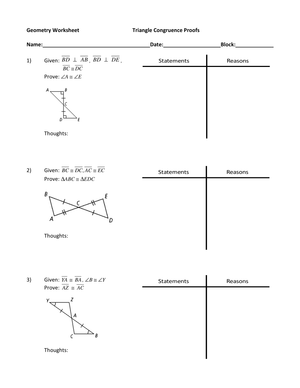
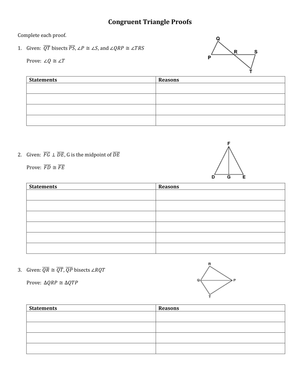
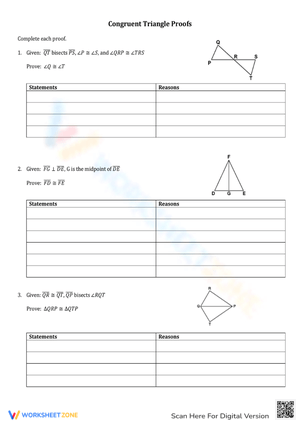
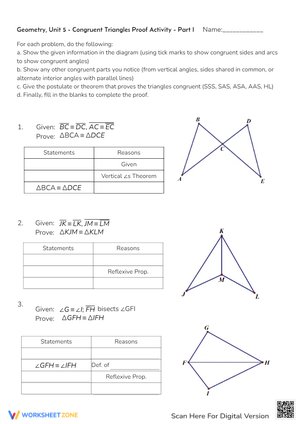
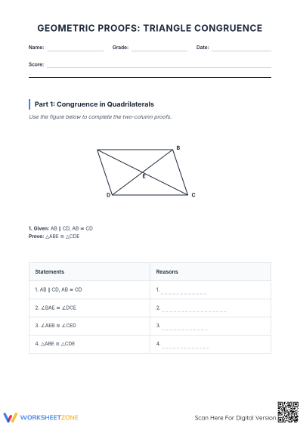
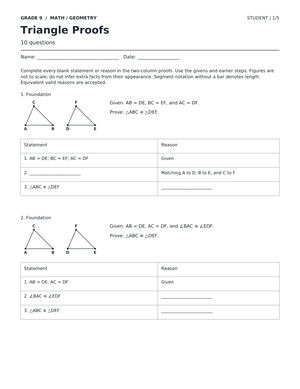
Proof writing is a progression, and your worksheets should reflect that. A reliable sequence starts with tasks where students only mark given information and shared parts on a diagram, then identify the criterion. The next tier offers fill-in-the-blank two-column proofs, where reasons are provided and students supply statements, or vice versa. The final tier presents open-ended proofs with only the given and the prove statement. This staging lets a single class work at three difficulty levels from the same figure, which is a practical way to differentiate without writing three separate lessons.
Two-column proofs remain the most commonly assigned format in US classrooms, but flow proofs and paragraph proofs are worth including for students who reason better visually or verbally. Offering the same problem in two formats also reveals whether a student understands the logic or has just memorized a template.
Aligning Proof Practice to Common Core Geometry
Documenting standards alignment makes proof worksheets easy to defend in lesson plans and observations. Triangle congruence practice maps directly onto the high school congruence cluster, which covers defining congruence through rigid motions, deriving the criteria, and proving triangle theorems.
According to the Common Core State Standards Initiative, standard HSG-CO.B.8 asks students to explain how the criteria for triangle congruence—ASA, SAS, and SSS—follow from the definition of congruence in terms of rigid motions. That means your proof worksheets should connect every criterion back to transformations, not treat them as memorized shortcuts students can recite but never justify.
Spotting Common Errors: SSA, AAA, and Missing Reasons
The most valuable worksheets do more than confirm correct answers; they surface predictable misconceptions. Two false criteria dominate student work: SSA (two sides and a non-included angle) and AAA (three angles). Neither guarantees congruence, yet both feel intuitive to learners who reason from appearance rather than logic. Including trap problems where a diagram tempts an SSA or AAA claim gives you a fast diagnostic before the unit test.
Here is a pattern worth watching for in student work: learners who write correct statements but leave reasons blank are usually one targeted mini-lesson away from full proficiency, while learners whose statements themselves are out of order need reteaching on the underlying logic. Sorting a stack of proof worksheets into those two piles—reasons missing versus sequence broken—turns a vague grade into a specific instructional next step, and it takes about the same time as marking each proof right or wrong.
Classroom Implementation
To get the most from triangle congruence proof worksheets, treat them as instructional tools rather than busywork. A few strategies that work well in grades 9-10 geometry:
- Color-code corresponding parts. Have students highlight matching sides and angles in the same color before writing a single line. This makes the criterion visible and cuts down on mismatched labeling.
- Pair every proof with its diagram. Students who mark givens directly on the figure write cleaner statements than those who work from text alone.
- Use guided practice first. Complete one fill-in-the-blank proof together, thinking aloud about reason selection, before releasing students to independent work.
- Run proofs as a warm-up for formative assessment. A single open-ended proof at the start of class tells you who is ready to move on and who needs small-group intervention.
- Assign parallel versions. Give struggling students the fill-in-the-blank tier and advanced students the open-ended tier of the same figure, so the whole class discusses one problem.
Used this way, a proof worksheet becomes a conversation starter about reasoning, not just a page of answers to check.
Frequently Asked Questions
1. What are the five triangle congruence criteria and when is each used?
The five criteria are SSS, SAS, ASA, AAS, and HL. Use SSS when all three side pairs match, SAS when two sides and the included angle match, ASA when two angles and the included side match, and AAS when two angles and a non-included side match. HL applies only to right triangles, using the hypotenuse and one leg.
2. How should teachers introduce two-column proofs to beginners?
Start with fill-in-the-blank proofs where most statements and reasons are already supplied, so students focus on one decision at a time. Model a complete proof aloud, emphasizing that every statement needs a reason. Gradually remove scaffolding until students write the full argument independently.
3. What common mistakes do students make with triangle congruence proofs?
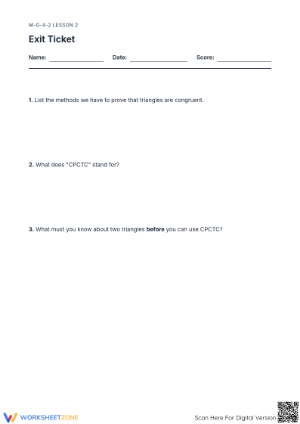
The two most frequent errors are claiming congruence from SSA or AAA, neither of which is valid. Students also leave reasons blank, list statements out of logical order, or use CPCTC before establishing that the triangles are congruent. Trap problems and reason-checking help catch these early.
4. Which geometry standards do these worksheets support?
They align with the high school congruence cluster, including HSG-CO.B.7 on defining congruence through corresponding parts, HSG-CO.B.8 on deriving ASA, SAS, and SSS from rigid motions, and HSG-CO.C.10 on proving triangle theorems such as the base angles of isosceles triangles.
5. How can teachers use these worksheets for review, intervention, or enrichment?
For review, assign mixed-criteria pages before a unit test. For intervention, use fill-in-the-blank tiers in small groups to rebuild reasoning step by step. For enrichment, give open-ended proofs or ask students to write a proof in two formats, such as two-column and flow, to deepen understanding.