What the Triangle Inequality Theorem Tests
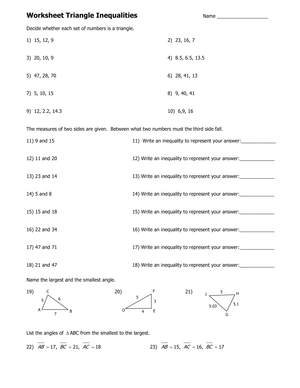
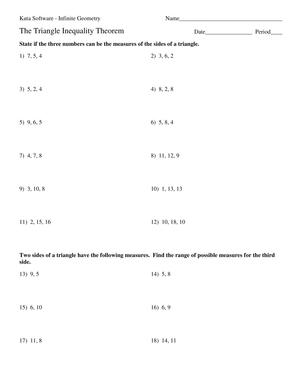
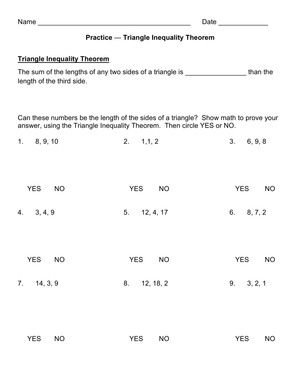
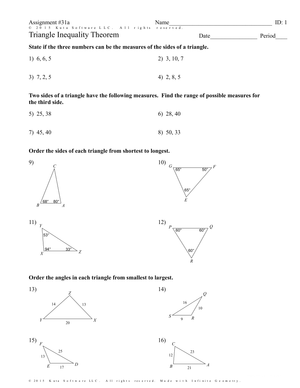
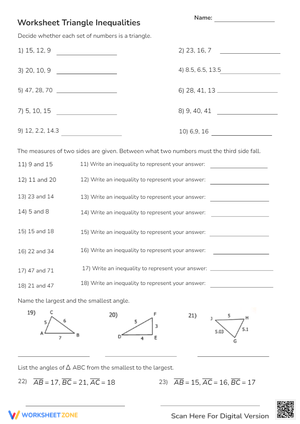
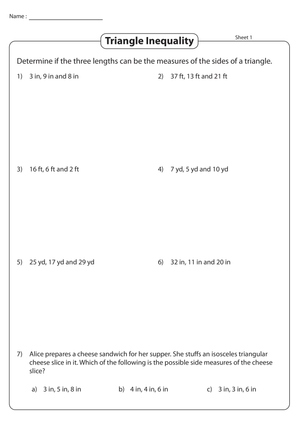
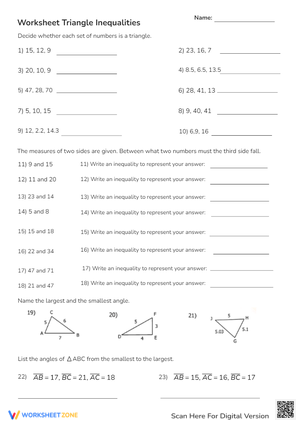
Before students can build a triangle from three side lengths, they need one rule that decides whether those measures will even close into a shape. The triangle inequality theorem states that the sum of any two side lengths of a triangle must be greater than the length of the third side. If that condition fails for even one pair, the sides can't meet and no triangle forms. These worksheets give your grade 7 and 8 students repeated practice applying that single test until it becomes automatic.
The power of the theorem is that it turns a fuzzy question, will these sides work?, into a concrete calculation. Students stop guessing and start checking. That shift matters because the concept determines whether given measures produce a unique triangle, more than one triangle, or no triangle at all, which is exactly the kind of reasoning your standards ask seventh graders to defend.
The Quick Check Your Students Can Use Every Time
Here's the rule of thumb worth writing on the board: add the two shorter side lengths and confirm the sum is greater than the longest side. If the two smaller numbers beat the biggest number, a triangle forms. If they tie or fall short, it doesn't. Students technically need to check all three pairs, but once they identify the longest side, testing the two shorter ones against it is the only comparison that can actually fail.
Teach this shortcut explicitly. When students internalize that the longest side is the one under pressure, they move through a worksheet of ten problems in a couple of minutes and spend their remaining time explaining why a set works. That explanation is where the real geometry lives.
How These Worksheets Support CCSS 7.G.A.2
The triangle inequality theorem sits in a specific place in the seventh-grade curriculum, and naming that alignment helps when you're mapping instruction to your pacing guide.
According to Common Core standard CCSS.MATH.CONTENT.7.G.A.2, seventh graders should draw and construct triangles from three given measures and judge whether those conditions produce one triangle, more than one, or none at all. The triangle inequality theorem is the single rule that settles that question for any three side lengths a student is handed, which is why it anchors this standard.
Worksheets built around this standard let students cycle through dozens of side-length sets, so the construction reasoning becomes routine rather than a one-time discovery lesson.
Classroom Implementation
Start with something students can hold. Hand out strips of paper, coffee stirrers, dry spaghetti, or straws cut to varying lengths and ask small groups to physically test which combinations snap into a triangle and which leave a gap. When a set fails, students see the two short pieces literally unable to reach across the long one, and the abstract rule suddenly has a picture attached.
Structure a lesson in three moves. Open with a five-minute warm-up where students test one or two side sets by hand. Move to a worksheet where they apply the quick check to a full column of problems. Close with a short discussion where two groups defend a tricky set, especially one where the numbers tie exactly. Use the worksheets as your intervention tool too: a small group that struggled can rerun the manipulative activity while the rest of the class works independently.
Real-World Connections for Enrichment
For students who finish early or need a challenge, connect the theorem to how things get built. Construction crews, bridge engineers, and architects rely on triangles precisely because they hold their shape under load, and the inequality rule explains why certain member lengths are impossible before anyone cuts material. Ask enrichment groups to design a simple truss and justify why their chosen lengths form valid triangles.
This framing answers the when will I use this? question honestly. Structural design is full of moments where three lengths either close or don't, and a student who can run the quick check is doing a scaled-down version of real engineering validation.
Frequently Asked Questions
1. How do you quickly determine if three side lengths can form a triangle?
Add the two shorter side lengths and compare the sum to the longest side. If the sum is greater than the longest side, the three lengths form a triangle. If the sum equals or is less than the longest side, no triangle is possible.
2. What grade level typically covers the triangle inequality theorem?
It's primarily a grade 7 topic tied to CCSS.MATH.CONTENT.7.G.A.2, though many grade 8 and high school geometry teachers revisit it during review or intervention. These worksheets work across all three settings.
3. What are effective hands-on activities for teaching this theorem?
Give students straws, coffee stirrers, dry spaghetti, or paper strips cut to different lengths and have them test which combinations form a triangle. Physically seeing short pieces fail to reach across a long one makes the rule stick far better than numbers alone.
4. How can teachers use these worksheets for intervention or review?
Use them for warm-ups, small-group reteaching, or exit tickets. Pair a struggling group with manipulatives while the class works independently, then use a single-problem exit ticket to check who's ready to move on.