


























Views
Downloads

Triangle Proofs Worksheet | Grade 9 Math Ready
Paste this activity's link or code into your existing LMS (Google Classroom, Canvas, Teams, Schoology, Moodle, etc.).
Students can open and work on the activity right away, with no student login required.
You'll still be able to track student progress and results from your teacher account.
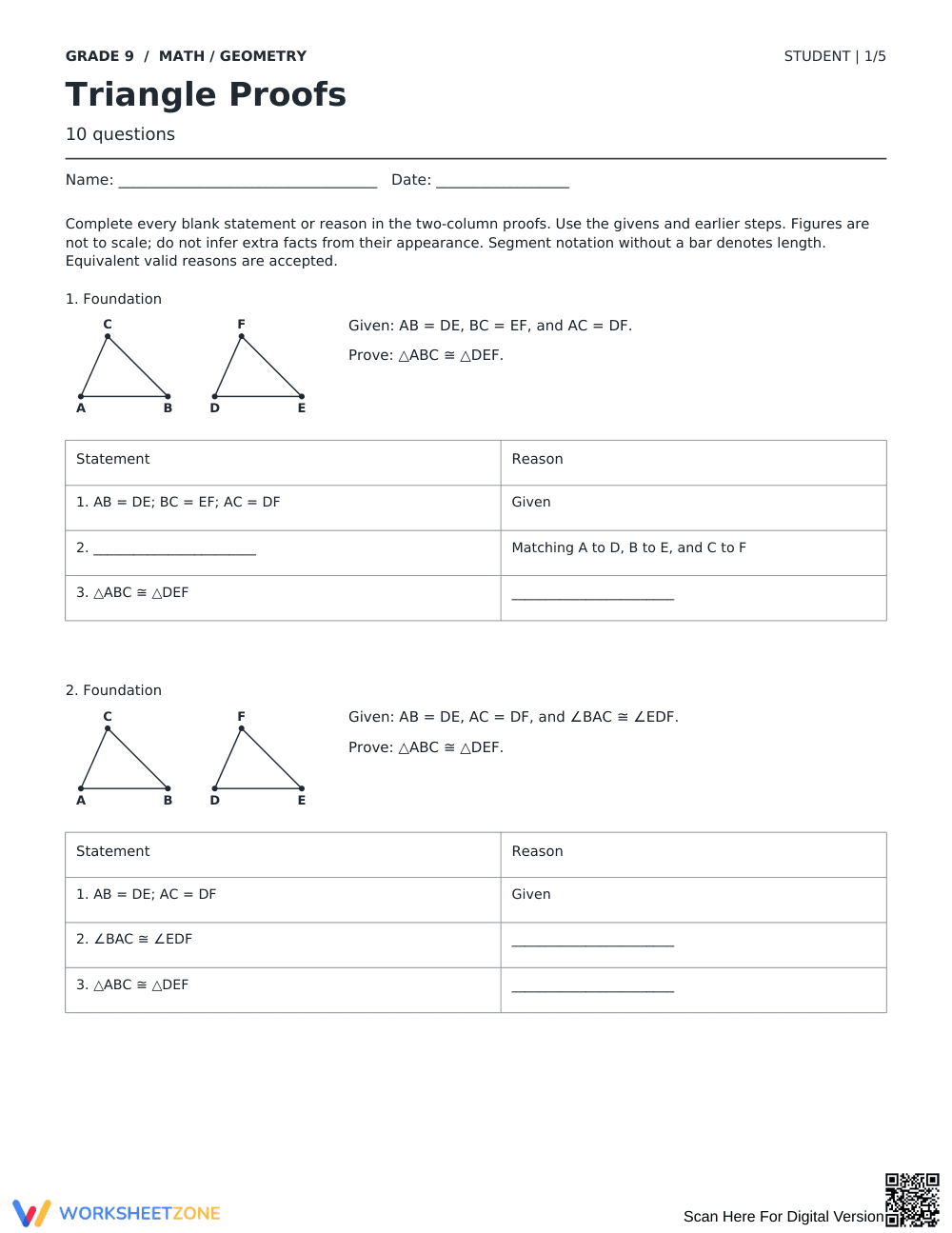
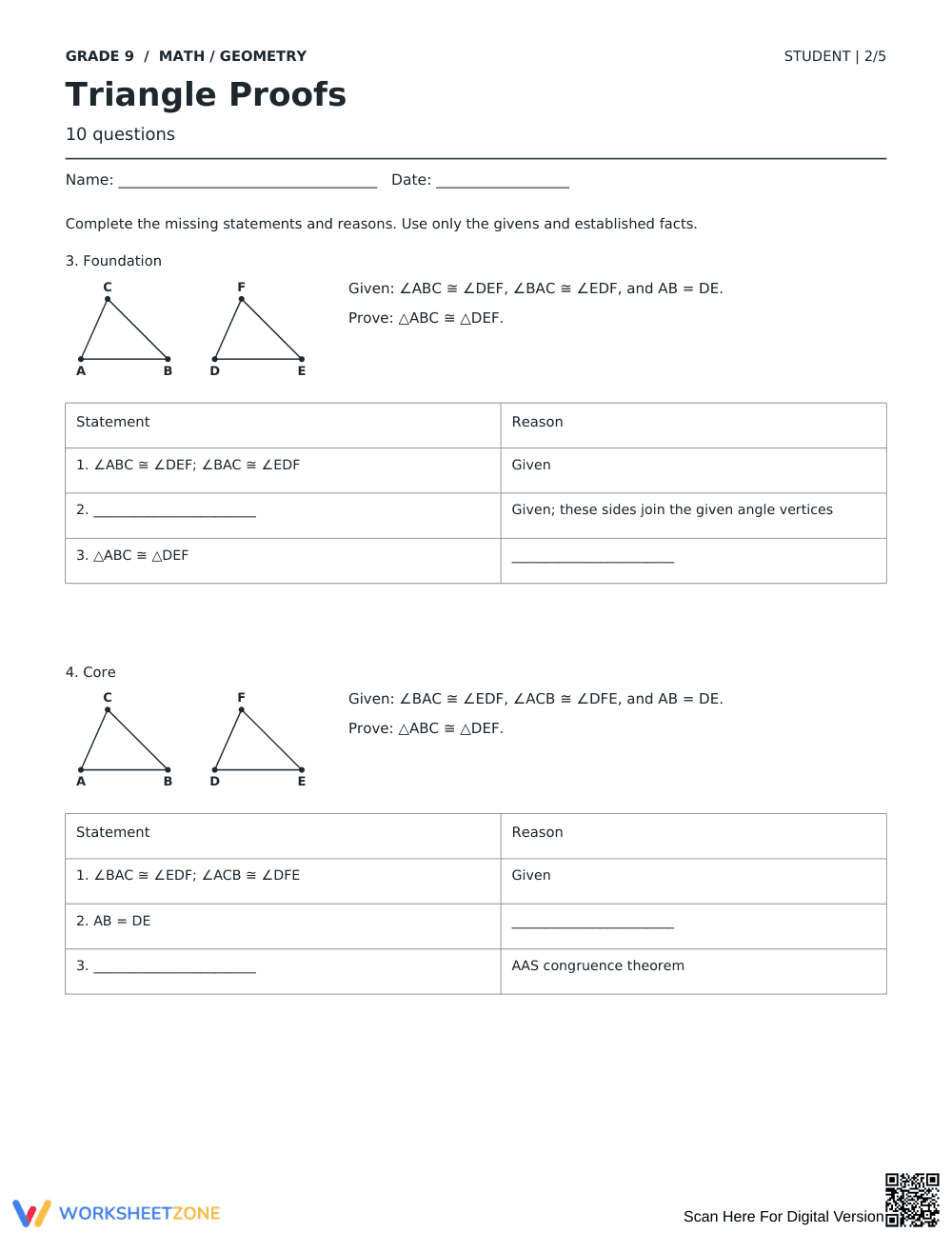
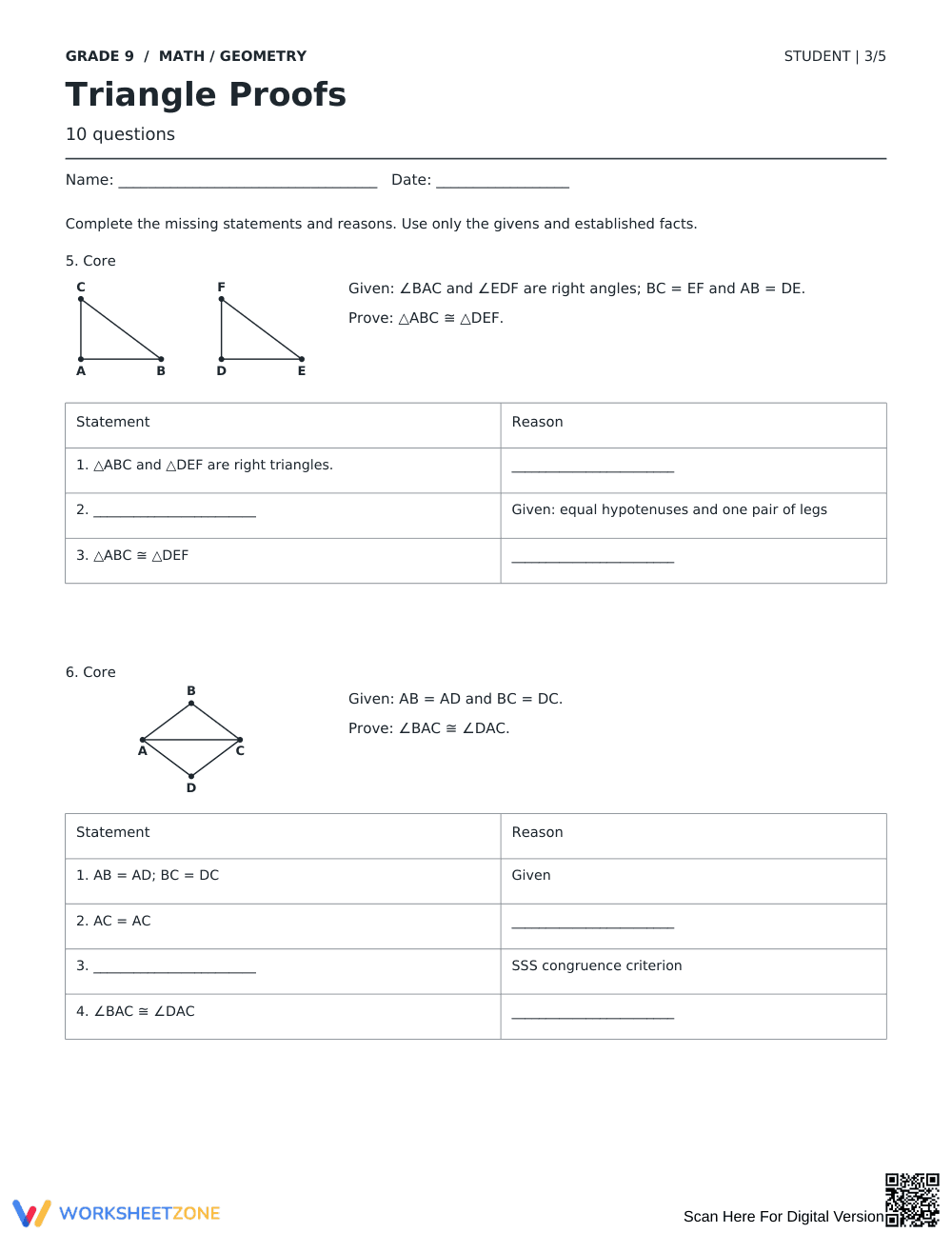
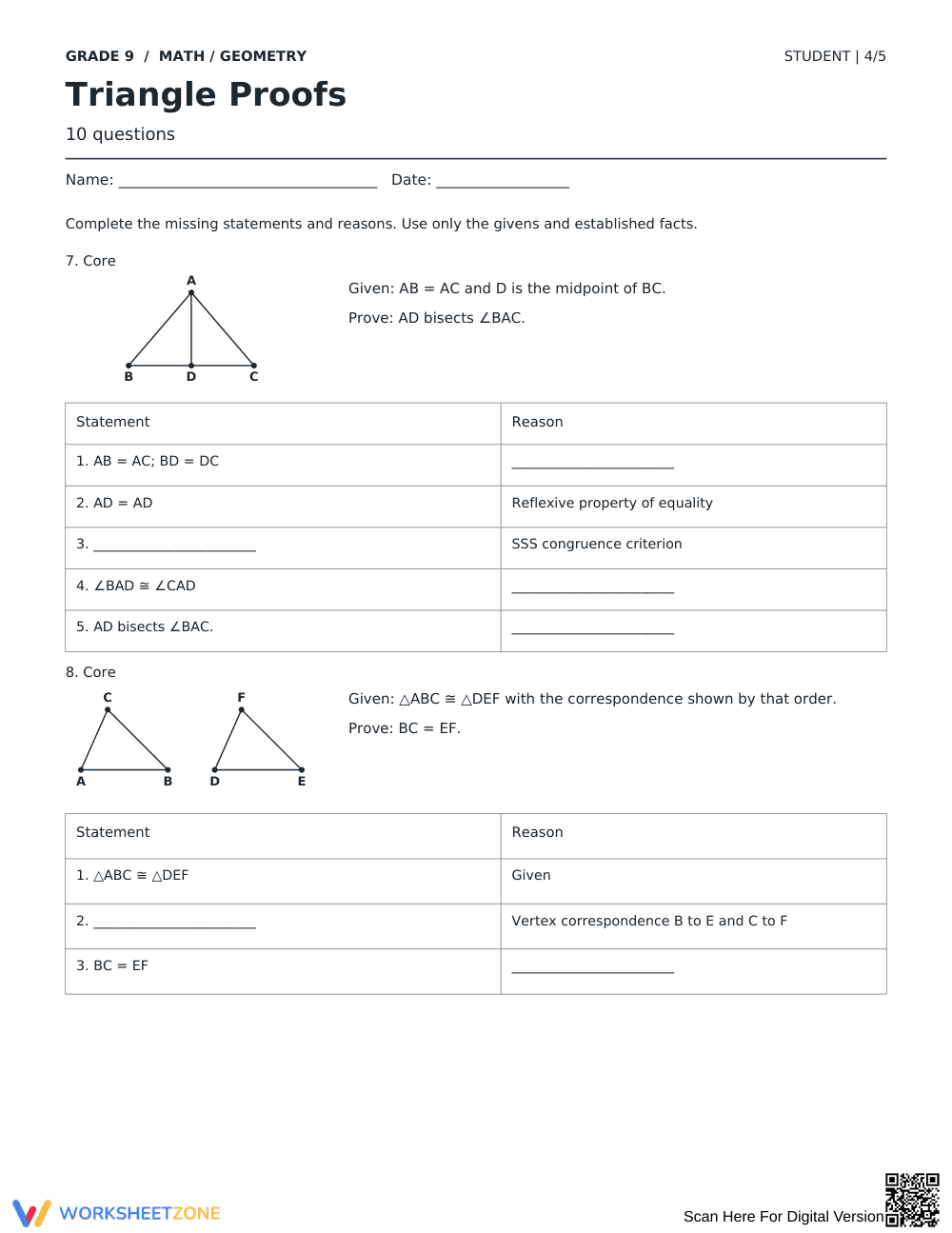
This comprehensive triangle proofs worksheet guides Grade 9 geometry students through constructing formal two-column deductive proofs. Learners analyze geometric diagrams, state given conditions, and justify congruent relationships using triangle congruence criteria including SSS, SAS, ASA, AAS, and Hypotenuse-Leg to establish geometric congruence and angle relationships with precision.
At a Glance
- Grade: 9 · Subject: Geometry
- Standard:
HSG.CO.B.8— Explain how criteria for triangle congruence follow from the definition of congruence- Skill Focus: Two-column triangle congruence proofs
- Format: 5 pages · 10 problems · Answer key included · PDF
- Best For: High school geometry deductive proof practice
- Time: 45–60 minutes
Inside, you will find 5 student pages featuring 10 structured two-column proof tasks accompanied by labeled geometric figures. Missing statement and reason blanks support stepwise reasoning across diverse configurations. A complete 2-page answer key provides step-by-step model solutions and scoring guidance with 1 point allotted per completed blank.
Skill Progression
- Guided practice (Questions 1–3): Foundation items provide isolated triangles and explicit side-angle givens, prompting students to supply single missing reasons or statements using SSS, SAS, and ASA.
- Supported practice (Questions 4–8): Core problems introduce shared sides, right triangles, midpoints, and overlapping figures requiring AAS, Hypotenuse-Leg, reflexive properties, and CPCTC deductions.
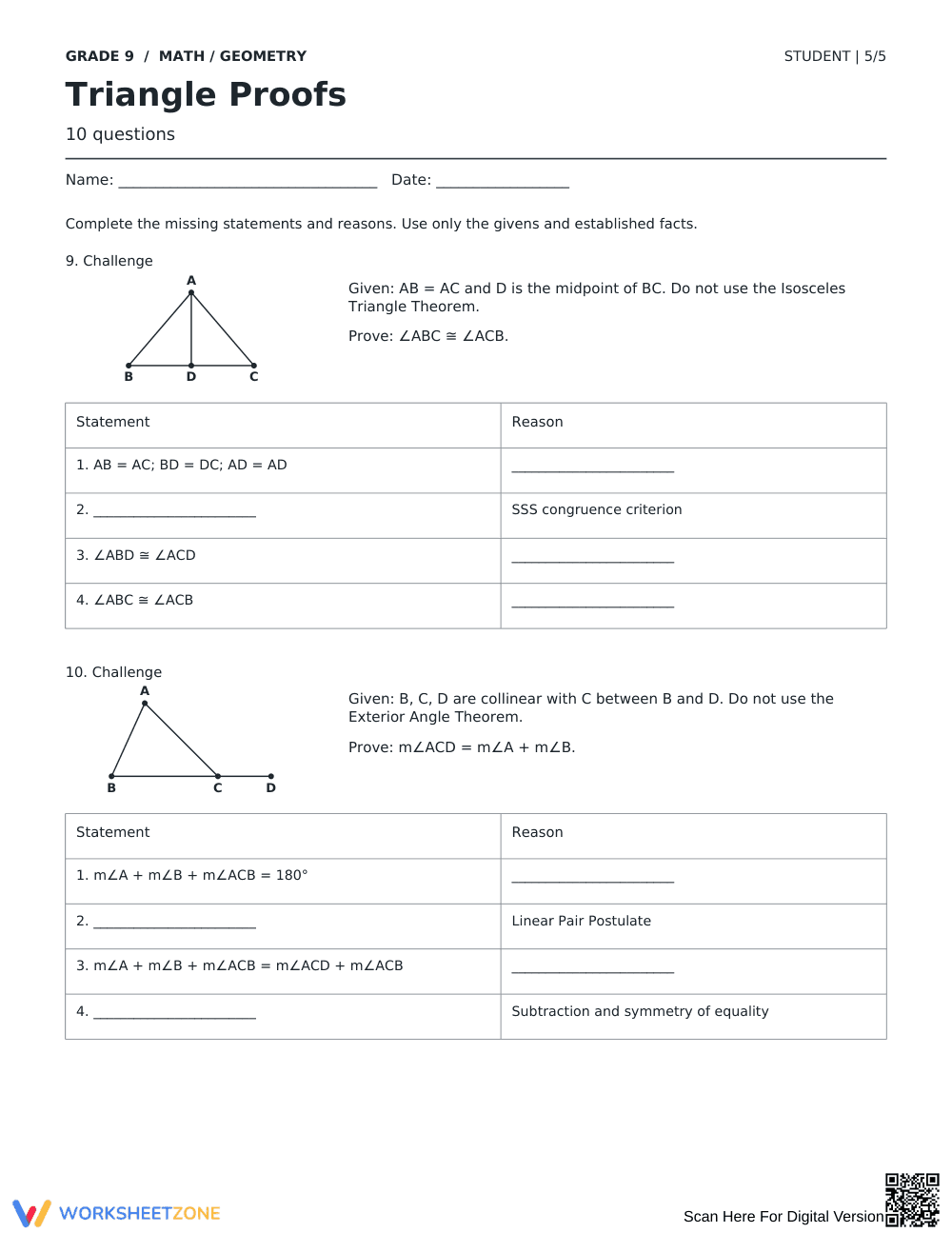
- Independent practice (Questions 9–10): Challenge items require multi-step deductive chains to prove base angles and exterior angle sums without relying on direct shortcut theorems.
This structured progression reflects the gradual-release model, moving high school learners smoothly from scaffolded frames to autonomous geometric deduction.
Standards Alignment
The primary focus aligns to `CCSS.MATH.CONTENT.HSG.CO.B.8`, which requires students to explain how the criteria for triangle congruence follow from the definition of congruence in terms of rigid motions. Supporting alignment includes `CCSS.MATH.CONTENT.HSG.CO.C.10` for proving theorems about triangles. Both standard codes can be copied directly into lesson plans, IEP goals, or district curriculum mapping tools.
How to Use It
Assign this activity directly after initial direct instruction on triangle congruence postulates. For formative assessment during classwork, observe whether students properly identify reflexive shared segments before applying congruence criteria. Alternatively, utilize the challenge tasks as a collaborative partner activity during test review. Expect students to complete all 10 two-column proofs within 45 to 60 minutes of focused class time.
Who It's For
Designed for Grade 9 geometry students developing deductive proof skills, this resource accommodates diverse learners through tiered scaffolding. Pair this worksheet naturally with an anchor chart summarizing triangle congruence criteria and CPCTC definitions to support emerging writers during formal geometric argument construction.
High school geometry students require systematic scaffolding to master abstract mathematical reasoning and two-column deductive proofs. According to research from Fisher & Frey (2014) on the gradual release of responsibility, structured instructional progressions that move from fully supported statement-reason frames to multi-step independent derivations significantly increase student problem-solving accuracy and conceptual retention. Aligned with CCSS.MATH.CONTENT.HSG.CO.B.8, this resource targets triangle congruence criteria by systematically guiding learners through identifying given conditions, recognizing reflexive properties, and applying SSS, SAS, ASA, AAS, and HL postulates. By practicing CPCTC applications and auxiliary angle theorems across 10 sequential proof tasks, students build the logical discipline needed to verify geometric relationships independently. This targeted practice equips high school learners to transition from intuitive diagram observation to rigorous mathematical argumentation and formal proof writing.


