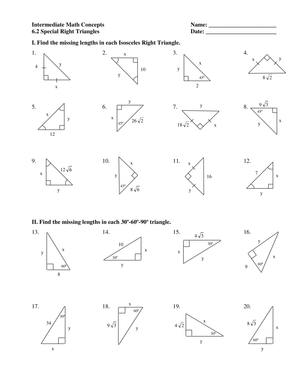
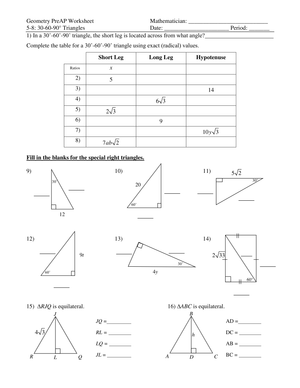
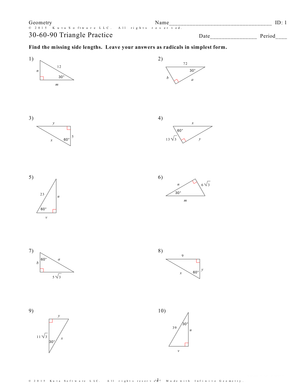
If a student can find the missing legs of a right triangle without reaching for a calculator, that skill usually traces back to solid practice with special right triangles. 30-60-90 triangle worksheets give geometry teachers a direct way to build that fluency. Students who can quickly apply the x, x root3, 2x ratio are better prepared for right triangle trigonometry, the unit circle, and precalculus work that assumes this pattern is automatic.
The Core Ratio Students Need to Internalize
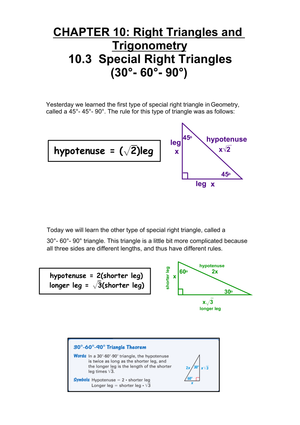
A 30-60-90 triangle has angles in a fixed 1:2:3 ratio, and its sides follow an equally fixed pattern: the side opposite the 30 degree angle is the shortest, call it x, the side opposite the 60 degree angle is x root3, and the hypotenuse opposite the 90 degree angle is 2x. Once students see this ratio holds true for every 30-60-90 triangle regardless of size, they can solve for missing sides in seconds rather than working through the Pythagorean theorem each time.
Many geometry teachers find that students retain the ratio far better when they derive it themselves before drilling problems. Bisecting an equilateral triangle down the middle creates two congruent 30-60-90 triangles, and walking students through that construction, labeling each side in terms of the original equilateral triangle's side length, gives the x root3 relationship a visual anchor instead of a memorized formula.
Sequencing Worksheet Practice Across a Geometry Unit
Special right triangles typically show up in a right triangle trigonometry unit, often paired with 45-45-90 triangles. A clear sequence for worksheet use might look like this:
- Day one: a guided worksheet built around the equilateral triangle bisection, so students derive the ratio before ever seeing a bare number problem
- Day two: mixed practice worksheets solving for one missing side given another, moving from simple whole-number setups to problems involving radicals
- Day three: word problems and diagram-only problems that require students to identify which side is given and which ratio to apply
- Day four: a short formative check mixing 30-60-90 and 45-45-90 problems to confirm students are not confusing the two ratios
Spacing practice this way keeps the ratio fresh without turning every day into repetitive drill, and it gives a teacher clear checkpoints for reteaching before moving into trigonometric ratios.
Classroom Implementation
When introducing a new worksheet set, start with a two-minute warm-up asking students to sketch a 30-60-90 triangle from memory and label the ratio. This surfaces which students already have the pattern down and which still need the equilateral triangle connection reinforced. During independent work, circulate and watch for students defaulting to the Pythagorean theorem instead of the special ratio; this is the most common sign that the ratio has not yet become automatic. A quick prompt like identify the shortest side first before writing anything else often redirects students back to the intended method.
For homework or independent review, pair a worksheet with a short answer key that shows the ratio applied step by step, not just final answers, so students can self-correct their reasoning rather than only checking numbers.
Frequently Asked Questions
1. What grade level typically covers 30-60-90 triangles?
30-60-90 triangles are most commonly taught in high school Geometry, usually within a right triangle trigonometry unit, though some pre-algebra or pre-geometry courses introduce the concept earlier as a preview.
2. How do you quickly find missing sides in a 30-60-90 triangle without a calculator?
Identify the side opposite the 30 degree angle first, since it is the shortest side, call it x. The side opposite 60 degrees is x root3, and the hypotenuse opposite the 90 degree angle is 2x. Once one side is known, the other two follow directly from that ratio.
3. How does a 30-60-90 triangle relate to an equilateral triangle?
Bisecting an equilateral triangle through one vertex down to the midpoint of the opposite side creates two congruent 30-60-90 triangles. This construction is a common way to help students derive the x root3 ratio instead of memorizing it as an isolated fact.
4. What is the best way to sequence worksheet practice for special right triangles in a unit plan?
A strong sequence starts with a guided derivation worksheet, moves into mixed numeric practice, then adds word problems and diagram-only problems, and closes with a short formative check mixing 30-60-90 and 45-45-90 problems to confirm students are not confusing the two ratios.