




























Views
Downloads

Proof Vocabulary & Theorems Worksheet | Essential Grade 9

Paste this activity's link or code into your existing LMS (Google Classroom, Canvas, Teams, Schoology, Moodle, etc.).
Students can open and work on the activity right away, with no student login required.
You'll still be able to track student progress and results from your teacher account.
This Grade 9 geometry worksheet provides focused practice with foundational proof vocabulary, equality properties, and key geometric theorems. Students identify axioms, justify statements, and evaluate logical reasoning fallacies across 20 structured problems to build essential readiness for formal geometric proofs.
At a Glance
- Grade: 9 · Subject: Geometry
- Standard:
CCSS.MATH.CONTENT.HSG-CO.C.9— Prove theorems about lines and angles using valid geometric definitions- Skill Focus: Proof vocabulary, postulates, properties, and logical justifications
- Format: 2 pages · 20 problems · Answer key included · PDF
- Best For: Geometry proof review and practice
- Time: 30–45 minutes
What's Inside
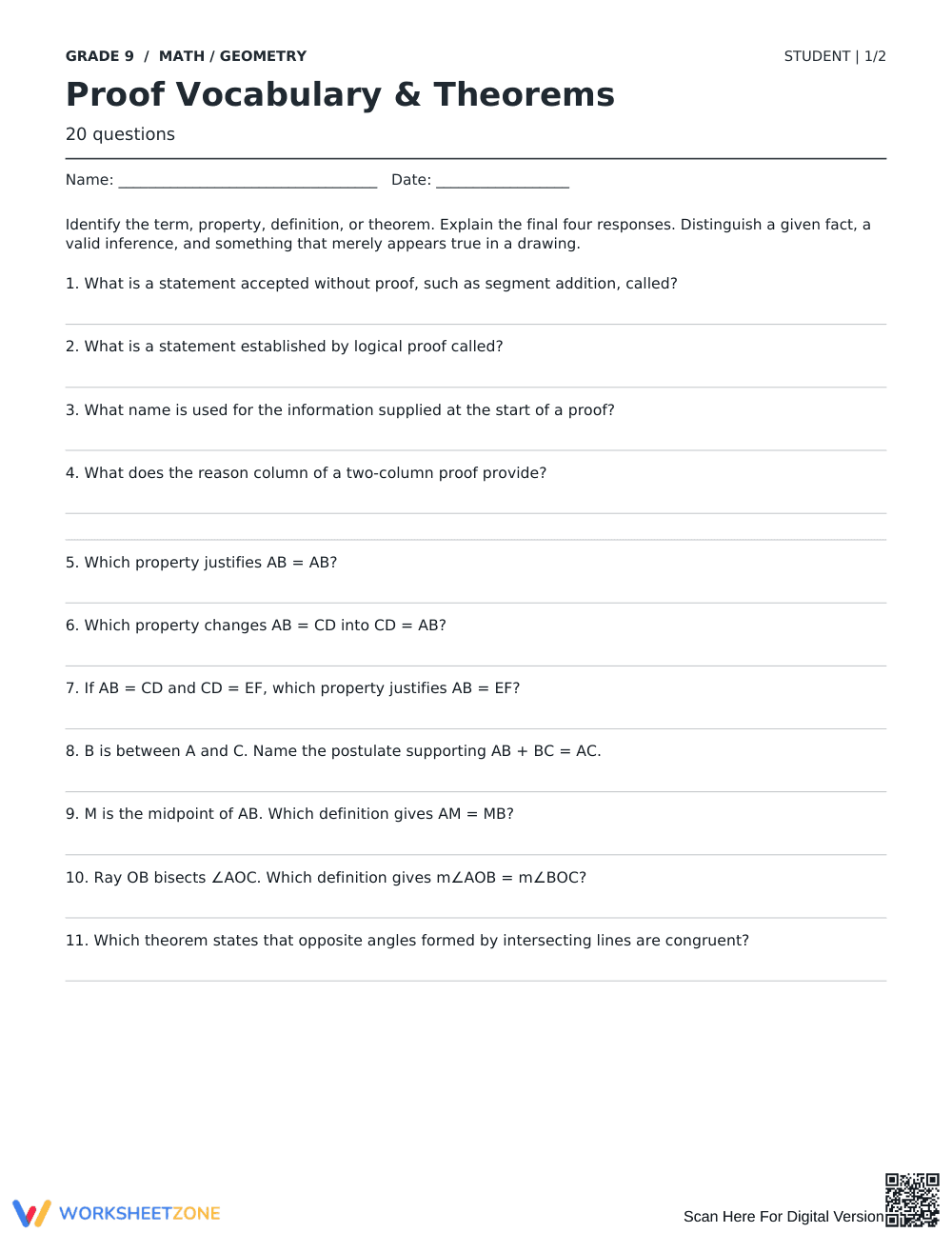
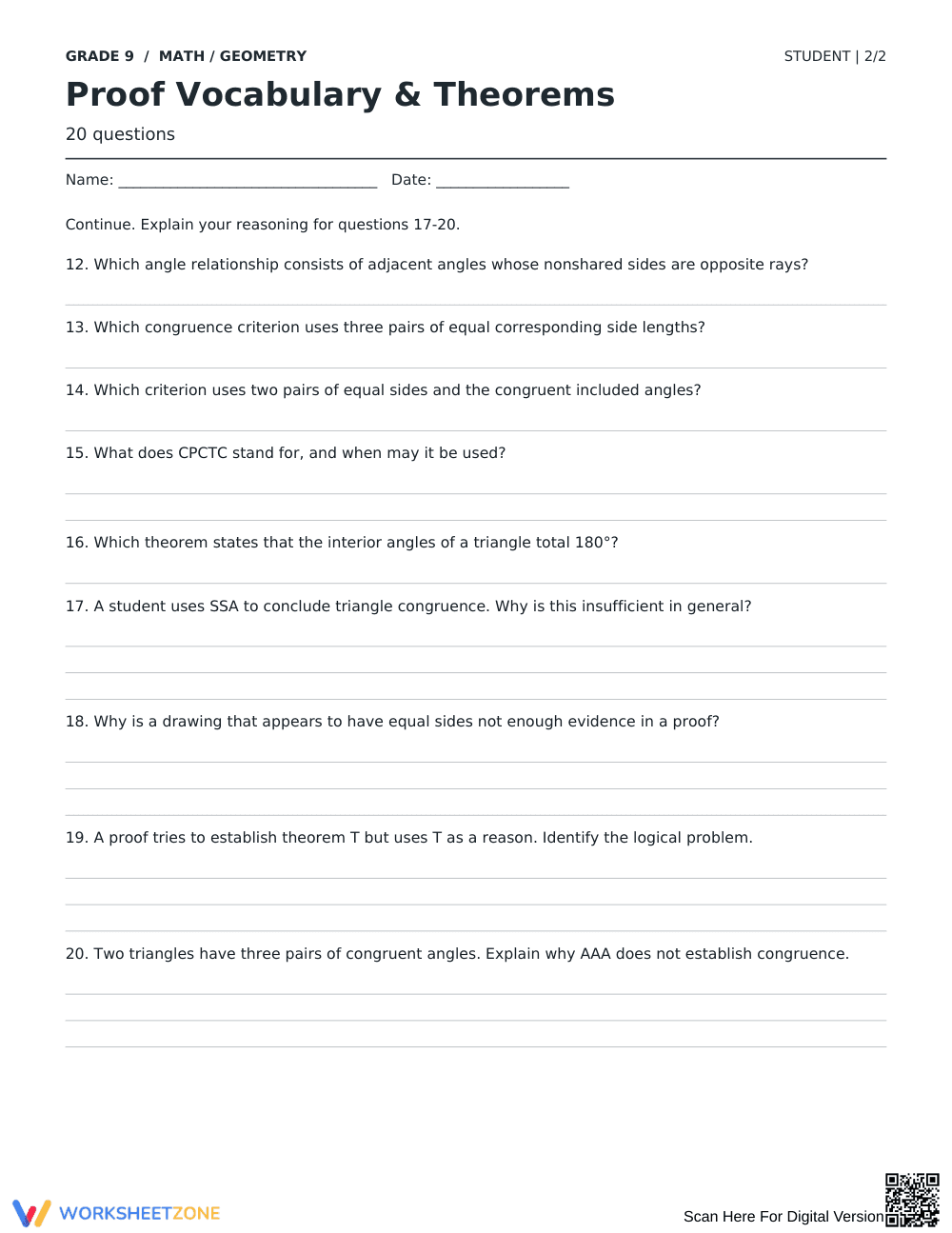
This two-page resource features 20 questions organized to build formal geometric reasoning. Page 1 targets proof terminology, equality properties (reflexive, symmetric, transitive), and definitions like midpoint and angle bisector. Page 2 covers triangle congruence criteria (SSS, SAS, CPCTC) and includes four open-ended questions targeting logical fallacies. A two-page answer key provides complete explanations and scoring notes.
Skill Progression
- Guided Practice (Questions 1–7): Students identify proof components, distinguishing postulates from theorems and recalling algebraic equality properties.
- Supported Practice (Questions 8–16): Learners match geometric conditions to formal definitions and triangle congruence theorems.
- Independent Practice (Questions 17–20): Students explain logical validity, evaluate invalid criteria like SSA, and justify why appearance is insufficient evidence.
This progression uses gradual release to move students from basic recall to analytical reasoning.
Standards Alignment
The primary standard addressed is `CCSS.MATH.CONTENT.HSG-CO.C.9`: Prove theorems about lines and angles. As a supporting standard, `CCSS.MATH.CONTENT.HSG-CO.B.7` requires applying triangle congruence criteria in deductive arguments. Both standard codes can be copied directly into lesson plans, IEP goals, or district curriculum mapping tools.
How to Use It
Assign this worksheet after direct instruction on geometric proofs or before unit assessments. During independent work, check question 18 formatively to ensure students do not rely on visual assumptions instead of deductive evidence. Have students discuss questions 17 through 20 in pairs. Expected completion time is 30 to 45 minutes.
Who It's For
This worksheet is designed for Grade 9 Geometry students learning formal deduction. Support developing learners with a theorem reference sheet for questions 1 through 12, and challenge advanced students to write two-column proofs for the reasoning prompts. Pair this printable with a proof justification anchor chart.
Mastering geometric terminology and deductive logic is essential for high school students writing formal proofs under CCSS.MATH.CONTENT.HSG-CO.C.9. This 20-question geometry worksheet reinforces proof vocabulary, equality properties, and theorem identification before challenging students to evaluate logical fallacies and explain why visual assumptions cannot replace mathematical deduction. Research by Fisher & Frey (2014) demonstrates that structured vocabulary acquisition and scaffolded conceptual analysis provide the foundational schema students need to articulate complex justifications independently. By transitioning from term recognition to open-ended analysis of congruence criteria like SSS and SAS, this two-page resource equips learners with the precise academic language required for formal geometric arguments. Educators can use this printable during geometry units to assess proof readiness, reinforce reasoning vocabulary, and eliminate common student misconceptions.


