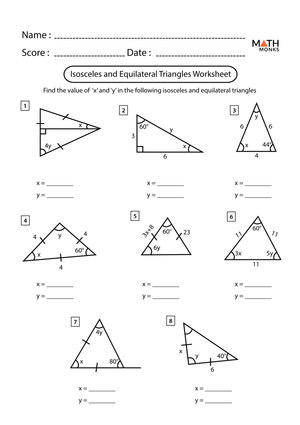
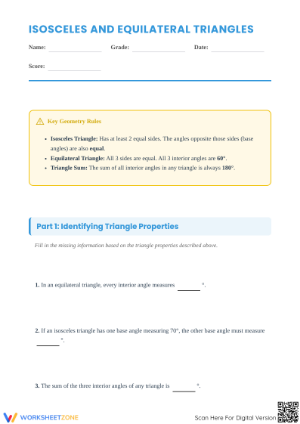
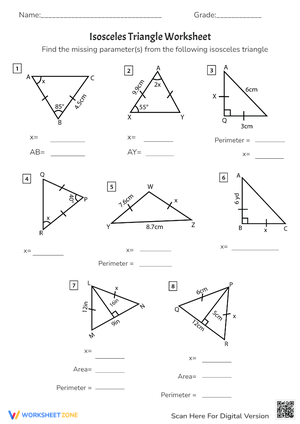
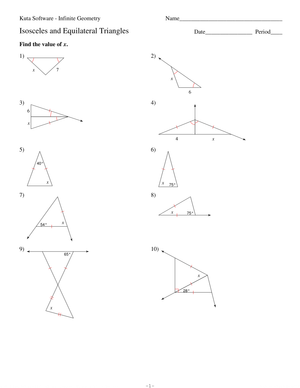
Students meet triangles early, but sorting them by side length and angle measure is where real geometric thinking starts. Isosceles and equilateral triangles worksheets give teachers a low-prep way to move students past 'that looks like a triangle' and into precise, property-based reasoning. Once students can name a triangle by counting congruent sides or matching angle measures, they are ready for the angle-sum work that middle school geometry builds on.
CCSS 4.G.A.2 requires fourth graders to classify two-dimensional figures based on properties of lines and angles, and it explicitly names equilateral, isosceles, and scalene triangles as the categories students must apply. That single standard is the anchor for most of the worksheet sets teachers search for in this grade band, which is why side-count and angle-match tasks show up so consistently across grade 4 geometry resources.
What Makes a Triangle Isosceles or Equilateral
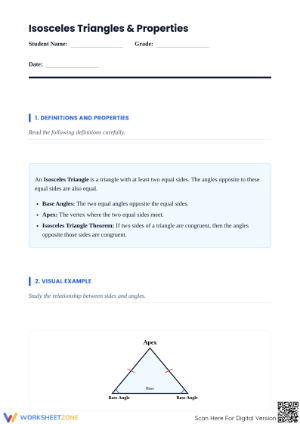
An equilateral triangle has all three sides congruent and all three interior angles equal to 60 degrees. An isosceles triangle has at least two congruent sides and two congruent base angles opposite those sides. Worksheets that ask students to measure or compare side lengths before naming the triangle tend to build stronger retention than worksheets that only ask students to look and guess.
- Equilateral: three equal sides, three 60-degree angles
- Isosceles: at least two equal sides, two equal base angles
- Scalene: no equal sides, useful as a contrast category during sorting tasks
Some state frameworks pair this side-length classification with angle-type classification in the same standard. Knowing that pairing helps a teacher choose whether a worksheet should stop at side-length sorting or also ask students to label acute, right, or obtuse angles within the same triangle set.
Sequencing a Lesson From Sorting to Measuring
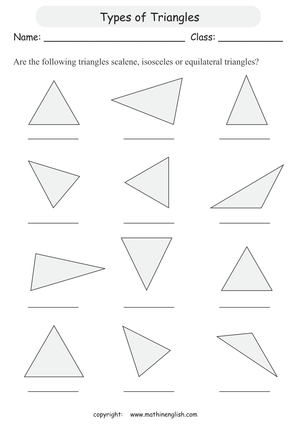
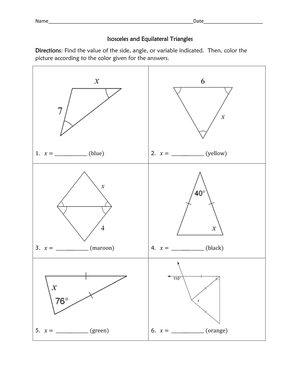
A worksheet works best inside a lesson arc rather than as a standalone drill. Start with a visual sort: students group triangle images by 'sides that look equal' without measuring. Move to a measured task where students use a ruler or protractor to confirm side length and angle measure before applying a label. Finish with an application task where students solve for a missing angle or side using the properties they just confirmed.
This progression matters most for grade 3 classes seeing the vocabulary for the first time. A worksheet that jumps straight to abstract labeling without a visual sort step often produces guessing rather than classification. For grade 4-5 review, teachers can start midway through the sequence and spend more time on the application step.
Common Misconceptions to Watch For
A few errors show up repeatedly in student work on this topic, and a well-designed worksheet can surface them early rather than letting them persist into middle school.
Students often confuse equilateral with equiangular, treating the terms as unrelated when every equilateral triangle is also equiangular. A worksheet item that asks students to state both properties for the same triangle helps make that connection explicit. Another common error is assuming that rotating or flipping a triangle changes its classification; a triangle drawn pointing downward or sideways is still isosceles or equilateral if its side lengths match the definition. Including triangles in varied orientations on a single worksheet page directly targets this misconception. A third error involves near-equal sides drawn without tick marks, where students guess isosceles based on appearance rather than the marked congruence symbols; worksheets should always include tick marks or measurements so students practice reading evidence rather than estimating by eye.
Classroom Implementation
These worksheets fit naturally into a math center rotation, a small-group intervention pull-out, or a whole-class warm-up before a geometry lesson. For a math center, laminate a sorting worksheet and pair it with cut-out triangle cards so students can physically group shapes before writing labels. For small-group intervention, use a shorter worksheet with four or five items and have students explain their reasoning aloud as they work, which surfaces misconceptions in real time rather than after grading.
As a quick formative check, a five-minute exit ticket with three triangles to classify gives a teacher enough data to decide whether the class is ready to move to angle-sum problems or needs another day on classification. Math journals also pair well with this content: after completing a worksheet, students can write one sentence defining isosceles and one defining equilateral in their own words, which reinforces vocabulary alongside the visual skill.
Frequently Asked Questions
1. What grade level typically covers isosceles and equilateral triangles?
Triangle classification by side length is commonly introduced in grade 3 and reinforced through grade 4 and 5, with CCSS 4.G.A.2 specifically requiring fourth graders to classify shapes including equilateral, isosceles, and scalene triangles.
2. How are isosceles and equilateral triangles different from scalene triangles?
An equilateral triangle has three congruent sides and three 60-degree angles. An isosceles triangle has at least two congruent sides and two congruent base angles. A scalene triangle has no congruent sides, which makes it a useful contrast category when sorting.
3. What standard covers classifying triangles by side length and angle?
CCSS 4.G.A.2 covers classifying two-dimensional figures based on properties of lines and angles at the national level. Some state frameworks, such as North Carolina's 4.MGSR.3.1, explicitly pair side-length classification with angle classification in the same standard.
4. How can teachers use these worksheets for small-group intervention or review?
Use a shorter set of four or five items and have students explain their classification reasoning aloud while working. This surfaces misconceptions, such as confusing equilateral with equiangular, immediately rather than after the worksheet is collected and graded.
5. What manipulatives or visuals pair well with a triangle classification worksheet?
Cut-out triangle cards for physical sorting, rulers or protractors for measured tasks, and triangles drawn in varied orientations all support the skill. Tick marks showing congruent sides on printed triangles help students classify based on evidence rather than visual estimation.