


























Views
Downloads

Essential HSG.CO.C.10: Triangle Congruence Worksheets - Grade 9
Paste this activity's link or code into your existing LMS (Google Classroom, Canvas, Teams, Schoology, Moodle, etc.).
Students can open and work on the activity right away, with no student login required.
You'll still be able to track student progress and results from your teacher account.
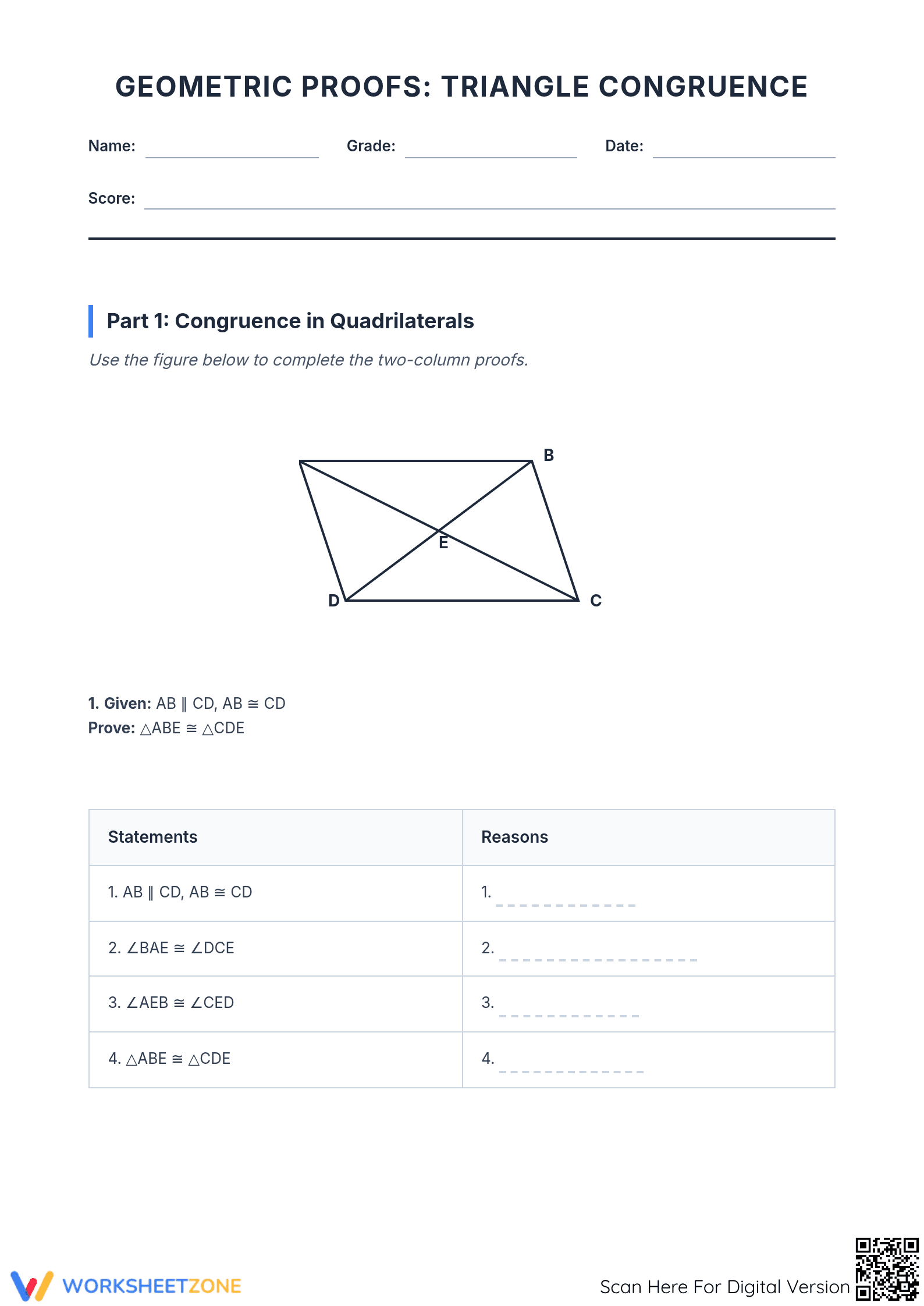
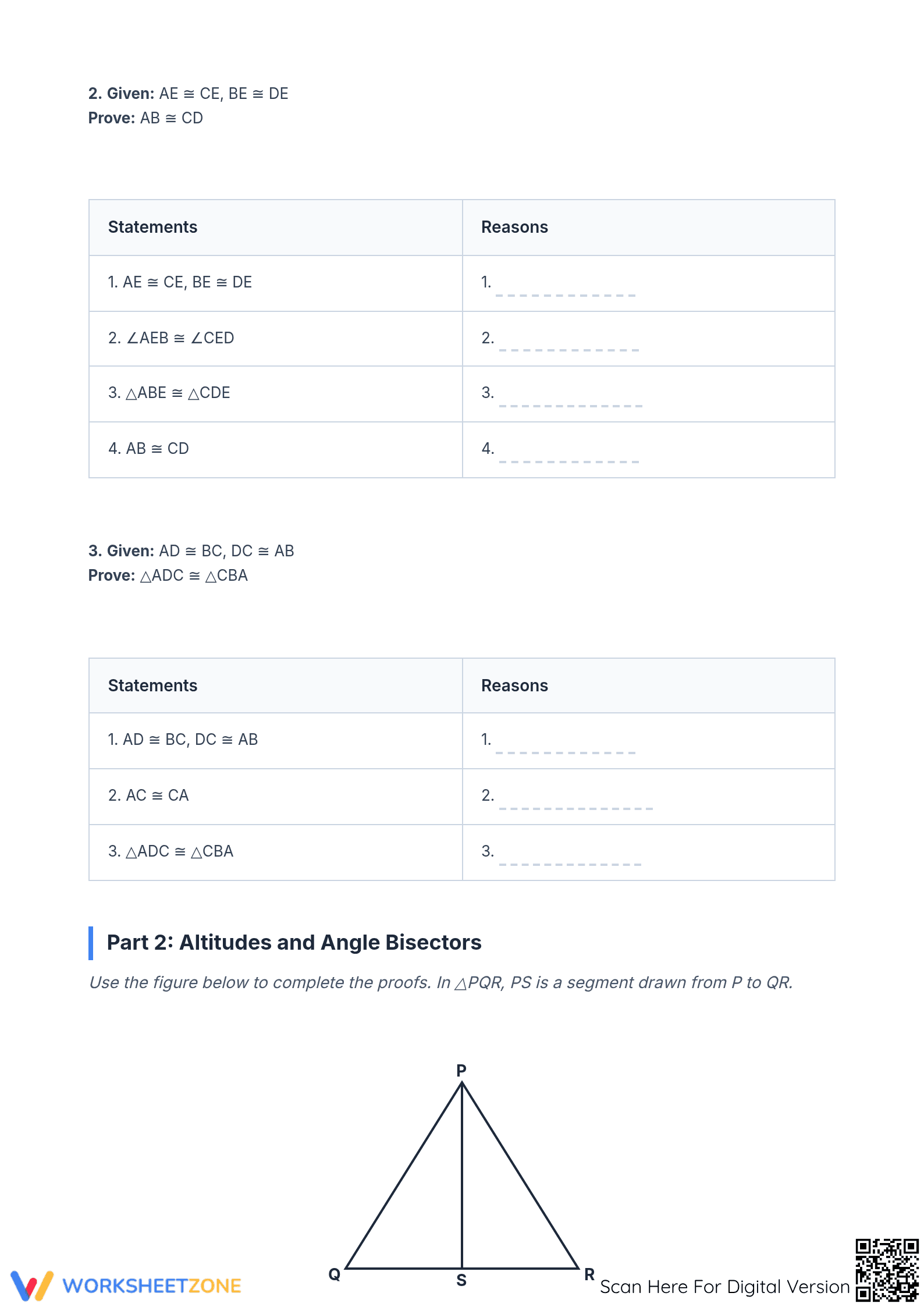
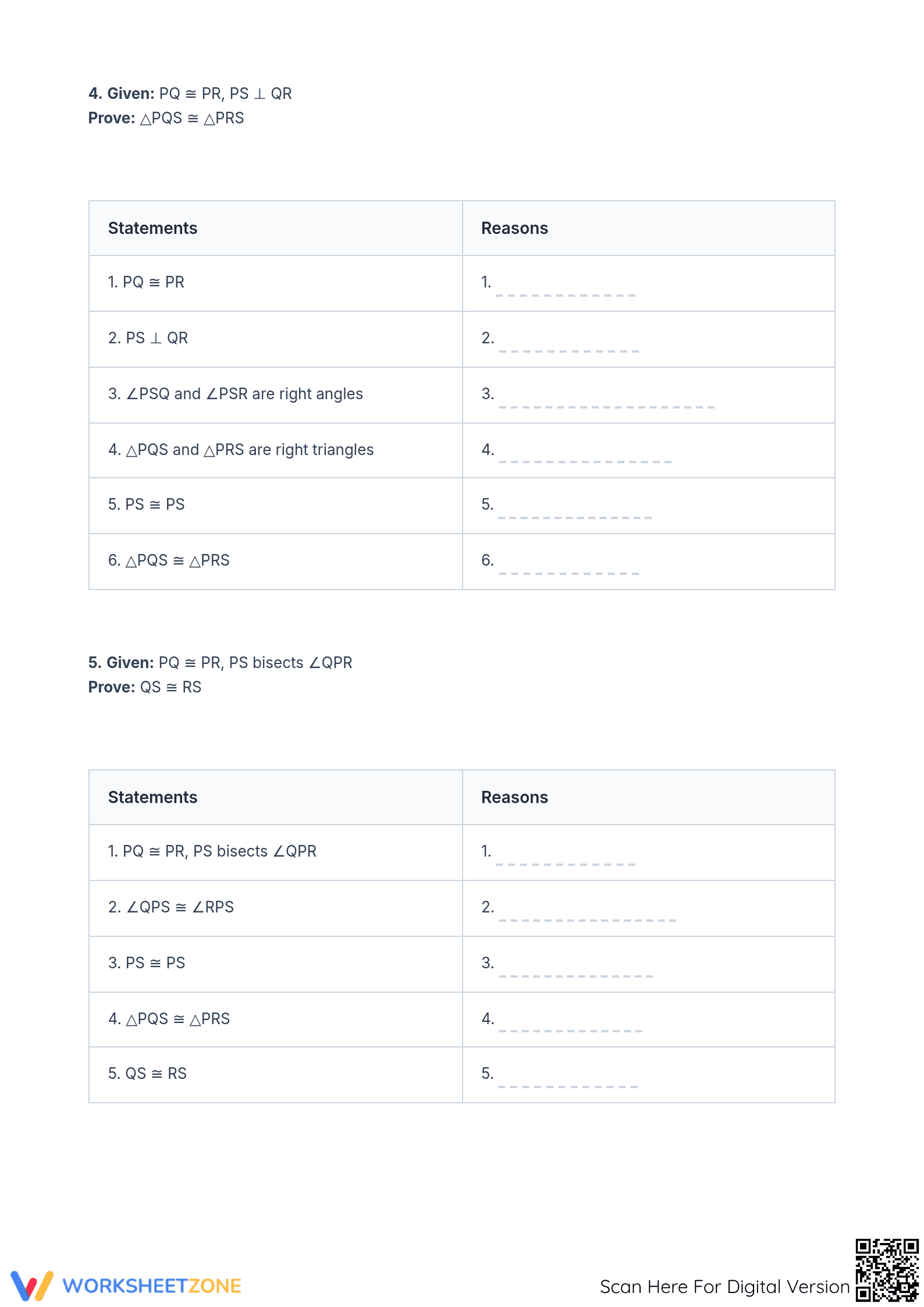
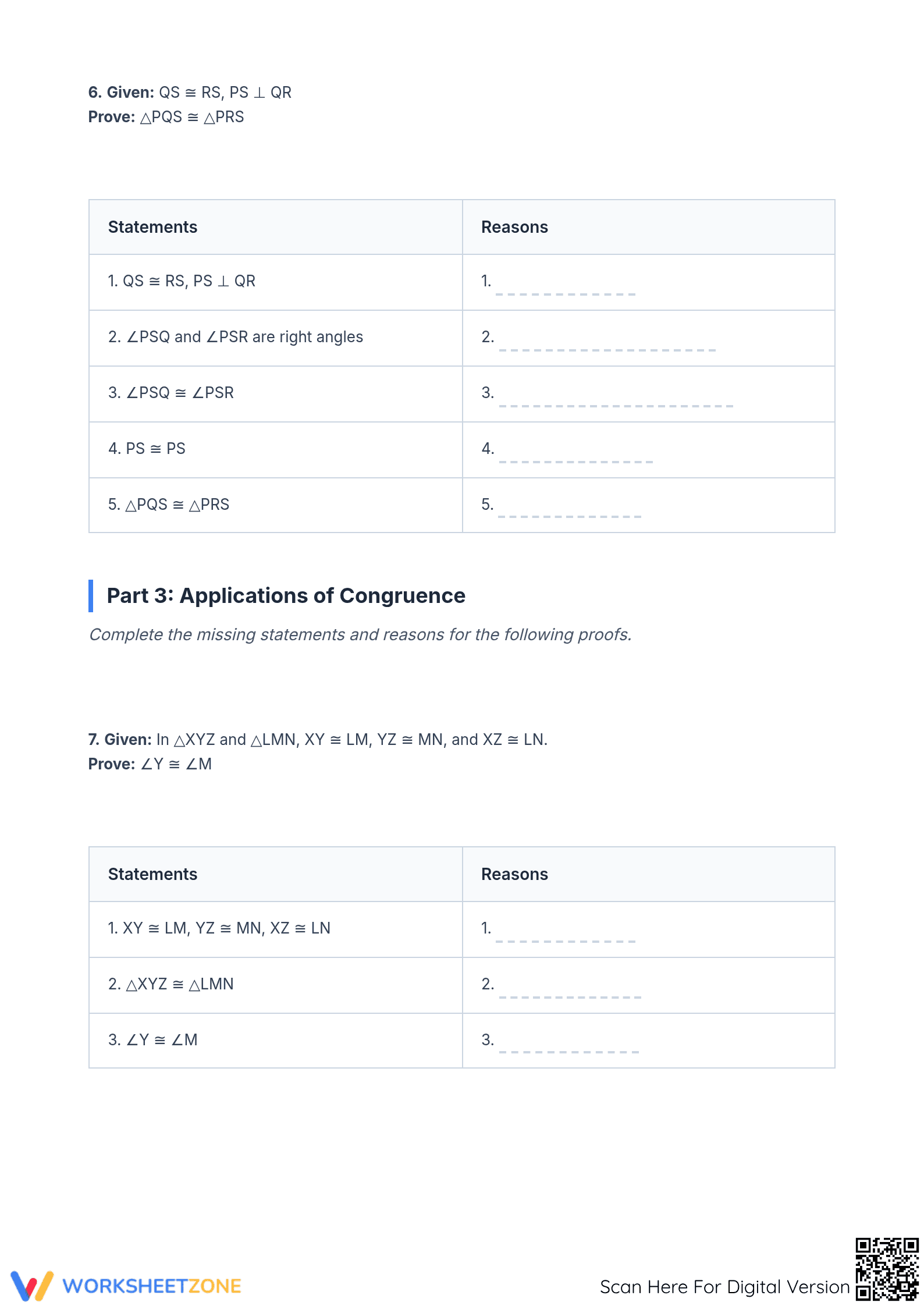
Mastering triangle congruence is a foundational requirement for high school geometry. This printable worksheet provides a structured environment for students to practice and internalize the logic of geometric proofs. By completing eight detailed two-column proofs, students develop the analytical skills necessary to identify congruence criteria and apply properties of quadrilaterals, altitudes, and angle bisectors effectively.
At a Glance
- Grade: 9 · Subject: Geometry
- Standard:
HSG.CO.C.10— Prove theorems about triangles, including congruence criteria and internal angle relationships- Skill Focus: Two-Column Geometric Proofs
- Format: 5 pages · 8 problems · Answer key included · PDF
- Best For: High school geometry mastery and assessment prep
- Time: 45–60 minutes
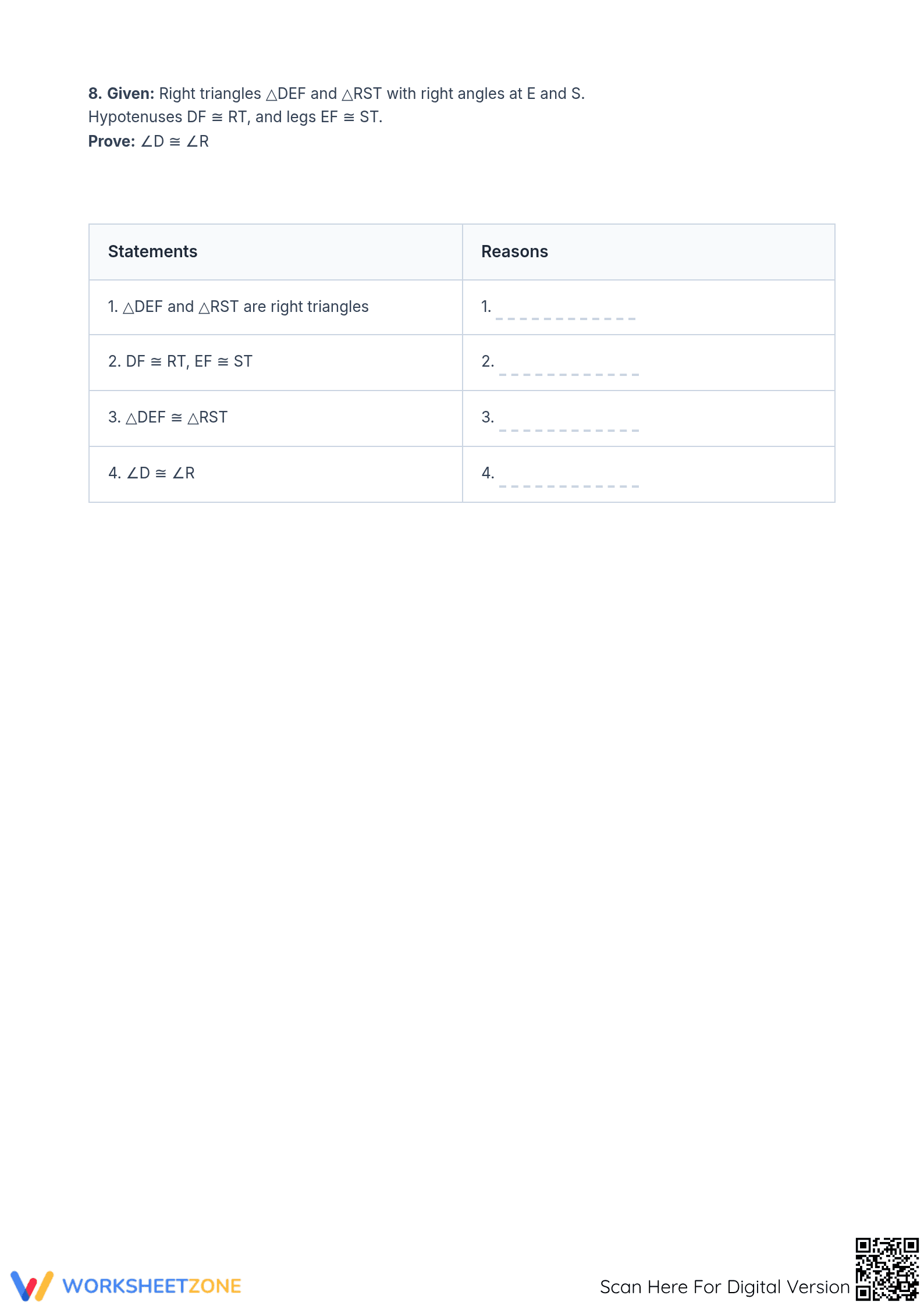
This comprehensive five-page resource features eight multi-step geometric proofs organized into three distinct parts. Part 1 focuses on congruence within quadrilaterals using parallel line properties. Part 2 introduces altitudes and angle bisectors, while Part 3 applies congruence to complex figures. Each problem provides a pre-formatted two-column table with given statements, prompting students to supply the corresponding mathematical reasons.
The worksheet elicits evidence of student mastery across three tiers of geometric reasoning. Initial problems serve as "Approaching" benchmarks, verifying students identify reflexive properties. The middle section represents "Meeting" the standard, requiring the integration of bisector definitions and altitude properties. Concluding applications serve as "Exceeding" indicators, challenging students to synthesize multiple theorems to reach a final proof, with scores easily translatable to IEP progress notes or district gradebooks.
Primary alignment is HSG.CO.C.10, requiring students to prove theorems about triangles. Students apply SAS, SSS, ASA, and AAS criteria to establish congruence. It also supports HSG.SRT.B.5 by using congruence criteria to solve problems and prove relationships. Both standard codes can be copied directly into lesson plans, IEP goals, or district curriculum mapping tools to ensure instructional coherence and ease of documentation.
This resource is most effective when used during the "guided practice" phase of a geometry unit. After direct instruction on triangle congruence theorems, assign the first three proofs to be completed in pairs, allowing for collaborative reasoning. Use the remaining problems as a formative assessment to observe how students handle the transition from simple quadrilaterals to proofs involving altitudes. Expected completion time for the full set is approximately 50 minutes.
This worksheet is specifically tailored for ninth-grade geometry students and advanced eighth-graders. It is an excellent fit for students who require scaffolded support in organizing their mathematical thoughts. The clear two-column format naturally pairs with a geometry passage or an anchor chart listing common postulates and theorems, providing the necessary visual cues for students who struggle with open-ended proof construction.
The systematic approach to proving triangle congruence using standard codes like HSG.CO.C.10 is supported by research into the cognitive load of geometric reasoning. According to a ScienceDirect TpT Analysis (2024), providing structured two-column formats significantly reduces extraneous cognitive load, allowing students to focus on the logical "why" rather than just the "what." This worksheet aligns with the National Assessment of Educational Progress (NAEP) frameworks emphasizing the importance of logical deduction and formal proof in secondary mathematics. By guiding students through eight specific tasks over five pages, the resource ensures learners are not merely memorizing steps but are instead building a robust mental model of geometric relationships. This evidence-based design promotes long-term retention of congruence criteria and supports the development of higher-order thinking skills essential for success in advanced STEM courses and standardized college readiness assessments.


