Why Property-Based Quadrilateral Worksheets Beat Shape Memorization
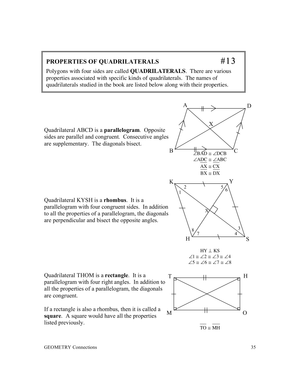
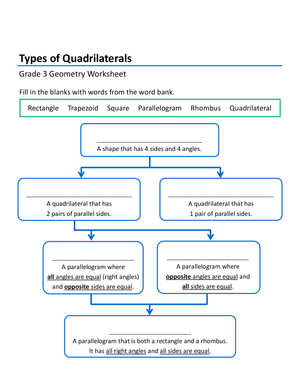
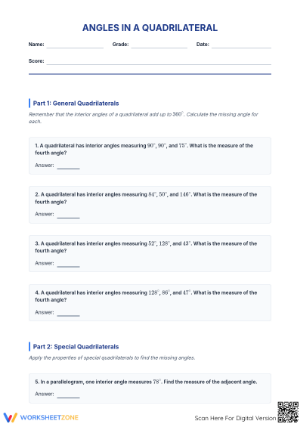
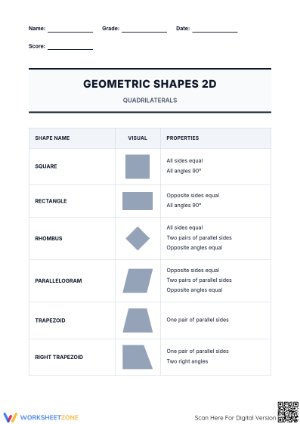
When students learn quadrilaterals by name alone, they memorize pictures instead of reasoning about attributes. A square becomes one fixed image, and the moment you rotate it or stretch it, confidence collapses. Property-based properties of quadrilaterals worksheets flip that pattern. Instead of asking only what is this shape called, they ask students to count parallel sides, check for right angles, and compare congruent sides before assigning a name. That shift matters because classification is a reasoning task, not a labeling drill. The five core categories students meet in elementary math are the parallelogram, rectangle, rhombus, square, and trapezoid, and each one is defined by a short list of properties rather than a single picture.
A strong worksheet set gives students the attribute checklist first, then lets them apply it to shapes drawn at odd angles and unusual proportions. That is where durable understanding forms, and it is exactly what teachers need for grade-level standards practice.
Aligning Worksheets to the 3.G.A.1 to 5.G.B.3 Progression
Quadrilateral instruction is not a single-grade event. It stretches across the elementary years, and your worksheets should mirror that arc. Third grade is the entry point, where students first sort shapes into categories and notice shared attributes. Fifth grade is where the reasoning becomes formal and hierarchical.
According to the Common Core State Standards Initiative, standard 5.G.B.3 states that attributes belonging to a category of two-dimensional figures also belong to all of its subcategories, so because a square is a rectangle, all squares have four right angles. That single sentence reframes an entire unit and tells you exactly which reasoning your worksheets must rehearse.
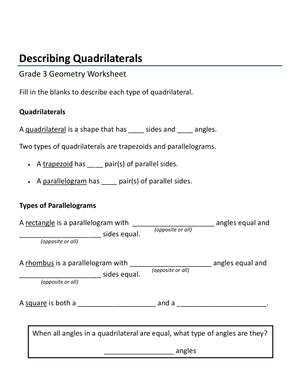
Practically, this means a 3.G.A.1 worksheet should ask students to recognize that rhombuses, rectangles, and squares are all quadrilaterals because they share the four-sided attribute. A 5.G.B.3 or 5.G.B.4 worksheet should push further, asking students to place figures in a hierarchy and justify why a subcategory inherits every property of the category above it. Choosing worksheets that name the standard keeps your practice tied to what will actually be assessed.
Fixing the "A Square Is Not a Rectangle" Misconception
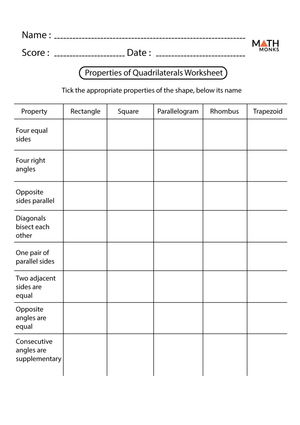
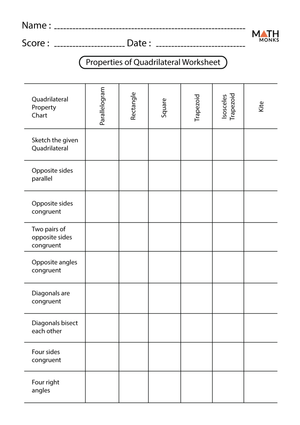
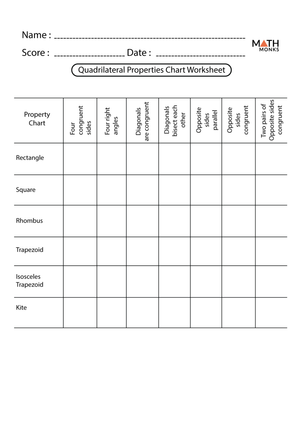
The single most common quadrilateral error in grades 3 through 5 is treating shape categories as mutually exclusive boxes. Students decide a shape is either a square or a rectangle, never both, because early instruction showed the two shapes side by side as opposites. The fix is not more definitions; it is a worksheet structure that forces overlap. Venn-diagram sorting tasks and property-matrix grids, where students check off every property a shape owns, make the inclusion visible. When a student marks that a square has four right angles and four equal sides, and then sees a rectangle checklist nested inside it, the hierarchy stops being abstract.
Sorting worksheets that ask could this shape also be called something else are far more effective than worksheets that ask for one right name. Give students shapes that legitimately belong to two or three categories and require them to list all valid names. That one design choice does more to repair the misconception than a week of vocabulary review.
Classroom Implementation
Introduce property worksheets only after students can name the attributes out loud. Start a lesson by building shapes on a geoboard or with pattern blocks, then have students describe the sides and angles before any printed page appears. Once the vocabulary is warm, hand out a property-identification worksheet as guided practice, not independent seatwork.
Use short property-check worksheets as exit tickets in the days leading up to a geometry unit test. A five-item page that asks students to identify parallel sides and right angles gives you a quick read on who is ready and who needs another small-group session. Keep an answer key visible during your own review so you can spot patterns in wrong answers, which usually cluster around the trapezoid and the rhombus.
- Open with a hands-on build so properties come from touch, not memory.
- Move to guided property worksheets with the class naming attributes together.
- Close the week with an independent classification page and an exit-ticket check.
Sequencing this way keeps the worksheet as reinforcement rather than a cold assessment, which is where most frustration comes from.
Frequently Asked Questions
1. What grade level should use properties of quadrilaterals worksheets?
Introduce basic sorting in third grade, where students first recognize shared attributes among quadrilaterals, and build toward formal hierarchical reasoning in fifth grade. Fourth grade is a strong bridge year for angle and parallel-side vocabulary.
2. How do these worksheets align with CCSS 3.G.A.1 and 5.G.B.3?
3.G.A.1 worksheets ask students to see that rectangles, rhombuses, and squares all belong to the quadrilateral category, while 5.G.B.3 and 5.G.B.4 worksheets require placing figures in a property hierarchy and justifying inherited attributes.
3. What is the best way to fix the idea that a square is not a rectangle?
Use Venn-diagram sorting and property-matrix worksheets that ask for every valid name of a shape. Requiring students to list all categories a figure belongs to makes the overlap concrete and repairs the exclusive-box thinking.
4. How can teachers use these worksheets for intervention versus general instruction?
For intervention, use fewer shapes, larger figures, a word bank, and only three categories at first. For general instruction, add all five categories and open-ended justification prompts so students reason rather than recall.
5. What manipulatives pair well with quadrilateral property worksheets?
Geoboards, pattern blocks, and index-card right-angle testers work best. Each lets students verify a property by touch before recording it, which makes independent worksheet practice far more accurate.













 Interactive Worksheet Maker
 Quiz Maker
 Word Search Maker
 Crossword Puzzle Maker
 Word Scramble Generator
 Sentence Scramble Generator
 Handwriting Worksheet Generator
 Name Tracing Generator
 Fill In The Blank Generator