


























Views
Downloads

Essential 2D Quadrilateral Properties Worksheet | Grade 7
Paste this activity's link or code into your existing LMS (Google Classroom, Canvas, Teams, Schoology, Moodle, etc.).
Students can open and work on the activity right away, with no student login required.
You'll still be able to track student progress and results from your teacher account.
This comprehensive 2D shapes worksheet focuses on the essential properties of quadrilaterals, helping students master the defining characteristics of squares, rectangles, rhombi, and more. Students will use the included visual reference guide to identify side relationships and angle measures before applying their knowledge to a series of targeted practice questions. It is a complete resource for building geometric fluency.
At a Glance
- Grade: 7 · Subject: Math / Geometry
- Standard:
CCSS.MATH.CONTENT.7.G.A.2— Describe quadrilateral properties including parallel sides and angle measures- Skill Focus: Quadrilateral Classification and Properties
- Format: 2 pages · 4 problems · Answer key included · PDF
- Best For: Introductory property review and student practice
- Time: 15–20 minutes
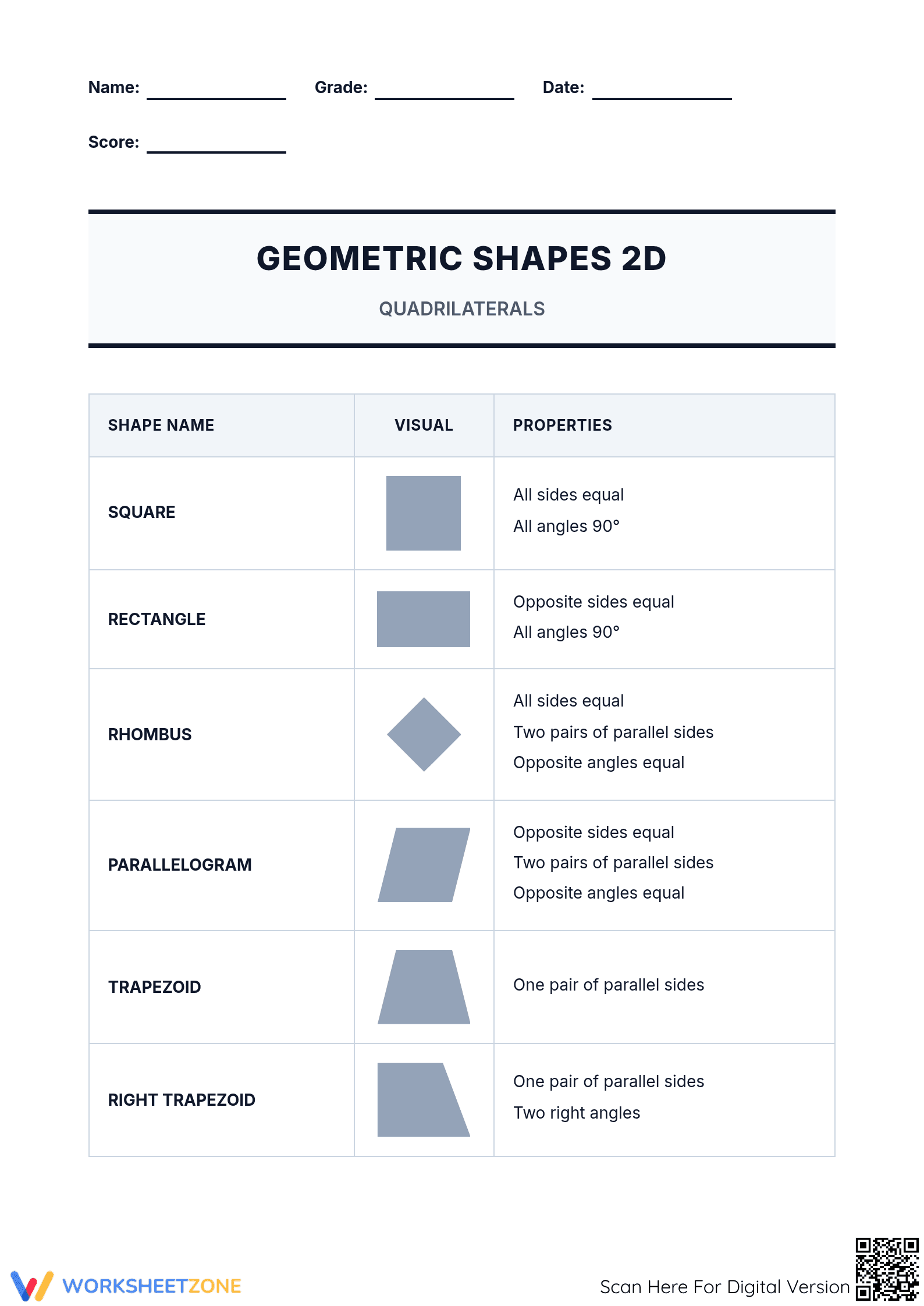
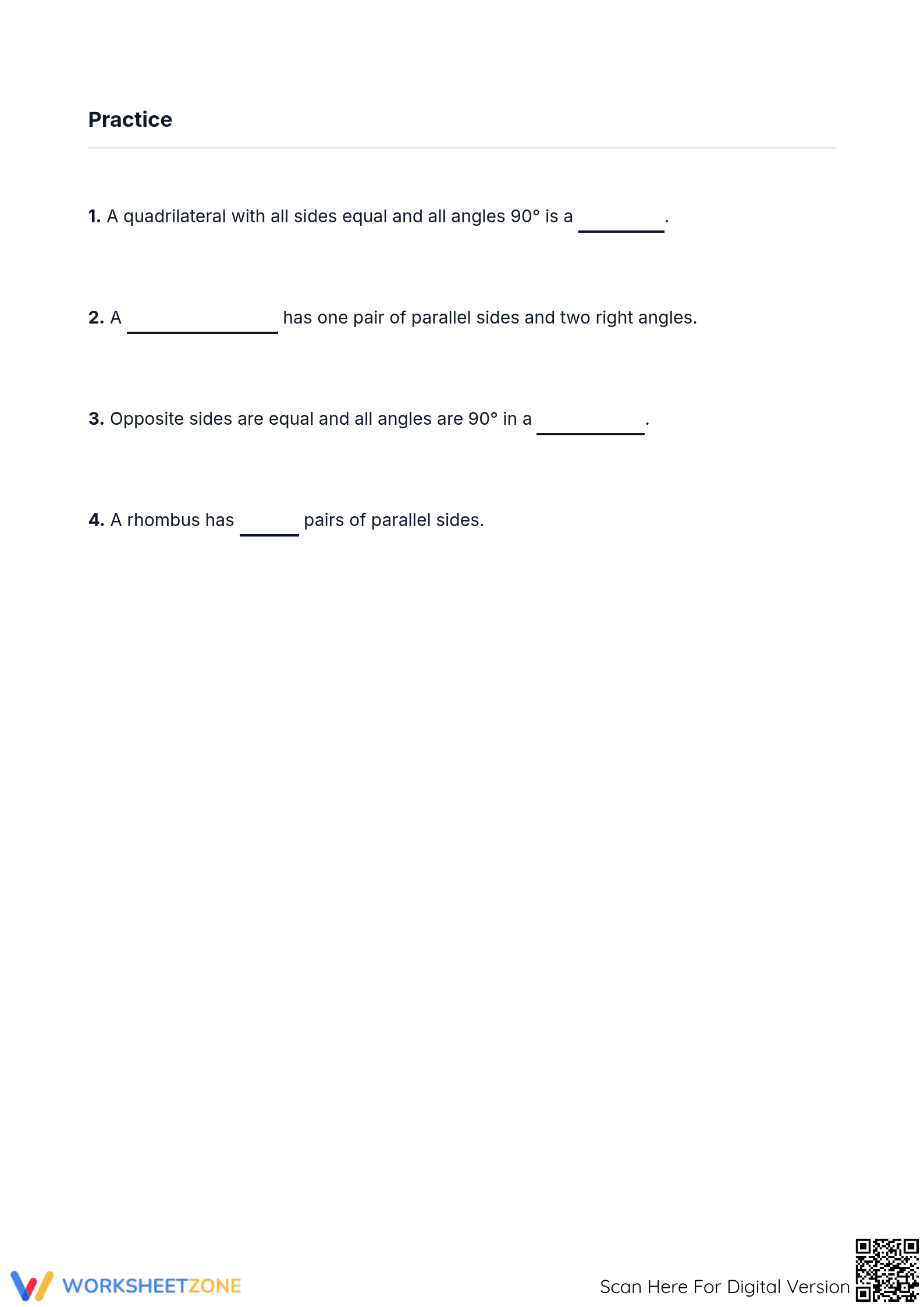
The resource features two distinct sections. Page one contains a reference table covering six key quadrilaterals, including squares and trapezoids, with names, visuals, and properties. Page two offers four fill-in-the-blank practice questions for attribute recall. A complete answer key is provided for efficient grading.
Skill Progression
- Guided Practice: Students use the visual reference chart as explicit scaffolding to identify side and angle properties.
- Supported Practice: Page two questions provide partial descriptions, requiring students to name quadrilaterals and reinforce geometric vocabulary.
- Independent Practice: Students demonstrate mastery by distinguishing between similar shapes like rhombi and parallelograms. This follows a gradual-release model to ensure long-term retention.
The primary focus of this worksheet is CCSS.MATH.CONTENT.7.G.A.2, which requires students to "draw, construct, and describe geometrical figures and describe the relationships between them." It specifically addresses the descriptive component by detailing the relationships between parallel sides and right angles. This standard code can be copied directly into lesson plans, IEP goals, or district curriculum mapping tools.
How to Use It
Use this as a guided notes supplement. Have students highlight properties in the chart during instruction. For assessment, assign the second page as an exit ticket to observe student recall of shape definitions. Expected completion time is 15-20 minutes.
Who It's For
This resource is ideal for Grade 7 students or Grade 6 review. It provides excellent support for visual learners and students requiring vocabulary scaffolding. Pair it with an anchor chart for a complete lesson.
Visual-spatial reasoning in geometry depends heavily on the transition from descriptive recognition to analytic classification. This Grade 7 resource utilizes a dual-page structure to facilitate this cognitive shift, providing a high-quality reference chart followed by targeted retrieval practice. According to Fisher & Frey (2014), the use of "scaffolded tools" like property charts allows students to offload lower-order identification tasks so they can focus on the higher-order logic required to differentiate between complex polygons such as trapezoids and rhombi. By identifying specific attributes—such as right angles and parallel side pairs—students build a robust internal schema for geometric classification. This worksheet directly supports CCSS.MATH.CONTENT.7.G.A.2 by requiring students to describe the defining relationships between 2D figures. The combination of visual cues and fill-in-the-blank synthesis ensures that the fundamental properties of quadrilaterals are encoded into long-term memory, preparing learners for more advanced coordinate geometry and proof-based reasoning in later grades.


