What Classifying Quadrilaterals Worksheets Actually Teach
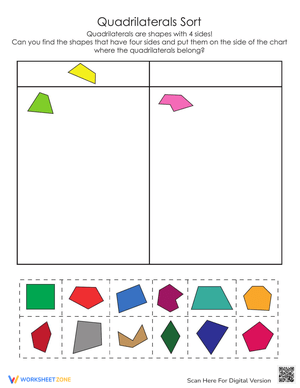
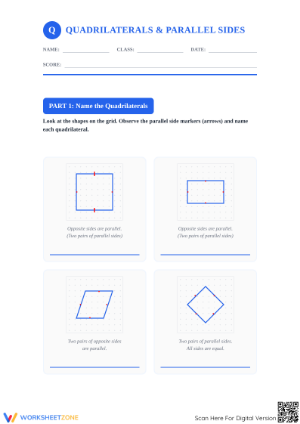
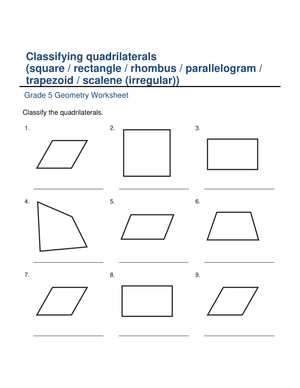
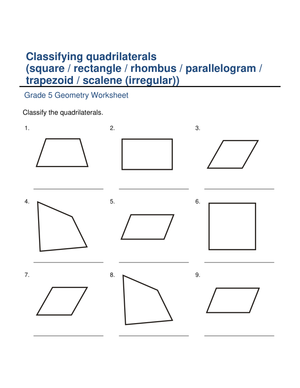
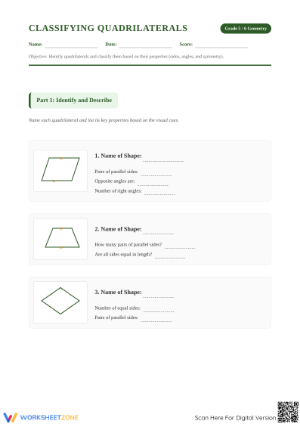
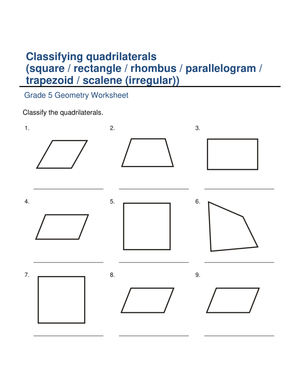
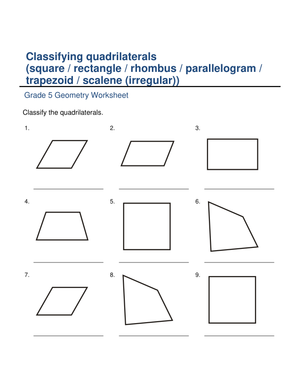
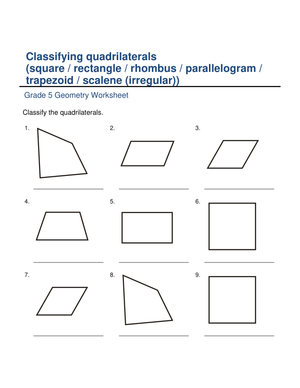
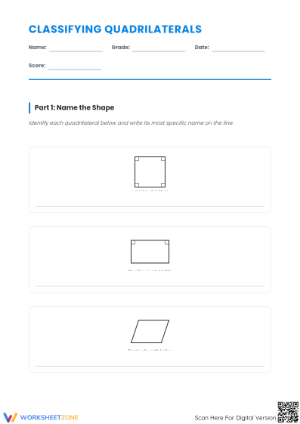
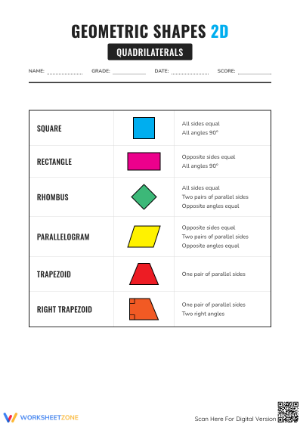
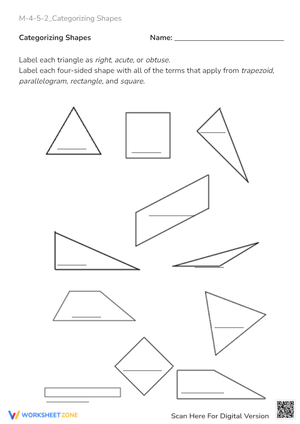
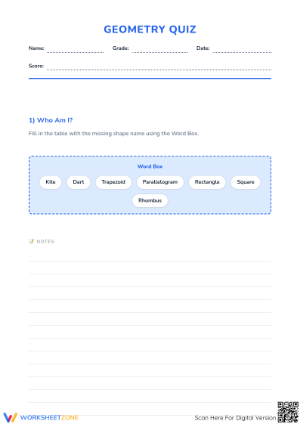
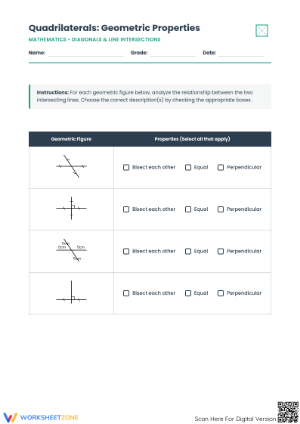
Classifying quadrilaterals worksheets move students past simply naming a shape and into reasoning about why it earns that name. A strong worksheet set asks learners to count sides, check for parallel pairs, mark right angles, and compare congruent sides before deciding whether a figure is a square, rectangle, rhombus, parallelogram, or trapezoid. That shift from recognition to attribute analysis is exactly what makes the practice worth planning around. When you hand students a page of mixed figures, you are really asking them to hold several properties in mind at once and sort by evidence rather than by appearance.
The best sheets combine three task types: identify-and-label items, sort-by-attribute grids, and short justification prompts where students explain their reasoning in a sentence. That mix keeps the work from becoming a matching exercise and pushes toward the kind of thinking geometry standards expect.
How These Worksheets Follow the CCSS Geometry Progression
Quadrilateral classification is a bridge skill. It connects the simple shape naming students do in kindergarten and first grade to the formal hierarchy reasoning that arrives in fifth grade. Worksheets should reflect that arc rather than treating every grade the same.
According to the Grade 3 geometry standards published by the Common Core State Standards Initiative, third graders must recognize rhombuses, rectangles, and squares as examples of quadrilaterals and draw examples that do not belong to any of those three subcategories. That single expectation, coded 3.G.A.1, anchors most classification work you will assign in the elementary grades.
In Grade 2, standard 2.G.A.1 asks students to recognize and draw shapes with specified attributes and to identify quadrilaterals among triangles, pentagons, and hexagons. By Grade 5, standards 5.G.B.3 and 5.G.B.4 raise the bar: students learn that attributes of a category belong to all its subcategories and classify two-dimensional figures in a hierarchy. Matching each worksheet to the right band keeps the practice honest.
Fixing the Square-Is-a-Rectangle Misconception
The most stubborn classroom misconception is that a square and a rectangle are separate, unrelated shapes. Students who learn shapes by picture tend to treat the two names as mutually exclusive, so they resist the idea that every square is also a rectangle. Worksheets can correct this directly when they are built for it.
Sorting activities with overlapping categories work best. A Venn-style page that labels one circle "has four right angles" and another "has four congruent sides" forces students to place the square in the overlap. Once a student physically writes a square into both regions, the hierarchy stops being an abstract rule and becomes something they discovered. Follow that with true-or-false justification prompts such as "A square is always a rectangle" and "A rectangle is always a square" so students confront the one-directional relationship head-on.
Classroom Implementation
Plan classification practice as a short arc across a week rather than a single worksheet day. Open with a whole-class attribute sort on the board, then release students to a printable that mirrors the same categories so the transfer is clear. Keep the vocabulary visible on an anchor chart while students work, because the language of parallel sides and right angles is often the real barrier, not the geometry itself.
Use worksheets as a formative assessment checkpoint. A quick classification page before you begin a triangle unit or a perimeter and area unit tells you whether students can reason from attributes or are still guessing from shape memory. Sort the returned pages into three quick piles: students who justify correctly, students who name correctly but cannot explain, and students who still confuse categories. Those piles become your next day's small groups.
Pair the printables with hands-on tools whenever possible. Geoboards let students build a parallelogram and then adjust it into a rectangle, and pattern blocks give a tactile way to compare quadrilateral attributes. The worksheet then captures the reasoning in a form you can review and file as evidence.
Differentiating Practice for Small-Group Intervention
In practice, the students who struggle most are rarely confused about all five quadrilaterals at once. When you analyze error patterns across a class set, the mistakes cluster almost entirely around two figures: the rhombus, which students confuse with a "tilted square," and the trapezoid, whose definition varies between inclusive and exclusive versions in different textbooks. Targeting intervention at just those two shapes tends to resolve the majority of classification errors, so a differentiated worksheet for a struggling group should weight items toward rhombus and trapezoid decisions rather than spreading evenly across all categories.
For intervention groups, reduce the number of figures per page and add a properties checklist beside each shape so students have a scaffold for their reasoning. For enrichment, hand advanced students blank hierarchy diagrams and ask them to place all five quadrilaterals and defend the nesting. Same skill, three levels of support, one planning session.
Building the Vocabulary of Classification
Classification collapses without precise vocabulary, so embed the terms directly in the worksheet tasks instead of front-loading them in isolation. Ask students to circle every pair of parallel sides in one color and mark right angles in another before they name a figure. That habit turns abstract words into visible marks on the page.
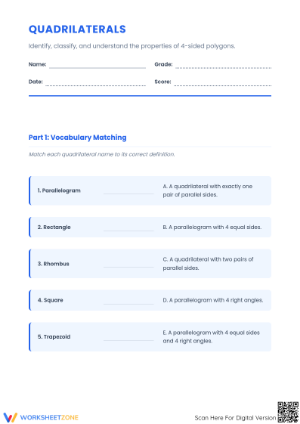
Focus on a tight set of terms: parallel sides, right angles, congruent sides, and vertices. Have students use the words in their written justifications, not just recognize them in a word bank. A sentence like "This is a parallelogram because it has two pairs of parallel sides but no right angles" is worth more than a correct label with no reasoning, and it gives you a clear window into what a student actually understands.
What Comes After Quadrilateral Classification
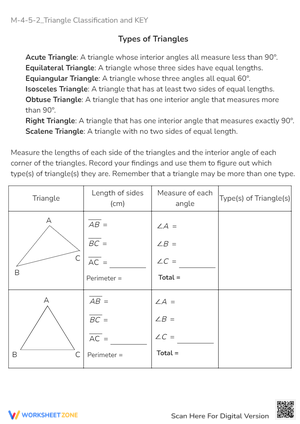
Once students can classify quadrilaterals by attributes, the curriculum usually turns to triangle classification by sides and angles, then to perimeter and area work that depends on knowing a shape's properties. The hierarchy reasoning practiced here also sets up the fifth-grade expectation that attributes of a category belong to all its subcategories, which reappears in later work with polygons and coordinate geometry. Treating quadrilateral classification as a foundation, rather than an isolated topic, helps you sequence the whole geometry strand with intention.
Frequently Asked Questions
1. What grade level typically introduces classifying quadrilaterals worksheets?
Most classification practice begins in Grade 2, where students identify quadrilaterals among other polygons, and deepens through Grade 3 as they distinguish rhombuses, rectangles, and squares. Full hierarchy classification arrives in Grade 5.
2. How do these worksheets align with CCSS geometry standards?
They map directly to 2.G.A.1, 3.G.A.1, and the Grade 5 standards 5.G.B.3 and 5.G.B.4, moving students from attribute recognition toward classifying figures within a hierarchy of properties.
3. What is the best way to address the square-is-a-rectangle misconception?
Use overlapping sorting or Venn-style worksheets that require placing a square into two attribute categories at once, then follow with true-or-false justification prompts about the one-directional relationship.
4. How can teachers use these worksheets for small-group intervention?
Sort returned pages by whether students can justify their answers, then build focused groups. Weight intervention worksheets toward rhombus and trapezoid items, where classification errors most often cluster.
5. What comes after classifying quadrilaterals in the curriculum sequence?
Students typically move to classifying triangles by sides and angles, then to perimeter and area, with quadrilateral hierarchy reasoning resurfacing in later polygon and coordinate work.













 Interactive Worksheet Maker
 Quiz Maker
 Word Search Maker
 Crossword Puzzle Maker
 Word Scramble Generator
 Sentence Scramble Generator
 Handwriting Worksheet Generator
 Name Tracing Generator
 Fill In The Blank Generator