


























Views
Downloads

Angles in a Quadrilateral Worksheet | Essential Grade 11
Paste this activity's link or code into your existing LMS (Google Classroom, Canvas, Teams, Schoology, Moodle, etc.).
Students can open and work on the activity right away, with no student login required.
You'll still be able to track student progress and results from your teacher account.
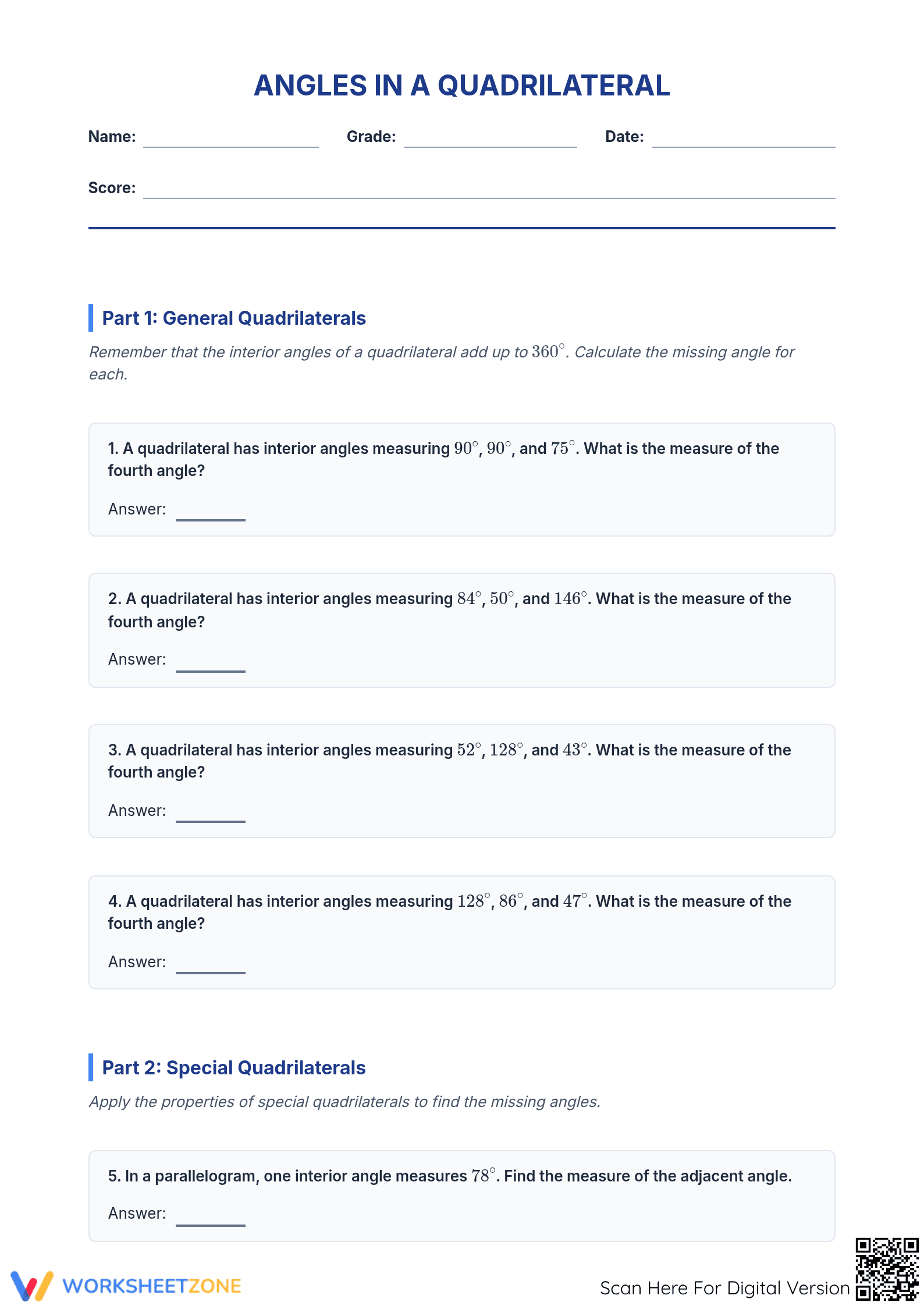
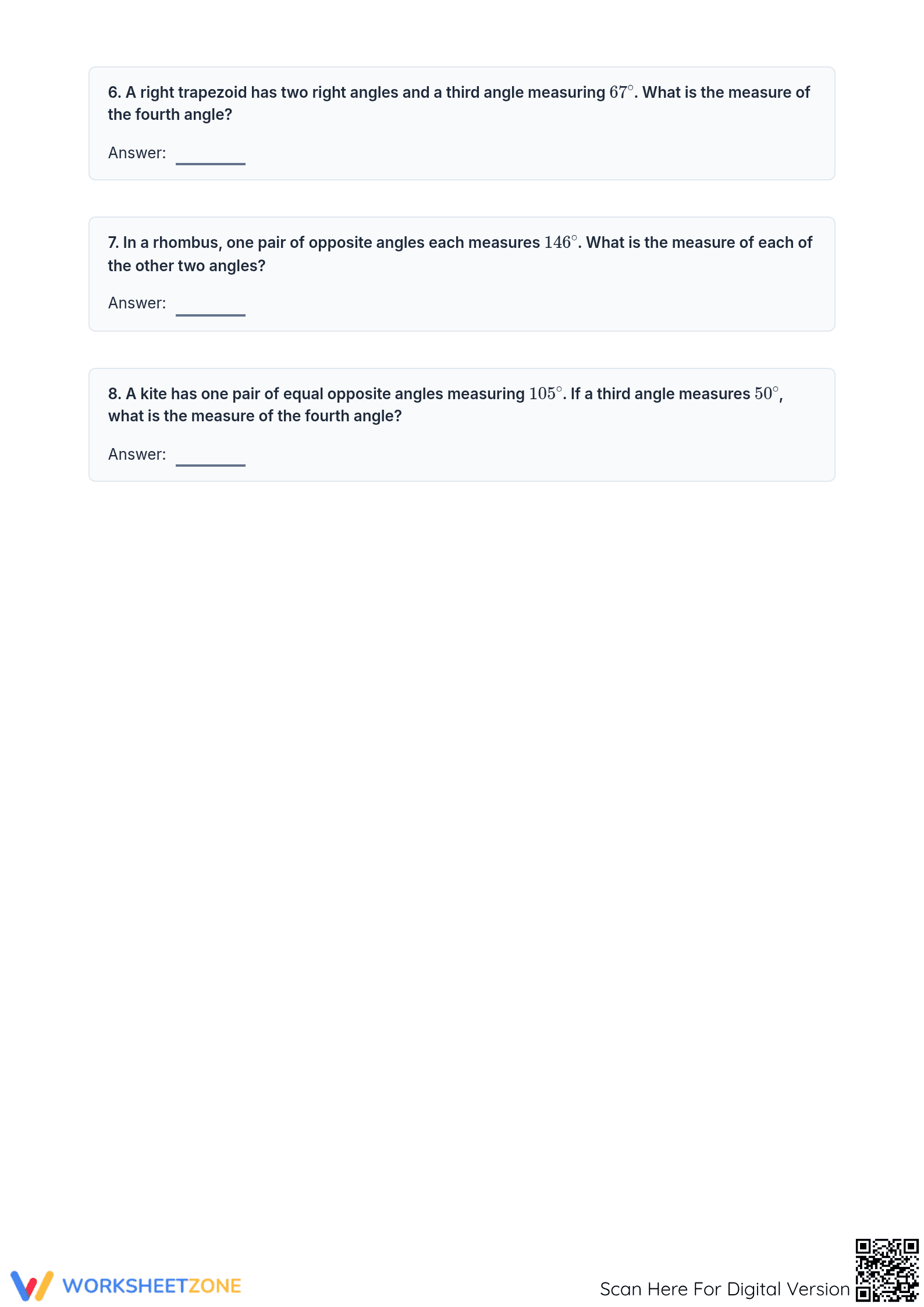
This Grade 11 math worksheet provides targeted practice for calculating missing interior angles within various four-sided polygons. Students apply the fundamental geometric principle that the sum of interior angles in any quadrilateral equals 360 degrees. By solving these 8 structured problems, learners transition from basic arithmetic calculations to applying specific geometric properties of specialized shapes.
At a Glance
- Grade: 11 · Subject: Math
- Standard:
HSG-CO.C.11— Use properties of quadrilaterals and parallelograms to solve for missing geometric measures- Skill Focus: Interior angle sums and quadrilateral properties
- Format: 2 pages · 8 problems · Answer key included · PDF
- Best For: Independent practice or quick formative assessment
- Time: 15–20 minutes
The worksheet is organized into two distinct sections to ensure a logical progression of difficulty. Part 1 focuses on general quadrilaterals, where students are given three angle measures and must determine the fourth. Part 2 introduces special quadrilaterals, including parallelograms, right trapezoids, rhombuses, and kites. This section requires students to recall specific theorems, such as opposite angles being equal or adjacent angles being supplementary, to find the correct solutions.
This resource is designed for a zero-prep classroom workflow. First, print the two-page PDF, which takes less than a minute for a full class set. Second, distribute the sheets for a focused 20-minute independent work session. Third, use the provided answer key to review results instantly. The total teacher preparation time is under 2 minutes, making this an ideal choice for emergency sub plans or bell-ringer activities.
This resource aligns with HSG-CO.C.11: "Prove theorems about parallelograms. Theorems include: opposite sides are congruent, opposite angles are congruent, the diagonals of a parallelogram bisect each other, and conversely, rectangles are parallelograms with congruent diagonals." While the worksheet focuses on application rather than formal proof, it builds the computational fluency required for higher-level geometric reasoning. This standard code can be copied directly into lesson plans, IEP goals, or district curriculum mapping tools.
To maximize instructional impact, use this worksheet as a mid-lesson check for understanding after introducing the properties of special quadrilaterals. Alternatively, assign it as a homework task to reinforce the 360-degree rule. During the activity, observe if students can identify which property to apply in Part 2 without prompting. Most students will complete the 8 tasks within a 15 to 20-minute window.
This practice set is intended for high school geometry students or Grade 11 learners requiring a refresher on polygon properties. It is particularly effective for students who benefit from clear, uncluttered layouts and direct question phrasing. Pair this worksheet with a reference anchor chart detailing the hierarchy of quadrilaterals to support students who are still mastering shape-specific theorems.
According to research by Fisher & Frey (2014) on the gradual release of responsibility, providing structured independent practice is vital for moving students toward mathematical mastery. This worksheet facilitates that transition by offering a consistent problem format that reduces cognitive load, allowing students to focus entirely on the geometric relationships. By requiring the application of the HSG-CO.C.11 standard across different shape categories, the resource ensures that learners do not just memorize a single rule but instead understand how that rule interacts with specific geometric constraints. The inclusion of an answer key supports immediate feedback loops, which have been shown by EdReports (2024) to significantly improve retention in secondary mathematics. This 8-problem set serves as a reliable tool for verifying that students can accurately calculate interior measures before they progress to more complex coordinate geometry or formal Euclidean proofs.


