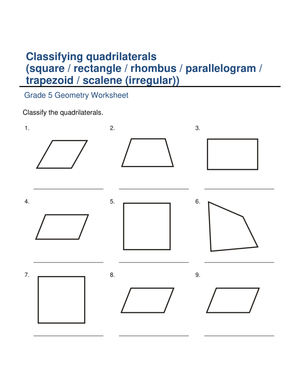
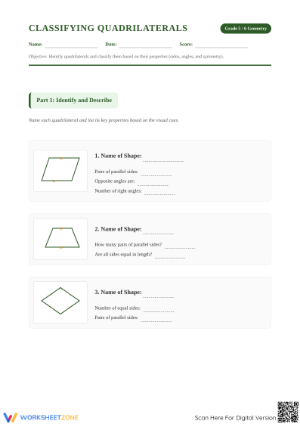
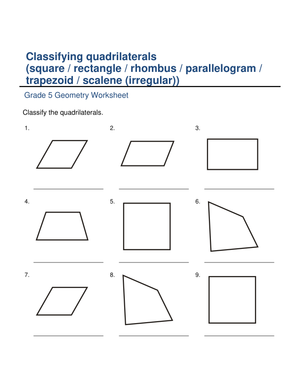
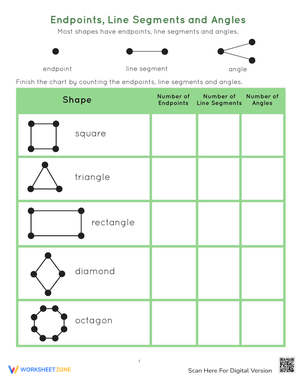
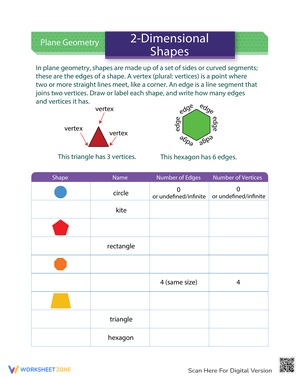
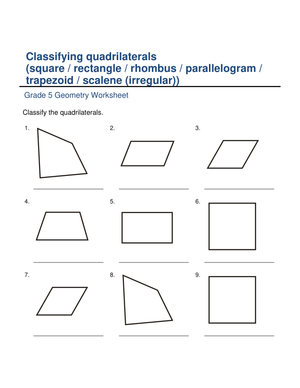
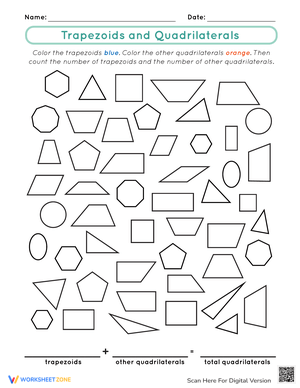
These quadrilaterals worksheets give grades 2–5 teachers a ready set of classification and identification tasks built around the six shape types students encounter across elementary geometry. The collection covers everything from basic naming in second grade to hierarchical reasoning in fifth — a span that reflects how differently a seven-year-old and an eleven-year-old think about the same four-sided polygon.
Concepts Included on These Quadrilaterals Worksheets
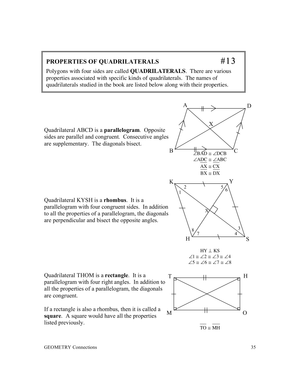
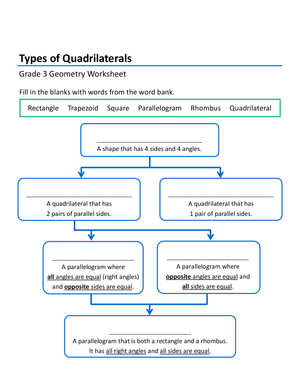
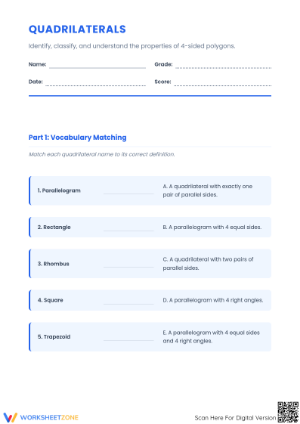
Every worksheet targets a specific property or relationship rather than asking students to "learn quadrilaterals" as a whole. The shape types addressed across the set are squares (four equal sides, four right angles), rectangles (opposite sides equal, all angles 90°), rhombuses (four equal sides, angles that may not be right), parallelograms (two pairs of parallel sides), trapezoids (exactly one pair of parallel sides), and kites (two pairs of adjacent equal sides). Exercises isolate single attributes — parallel sides only, or equal sides only — before presenting tasks that require weighing multiple properties at once. That sequencing reflects how working memory actually operates: students who try to evaluate three attributes simultaneously before mastering any one of them make errors that look like confusion but are really just overload.
Activity Formats in these Quadrilaterals Worksheets
The worksheets use several distinct formats, each suited to a different point in instruction:
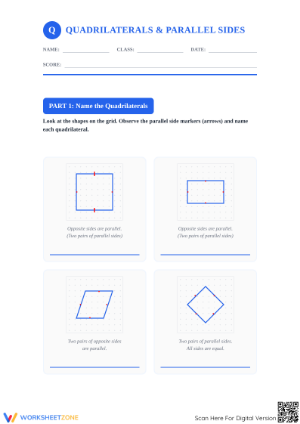
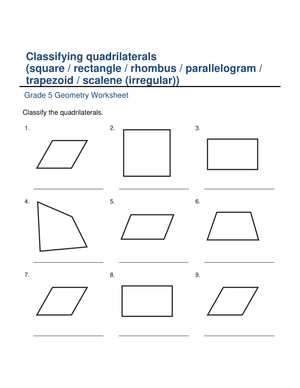
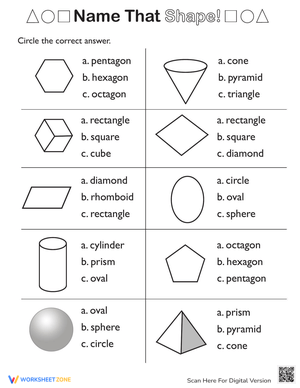
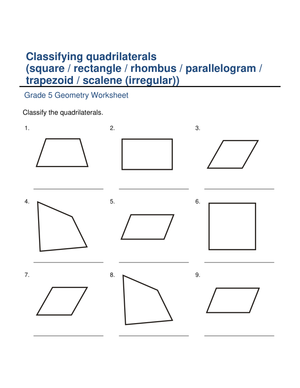
- Identify and name: Students examine a shape image and write its name, or draw a line from a label to the correct figure. This is the entry-level task, appropriate for grades 2–3 working on recognition before properties language is solid.
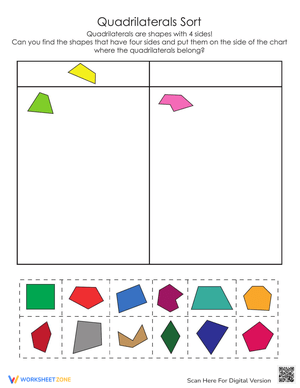
- Sort by single attribute: A set of shapes is sorted into two columns — parallel sides or not, right angles or not. Asking students to sort rather than label forces them to actually examine the shape rather than pattern-match to a prototype.
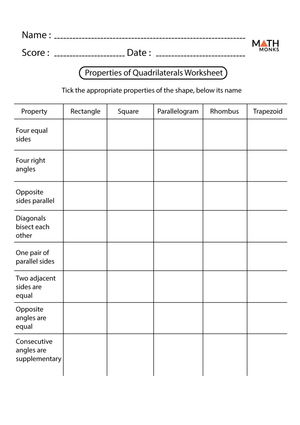
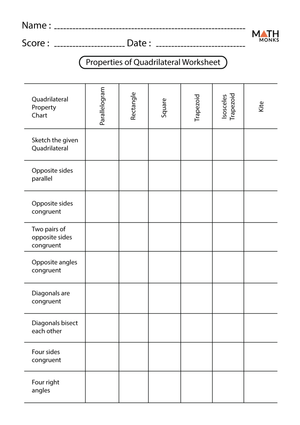
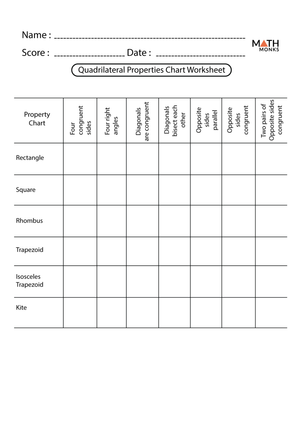
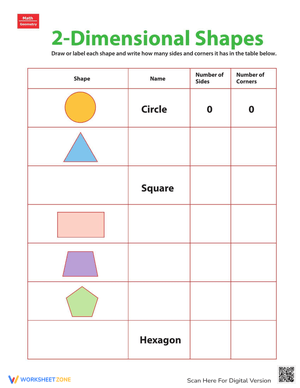
- Properties table: Students mark off which attributes each shape possesses. Once the table is complete, the hierarchical relationships become visible without any additional explanation — a square simply has every row checked that a rectangle has, plus one more.
- Venn diagram classification: Shape names or cards are placed inside overlapping circles. Best reserved for grades 4–5 after the properties table work is done, because the overlapping regions require students to hold two category memberships in mind at once.
- True/false evaluation: Students decide whether statements about a shape are accurate ("A square is always a rectangle — true or false?"). This format surfaces the specific claims students hold incorrectly, which a simple naming task would never reveal.
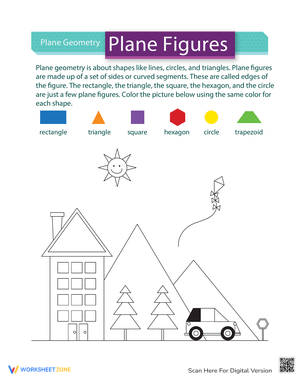
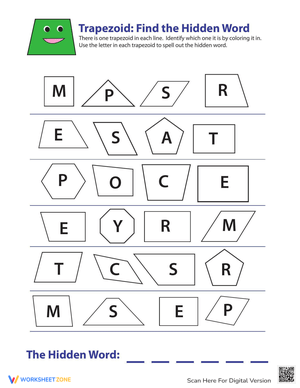
- Color-by-type: Each quadrilateral type is assigned a color; students work through a page of mixed shapes and apply the key. Low-stakes, manageable for early finishers in grade 2, and useful as a diagnostic before a unit begins.
Standards Alignment
The instructional arc here maps directly onto the CCSS geometry progression.
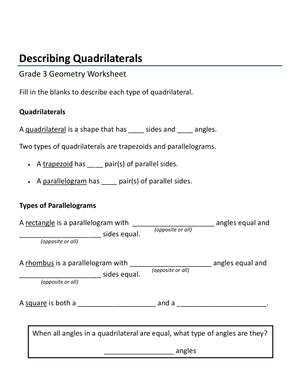
Standard 3.G.A.1 asks third graders to understand that shapes can belong to a broader category based on shared attributes — quadrilaterals being the clearest example in the grade 3 curriculum. That standard is where the properties table format does its heaviest work.
By grades 4 and 5, standards 5.G.B.3 and 5.G.B.4 require students to classify two-dimensional figures in a hierarchy, meaning a student must explain not just that a square has four equal sides but that this makes it a specific kind of rhombus and also a specific kind of rectangle. The Venn diagram worksheets are designed for exactly that expectation.
Worth noting: Common Core is not the only framework in play. Many state-level standards front-load shape identification into grade 1 and 2 and push hierarchical reasoning to grade 5 only — so the grade-band labels on the worksheets are starting points, not prescriptions. Match to your pacing guide, not the label.
Patterns You'll Recognize in Student Work
The most persistent error across grade levels is treating the square and the rectangle as mutually exclusive. Students who can correctly identify both shapes in isolation will still write "that's a square, not a rectangle" when asked to classify — because their mental model was built on appearance rather than properties. A student who learned to recognize a rectangle by its elongated shape genuinely cannot see why a square belongs in the same category. The properties table is the most direct fix: once a student has written down that rectangles require four right angles and opposite equal sides, and then written the same for squares, the inclusion relationship is right in front of them.
A second consistent difficulty appears with the rhombus. Students routinely confuse it with a square because both have four equal sides, and in most textbook illustrations the rhombus is drawn as a "tilted square." The worksheets address this by presenting rhombuses in multiple orientations and including examples where the angles are visibly acute and obtuse — removing the visual shortcut that lets students fake understanding without attending to the angle property.
Trapezoids generate a different kind of error: definitional confusion. Whether a trapezoid has exactly one pair of parallel sides (exclusive definition) or at least one pair (inclusive definition, under which parallelograms are also trapezoids) is genuinely contested across curricula. The worksheets use the exclusive definition standard in most U.S. elementary programs — one pair only — and teachers should flag this if their state materials use the inclusive version, because the sorting tasks will produce wrong answers under the wrong definition.
How Teachers Use These Worksheets In Their Lesson Plans
The most common deployment is the five-minute warm-up before a geometry lesson. A single-property sorting task on entry gives students something concrete to do while attendance is taken, and it activates prior knowledge without requiring you to cold-call anyone at 8:07 in the morning. Exit ticket use is equally practical — a true/false page handed out in the last six minutes of a lesson tells you exactly which property relationship to address at the start of tomorrow's class.
Small-group instruction is where the properties table earns its keep. Pull four students who are still confusing rhombuses and parallelograms, sit with the table worksheet, and fill in one row together before asking them to complete the next row independently. The conversation that happens when a student disagrees with a peer's answer about whether a shape has right angles is more instructionally productive than five minutes of whole-class explanation.
One use pattern that works particularly well: run the same color-by-type worksheet as a pre-assessment on the first day of the geometry unit, collect it without grading, return it unmarked on the last day, and ask students to redo it. Comparing their two attempts is a genuine self-assessment moment — students can see the shift in their own thinking without a score attached.
Adjusting for Different Learners' Levels
Students who struggle with fine motor demands do better when sorting tasks use cut-and-paste formats rather than drawing or writing shape names repeatedly. The content load stays the same; the physical demand drops. For students working above grade level, the open-ended extension that produces the most useful thinking is this: draw a quadrilateral that does not fit any of the six named types and explain in writing why it doesn't qualify. Most students discover quickly that this is harder than it sounds, and the attempt surfaces their understanding of what each type actually requires.
English learners benefit from the properties table format specifically because it pairs visual information with vocabulary in context rather than presenting definitions in isolation. A student who doesn't yet own the word "parallel" can still learn to recognize parallel sides by examining examples and non-examples — and the table gives that learning a place to land.
Frequently Asked Questions
Is a square a rectangle?
Yes, under the standard elementary definition. A rectangle requires four right angles and two pairs of opposite equal sides — a square satisfies both conditions, so every square is also a rectangle. This trips students up because it violates their prototype-based reasoning, which is exactly why the properties table and Venn diagram formats exist. The moment a student fills in a properties table and sees that the square column is a subset of the rectangle column, the relationship stops being an arbitrary rule to memorize.
Which format should I use first?
Start with identify-and-name or color-by-type to establish shape recognition, then move to sorting by a single attribute, then the properties table, then Venn diagrams. Skipping directly to Venn diagrams with students who haven't worked through properties in a structured way produces errors that look like conceptual misunderstanding but are actually just sequencing problems — the student never had a chance to build the foundation the diagram requires.
What about trapezoids — one pair of parallel sides or at least one?
Check your state standards and your district's adopted materials before introducing the trapezoid sorting tasks. These worksheets use the exclusive definition (exactly one pair), which is what most U.S. elementary programs use. If your curriculum uses the inclusive definition, the sorting tasks will need a quick verbal clarification before students begin — otherwise a student who correctly identifies a parallelogram as having two pairs of parallel sides will mark it as a trapezoid and believe they got the right answer.













 Interactive Worksheet Maker
 Quiz Maker
 Word Search Maker
 Crossword Puzzle Maker
 Word Scramble Generator
 Sentence Scramble Generator
 Handwriting Worksheet Generator
 Name Tracing Generator
 Fill In The Blank Generator