


























Views
Downloads

Printable Shapes Pattern Worksheet | Grade K Math
Paste this activity's link or code into your existing LMS (Google Classroom, Canvas, Teams, Schoology, Moodle, etc.).
Students can open and work on the activity right away, with no student login required.
You'll still be able to track student progress and results from your teacher account.
Strengthen early geometry skills with this focused practice worksheet designed to help young learners identify, analyze, and extend visual sequences. Students observe a variety of geometric shapes arranged in logical sequences and must determine which shape correctly completes the pattern. This activity builds the foundational logic required for algebraic thinking and mathematical reasoning.
At a Glance
- Grade: Kindergarten · Subject: Math
- Standard:
CCSS.MATH.CONTENT.K.G.B.4— Analyze and compare shapes to identify their defining attributes in patterns- Skill Focus: Pattern extension and shape recognition
- Format: 2 pages · 10 problems · Answer key included · PDF
- Best For: Early finishers or small group math centers
- Time: 10–15 minutes
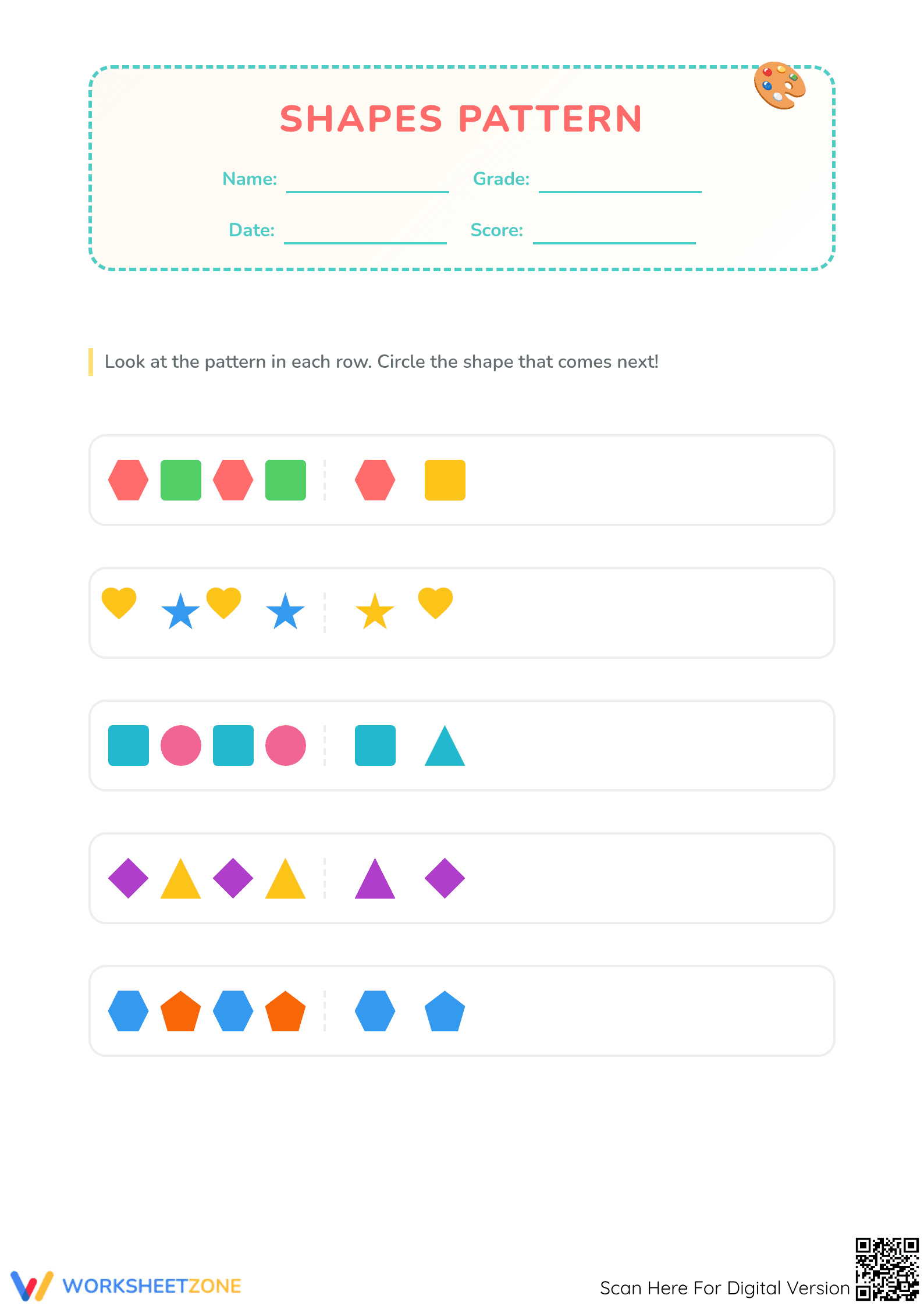
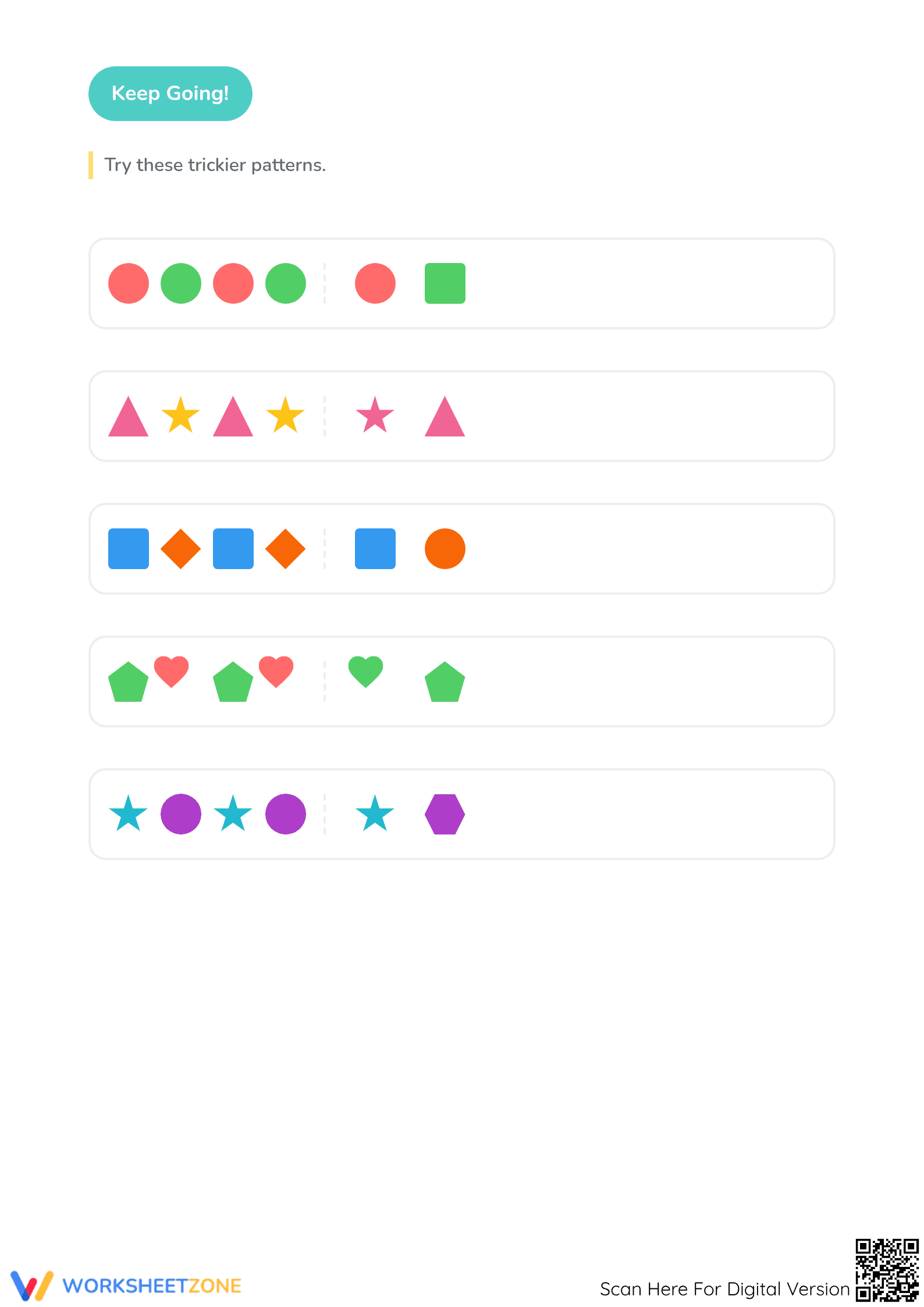
The worksheet is structured across two pages to prevent cognitive overwhelm, featuring high-contrast colorful illustrations of hearts, stars, hexagons, and more. Each row presents a clear sequence followed by a choice of shapes to circle, providing 10 distinct opportunities for students to demonstrate mastery. A comprehensive answer key is included to facilitate quick grading or student self-correction during independent work time.
Skill Progression
- Guided Practice: The first page introduces basic ABAB and AABB patterns using highly distinct shapes like circles and squares to build initial confidence with 5 structured problems.
- Supported Practice: Students move into more complex sequences involving three-shape rotations, requiring them to hold multiple attributes in their working memory before making a selection.
- Independent Practice: The second page features "trickier patterns" that challenge students to identify subtle shifts in shape orientation and type, culminating in 10 total completed tasks.
This approach follows a gradual-release model, moving from simple visual recognition to the more complex application of logical rules.
Standards Alignment
This resource is primarily aligned to CCSS.MATH.CONTENT.K.G.B.4, which tasks students with analyzing and comparing two-dimensional shapes. By identifying shapes within a pattern, students must focus on defining attributes rather than color or size alone. This standard code can be copied directly into lesson plans, IEP goals, or district curriculum mapping tools.
How to Use It
Use this worksheet as a formative assessment after a direct instruction lesson on geometric shapes. Observe students as they work; if a student struggles to identify the next shape, encourage them to "read" the pattern out loud (e.g., "square, circle, square, circle") to activate auditory processing. This activity typically takes 10 to 15 minutes and works well as a quiet morning work task or a component of a math rotation station.
Who It's For
This resource is ideal for Kindergarten students and advanced Pre-K learners who are beginning to explore mathematical logic. It is also an excellent tool for Special Education (SPED) instructors looking for high-visual, low-text materials to support students with processing delays. The clean layout and predictable structure make it a natural pairing for an anchor chart displaying common geometric shapes.
Research from ScienceDirect TpT Analysis indicates that visual patterning activities in early childhood are significant predictors of later mathematical achievement in elementary school. By engaging with these 10 structured problems, students develop the ability to see regularity and structure in mathematical objects, a core competency highlighted in the NAEP framework. The use of varied geometric forms like hexagons and pentagons ensures that students are not merely memorizing simple shapes but are actively analyzing attributes as described in CCSS.MATH.CONTENT.K.G.B.4. Educators can rely on this printable to provide the repeated, focused exposure necessary for students to move from basic recognition to the ability to predict and extend more complex mathematical systems. This zero-prep PDF serves as a practical bridge between concrete manipulatives and abstract symbolic reasoning, providing a clear record of student progress for portfolios or parent-teacher conferences.


