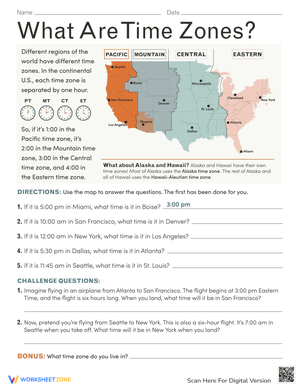
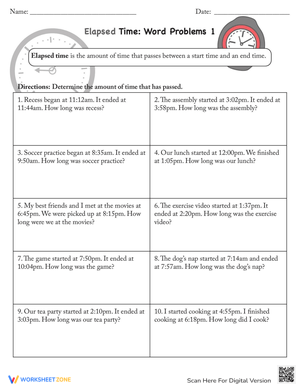
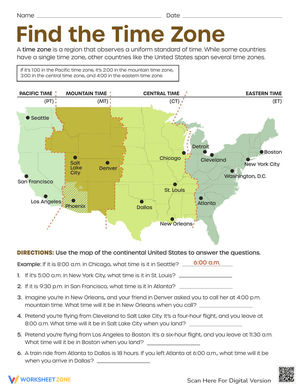
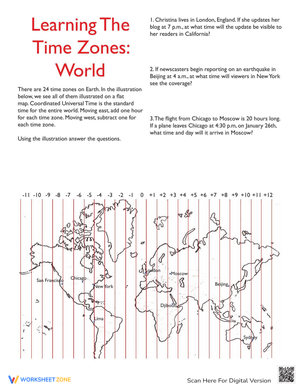
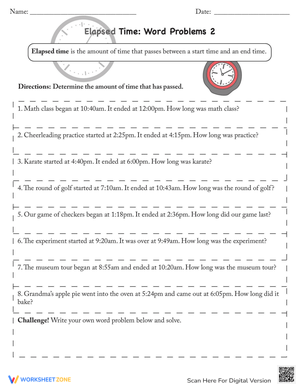
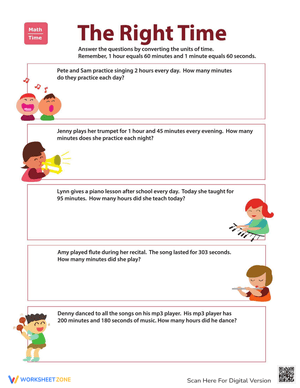
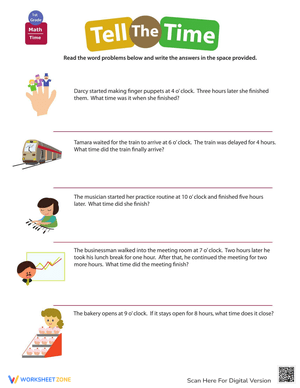
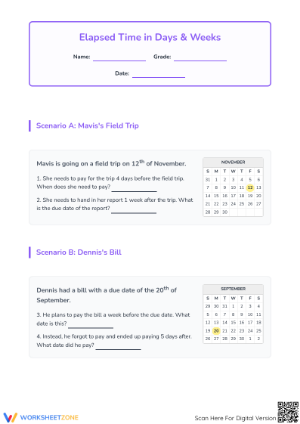
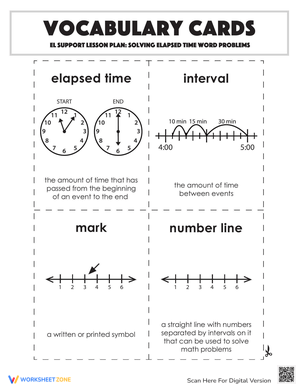
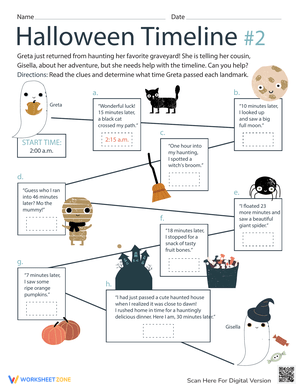
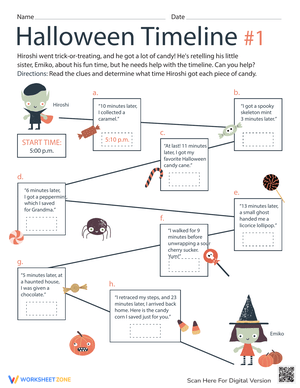
These elapsed time word problems worksheets give 3rd, 4th, and 5th grade students structured practice with one of the measurement concepts that trips up even confident math learners — not clock-reading itself, but the reasoning required to work across hour boundaries, calculate intervals in base 60, and track whether a span crosses noon. Each page presents real-world scenarios with built-in scaffolds that move students from counting up on a number line toward more efficient strategies.
The Three Problem Types and Why Each One Is Different
Elapsed time problems come in three distinct forms, and students who can solve one type fluently often stall on another.
- Finding the duration (how long something lasted) requires counting up or subtracting between two known times.
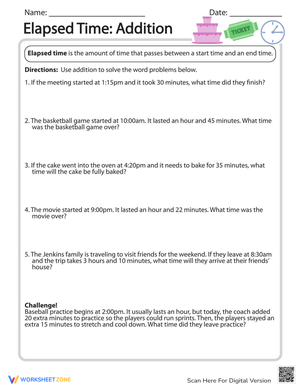
- Finding the end time means adding an interval to a known start.
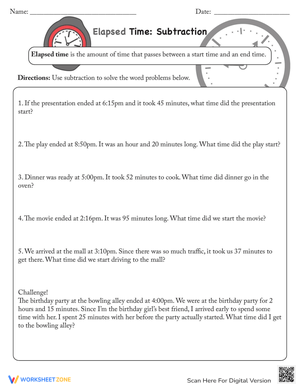
- Finding the start time — given only when something ended and how long it took — is the one that consistently produces the most errors, because students must work backward and many instinctively try to add instead of subtract.
Worksheets organized by problem type let teachers give students targeted reps on whichever form is causing trouble, rather than cycling through a mixed set before the confusion is resolved.
Within each type, complexity scales along two predictable dimensions: whether the interval crosses an hour boundary, and whether it crosses noon. Problems contained within a single hour (2:10 to 2:45) are the appropriate entry point. Problems that span one or two hours come next. AM-to-PM problems — say, 10:50 AM to 1:20 PM — belong at the end of the sequence, once students have internalized the noon landmark as a natural stopping point on the number line.
Strategies Built Into the Pages
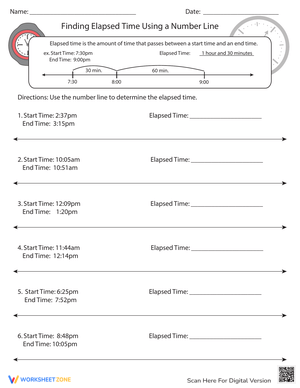
The most effective elapsed time word problems worksheets embed the strategy rather than leaving students to invent their own approach. The open number line is the foundational scaffold: students mark the start time on the left, jump forward in meaningful chunks, and land at the end time. Pre-drawn number lines beneath each problem remove the setup burden so students can focus on the intervals themselves. For AM-to-PM problems, worksheets that mark noon as a fixed reference point on the line make the two-chunk approach concrete — jump to 12:00, record that partial time, then jump from noon to the end, and add the two pieces.
Some pages use a decomposition framework that names the jump sizes: whole-hour jumps, ten-minute jumps, and single-minute jumps, each recorded separately. This prevents the most common computational error — treating time like base-10 and subtracting 2:45 from 4:10 as though it were 410 minus 245. T-chart formats, where the running time total is recorded alongside each jump, work well for students who need a step-by-step written record and struggle to track partial sums mentally.
Where These Fit in the Instructional Day
A single elapsed time word problem projected during morning meeting or the transition after specials works well as a low-stakes daily warm-up — students solve it on a whiteboard or scratch paper, then one student walks through the number line while the class checks. That routine builds fluency incrementally without requiring a full lesson block every day.
For small-group reteaching, pull the students who are still trying to subtract clock times directly (writing 4:10 minus 2:45 in column form, then subtracting 45 from 10 without accounting for the 60-minute base) and work through two or three number-line problems together before releasing them to a scaffolded page. The rest of the class can work independently on a full worksheet during that window. At the end of a lesson, a five-problem page serves as a quick formative check — who crossed the hour cleanly, who used a number line correctly, who got the start-time problems wrong in both directions. That data shapes the next day's grouping.
Where Student Work Goes Wrong
The direct-subtraction error is the most persistent: a student who can read an analog clock accurately will still write 3:15 minus 1:45 in vertical form and arrive at 1:70, then either leave it or convert it incorrectly. Number-line work exposes this error immediately because there is no column to borrow from — the student has to account for each jump explicitly.
A second common error appears in start-time problems. Asked "A movie ended at 4:30 PM and lasted 1 hour and 45 minutes — when did it start?", students who understand the concept will still go forward instead of backward, adding 1:45 to 4:30 and arriving at 6:15. The wording "when did it start?" is clear to an adult; to a student who has only practiced forward-counting problems, the direction of movement on the number line is not obvious. Worksheets that include a directional prompt ("count back from the end time") or require students to label the unknown before solving catch this before it becomes a habit.
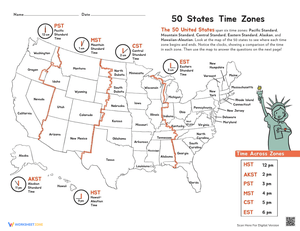
The noon crossing error is its own category. Students who confidently handle 9:30 AM to 11:15 AM often freeze or guess on 11:30 AM to 1:10 PM. The fix is treating noon as a landmark rather than asking students to count straight through. On a number line, the jump from 11:30 to 12:00 is 30 minutes; the jump from 12:00 to 1:10 is 70 minutes; total, 100 minutes or 1 hour and 40 minutes. Worksheets with a noon tick mark already placed on the number line make this structure visible before students have to impose it on their own.
Adjusting the Pages for the Full Range of Learners
For students still consolidating place value and subtraction, start with within-the-hour problems and provide a number line that has the start time and end time already marked, leaving only the jump-counting to the student. Remove one scaffold at a time: first, let them place the start time; then, let them place both endpoints; then, move to a blank line. For students who are ready to extend, multi-step problems — a daily schedule with four events, where they must find total time across the school morning — require them to hold intermediate results and add elapsed times together, which is meaningfully harder than any single-step problem.
Students who struggle with the reading load in word problems benefit from versions that reduce sentence complexity without reducing mathematical complexity. The problem "Rosa's soccer practice started at 3:15 PM and ended at 4:40 PM. How long was practice?" and its linguistically simplified version ask for the same reasoning. PDF sets that include both versions let teachers assign the appropriate page without creating two separate lesson plans.
Standards Aligned
Elapsed time word problems align to CCSS 3.MD.A.1, which requires students to tell and write time to the nearest minute and solve word problems involving addition and subtraction of time intervals in minutes. The standard explicitly places this work in third grade, which is why the concept appears when it does — students at that age are consolidating multi-digit addition and subtraction, and elapsed time is an application that demands both. Fourth and fifth grade worksheets typically address elapsed time through multi-step measurement problems rather than as a standalone standard, which is why the problem sets at those grades tend to embed elapsed time within longer scenarios rather than isolating it.
Frequently Asked Questions
1. My students keep trying to subtract times in column form. What's the fastest way to break that habit?
Put away any worksheet that presents problems without a number line until the habit is replaced. For two or three days, require every student to draw and label a number line before writing any numbers. The column-subtraction impulse disappears when the number line becomes the default recording format — students stop looking for a column because the page doesn't offer one.
2. At what point should students stop using the number line and solve mentally?
There's no fixed timeline, and rushing it produces fragile fluency. A student who can explain their number-line jumps clearly and is consistently accurate is ready to try a few problems without the scaffold — but the number line should stay available as a check, the same way a multiplication chart stays available for students who know most facts but occasionally verify. Mental elapsed time is a legitimate adult skill; an open number line is also a legitimate adult skill. The goal is accuracy and understanding, not a particular strategy.
3. How do these worksheets work as homework?
They work well when the strategy is already established in class. Sending home an elapsed time page before students have used a number line at school reliably produces confused parents and abandoned homework. Once the number-line approach is familiar, a short homework page — four to six problems, with a pre-drawn scaffold — is appropriate. Include the answer key on a separate page or send it home the next day so students can self-check rather than waiting a week for corrected work to return.













 Interactive Worksheet Maker
 Quiz Maker
 Word Search Maker
 Crossword Puzzle Maker
 Word Scramble Generator
 Sentence Scramble Generator
 Handwriting Worksheet Generator
 Name Tracing Generator
 Fill In The Blank Generator