


























Views
Downloads


Essential School Bell Times Worksheet | Grade 3 Math
Paste this activity's link or code into your existing LMS (Google Classroom, Canvas, Teams, Schoology, Moodle, etc.).
Students can open and work on the activity right away, with no student login required.
You'll still be able to track student progress and results from your teacher account.
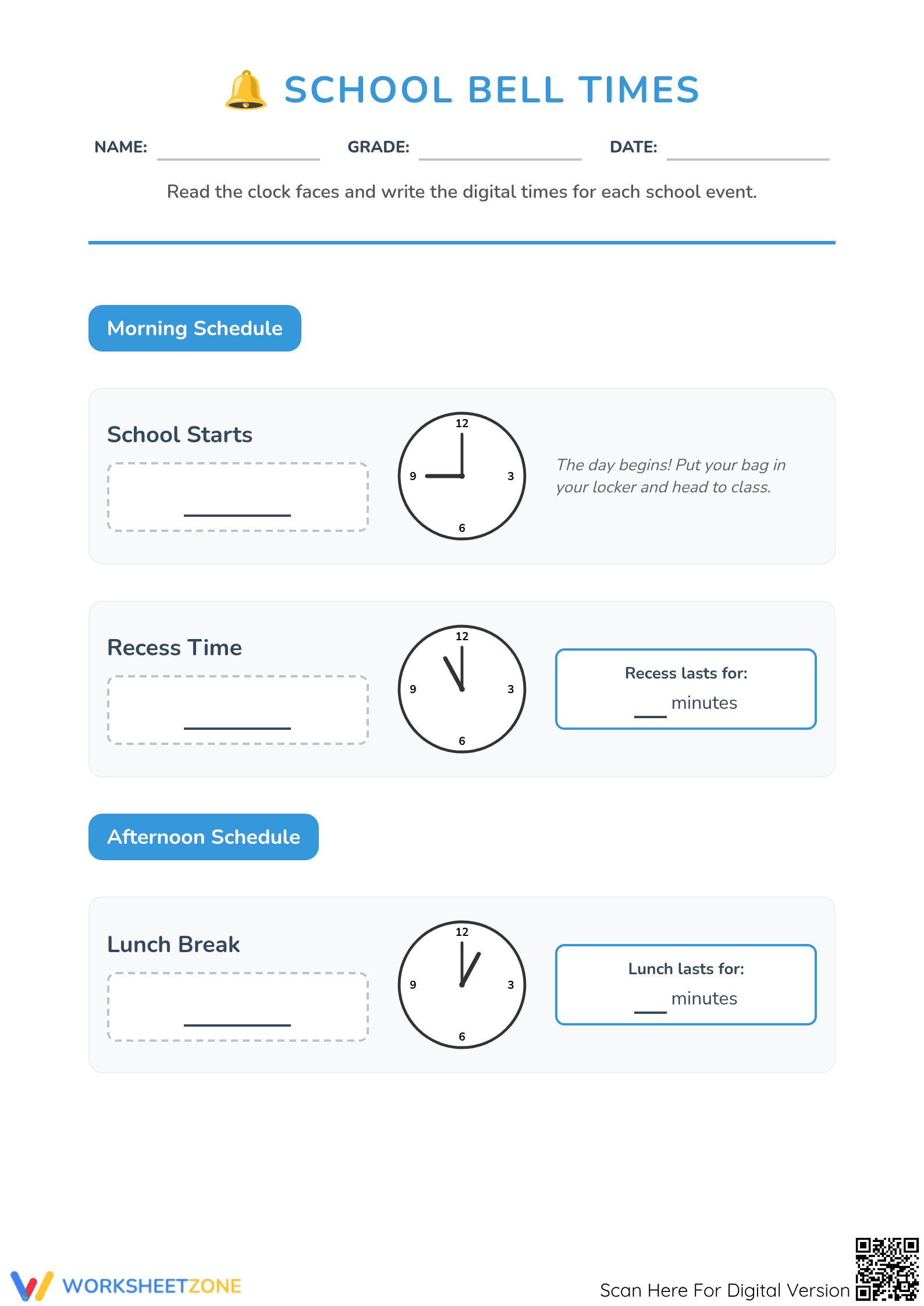
This Grade 3 math worksheet helps students master the practical skill of telling time and calculating elapsed time through a relatable school schedule. By reading analog clocks for events like school starts, recess, and lunch, students build fluency in translating visual time into digital formats and solving real-world word problems.
At a Glance
- Grade: 3 · Subject: Math
- Standard:
CCSS.MATH.CONTENT.3.MD.A.1— Tell and write time to the nearest minute and measure time intervals- Skill Focus: Telling Time & Elapsed Time
- Format: 2 pages · 11 problems · Answer key included · PDF
- Best For: Real-world time application and elapsed time practice
- Time: 20–30 minutes
This 2-page PDF features a structured morning and afternoon schedule where students read four analog clocks to identify key bell times. It includes specific sections for calculating the duration of recess and lunch, a total school day calculation, and four rigorous time word problems that require students to add time intervals and draw clock hands.
Zero-Prep Workflow
- Step 1: Print — Select "Fit to Page" and print the 2-page set in seconds for your entire class.
- Step 2: Distribute — Hand out to students as a morning warm-up, a standalone lesson on schedules, or a quick sub plan activity.
- Step 3: Review — Use the provided answer key for a 2-minute group check or individual grading to provide immediate student feedback.
Total teacher preparation time is less than two minutes, making this an ideal resource for busy classrooms.
Standards Alignment
`CCSS.MATH.CONTENT.3.MD.A.1`: "Tell and write time to the nearest minute and measure time intervals in minutes. Solve word problems involving addition and subtraction of time intervals in minutes, e.g., by representing the problem on a number line diagram." This resource also supports Grade 2 standards for telling time to five-minute intervals. Both standard codes can be copied directly into lesson plans, IEP goals, or district curriculum mapping tools.
How to Use It
Use this as a formative assessment after teaching the basics of analog clocks to see if students can apply their knowledge to a sequential schedule. It also works perfectly as a homework assignment or a sub plan, as the "School Bell Times" theme is self-explanatory and provides enough context for independent work. Expected completion time is roughly 25 minutes.
Who It's For
This resource is designed for Grade 3 students but provides excellent enrichment for Grade 2 learners ready for elapsed time. It is ideal for students who struggle with the abstract concept of time by grounding it in their daily school routine. Pair this with a classroom analog clock or a "daily schedule" anchor chart for additional support.
The School Bell Times Worksheet targets CCSS.MATH.CONTENT.3.MD.A.1 by requiring students to tell time and calculate intervals within a functional context. Research from EdReports (2024) emphasizes that grounding mathematical concepts in authentic, "real-world" scenarios significantly increases student engagement and retention of measurement standards. By moving from simple clock reading to multi-step word problems involving "halfway" points and addition of minutes, students develop the cognitive flexibility required for higher-level temporal reasoning. This transition from procedural fluency to conceptual application aligns with best practices in mathematics instruction, ensuring that students do not just read the time but understand its passage. The inclusion of duration calculations and word problems provides the rigorous practice necessary for mastery of the Grade 3 measurement and data domain. Teachers can utilize these tasks for both formative checks and summative assessments of student progress.


