These days weeks and months calendar worksheets give K–2 teachers a set of focused, printable exercises that move students from rote recitation — "thirty days hath September" — toward actually reading, interpreting, and reasoning with a calendar grid. Each page targets a discrete skill, so teachers can assign them individually rather than hunting through multi-skill packets for the one activity that fits today's lesson.
What Each Page Asks Students to Do
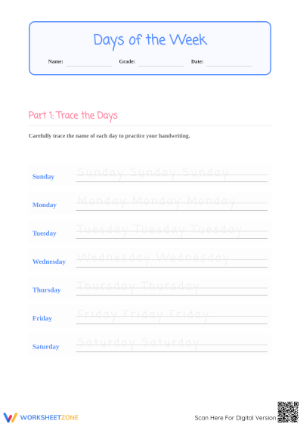
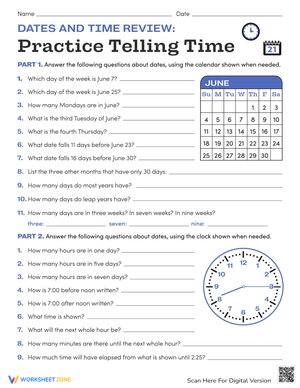
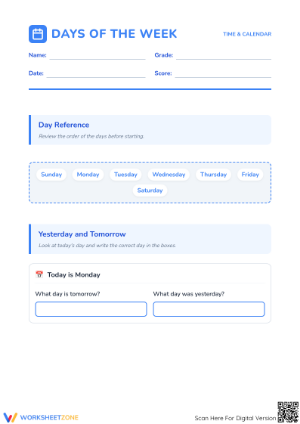
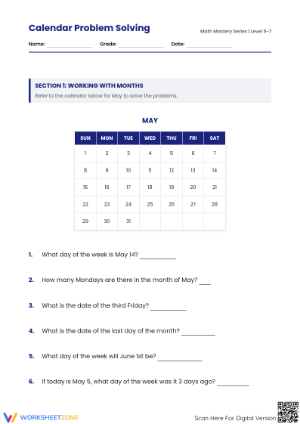
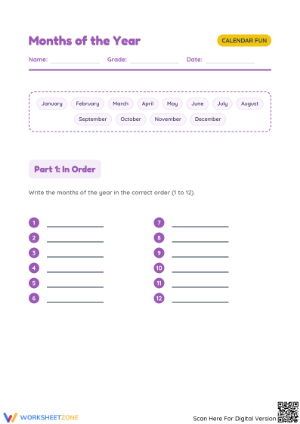
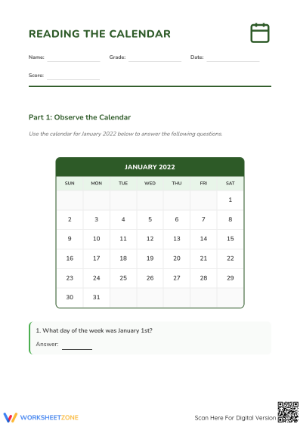
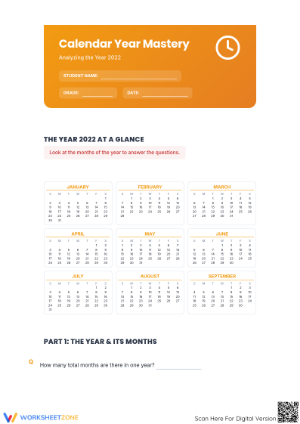
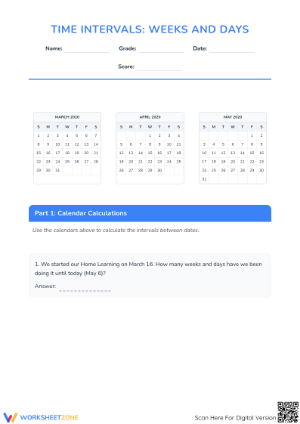
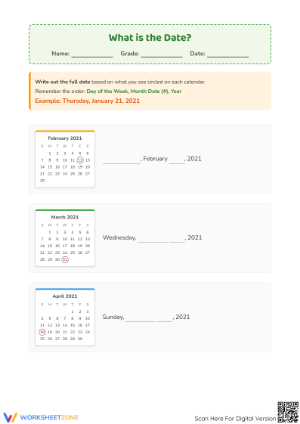
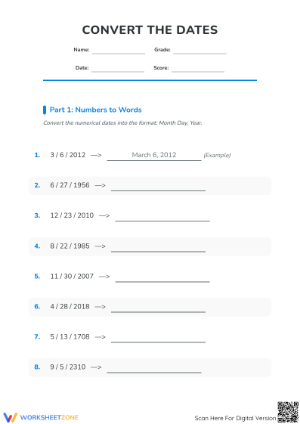
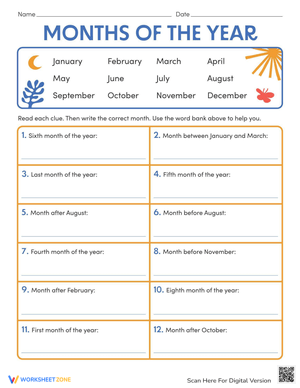
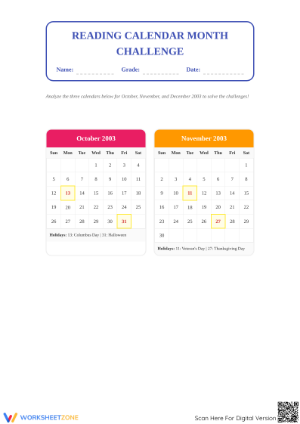
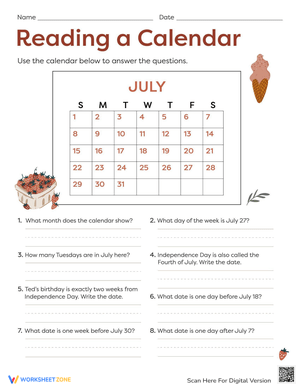
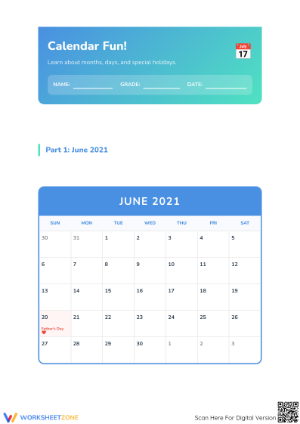
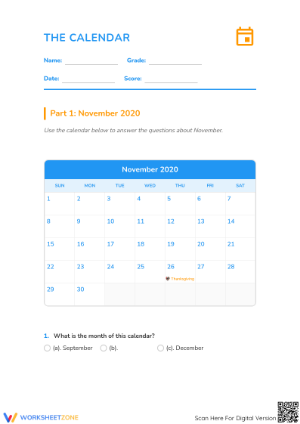
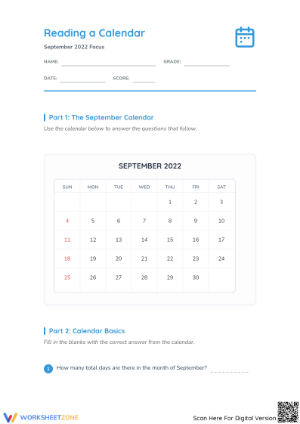
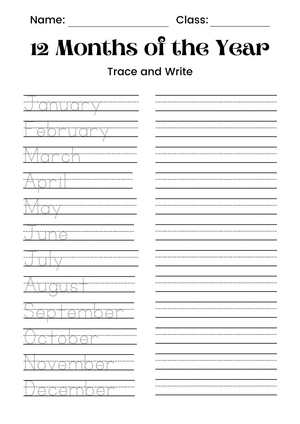
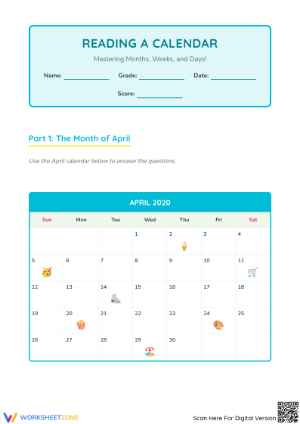
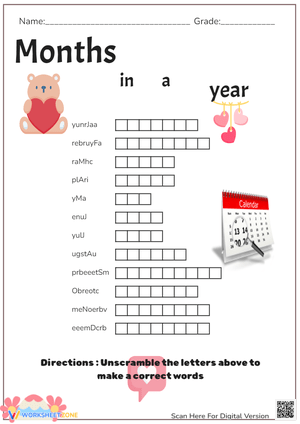
The set covers the full range of calendar skills students work through across kindergarten, first, and second grade. Earlier pages build the sequence knowledge that everything else depends on: students write the seven days in order from memory, fill missing months into a partially completed year, and sort scrambled weekday cards into the correct sequence. Mid-set pages shift to reading a calendar grid — locating a specific date, identifying what day of the week the fourteenth falls on, counting how many Tuesdays appear in a given month. The later pages introduce interval reasoning: how many days between the third and the seventeenth, what is the date one week after the twenty-second, how many weeks remain in the month after a marked date.
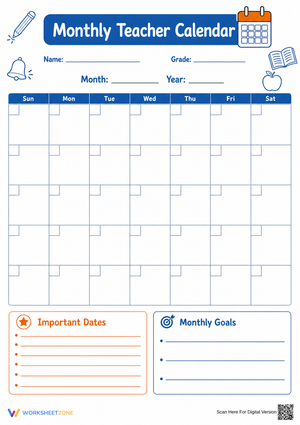
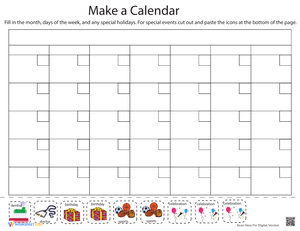
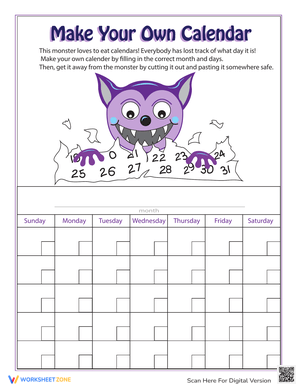
A few pages ask students to build a calendar from scratch — they receive a blank grid, the name of a month, and the day of the week that the first falls on, then fill in every date themselves. This task surfaces more confusion than any other format in the set. Students who can recite days in sequence will still misalign rows when the month starts on a Wednesday rather than a Sunday, because they haven't yet internalized that the column position determines the day, not the date's distance from the left margin.
Where These Pages Fit in a Classroom Week
Most teachers reach for these during morning meeting or the opening ten minutes of math, when the class calendar is already on display and the conversation about today's date is fresh. Handing each student a printed page while projecting a blank calendar grid lets students mark, count, and annotate rather than watching passively. The physical act of touching each square while counting — something a projected image doesn't allow — reduces the off-by-one errors that come from trying to calculate intervals mentally.
They also work well as Friday consolidation before a new month begins, giving students a chance to work with a month they've been living inside rather than an unfamiliar template. For teachers running math stations, the interval and elapsed-time pages make a reliable independent center because the directions are self-contained and the answer is always verifiable by re-counting the grid.
Why This Skill Is Harder Than It Looks at This Grade Level
Calendar reading sits at an awkward intersection of linguistic knowledge, spatial reasoning, and arithmetic — and all three have to come together before a student can answer something as apparently simple as "what day is the twenty-eighth?" A child who hasn't fully consolidated the weekday sequence can't reliably read across a grid row. A child who hasn't internalized the row-as-week structure will count dates linearly (1, 2, 3...) rather than jumping by sevens. And a child still developing left-to-right tracking will skip columns or double-count them.
From a cognitive load standpoint, asking a student to simultaneously hold the weekday sequence in memory, orient herself within the grid, and perform addition or counting is a significant demand for a six- or seven-year-old. These worksheets reduce that load by isolating each component. The sequencing pages remove the grid entirely. The grid-reading pages supply a completed calendar and limit the task to locating information. Only the later interval pages ask students to integrate both skills at once.
Error Patterns Worth Watching For
The most consistent error across grade levels appears on interval problems: students count the start date as day one. Asked how many days from the 5th to the 12th, a student will mark the 5th, count "one, two, three..." and land on the 11th. This isn't carelessness — it reflects genuine ambiguity about whether you count the ground you're standing on. A brief class discussion about "how many days do you travel" versus "which day do you arrive" usually resolves it, and the worksheets include enough interval problems that the pattern shows up clearly before summative assessment.
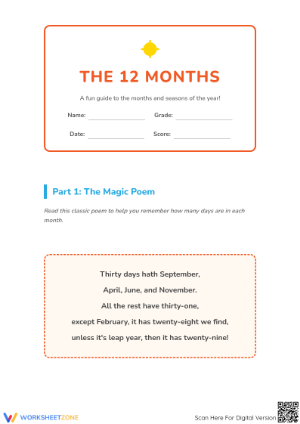
A second predictable slip involves months with 30 versus 31 days. Second graders who have memorized February confidently will still write "31" for April or June because the default assumption, once a student knows some months are 31 days, becomes that most are. Worksheets that ask students to name how many days a specified month contains catch this before it migrates into elapsed-time word problems.
Scaling the Pages for Different Learners
For students still working on weekday sequence, the fill-in-the-blank pages are more productive when two or three days are pre-filled as anchors — Wednesday in the middle, Sunday at the start — so the student practices the relative positions rather than restarting the sequence from memory each time. Removing those anchors is a straightforward way to increase demand once the sequence is secure.
Students who move quickly through the standard pages benefit from open-ended extensions built around the same grids: find two dates that are exactly three weeks apart, write a word problem whose answer is the 19th, figure out what day of the week your birthday falls on this year. These tasks use identical content but require students to work backward from a constraint rather than forward from a prompt — a meaningfully different cognitive demand that doesn't require separate materials.
Standards Alignment
First-grade CCSS measurement standards (1.MD) don't address calendars directly, but the underlying work — ordering, sequencing, and counting within a structured representation — supports the foundational numeracy those standards build on. Second grade is where calendar reasoning becomes explicitly tied to standards work: 2.MD.C.7 addresses time intervals, and telling time to the nearest five minutes relies on the same skip-counting-by-fives logic that underlies counting weeks across a month. The interval and elapsed-days pages in this set give students repeated practice with exactly that reasoning before it appears in clock-reading contexts.
Frequently Asked Questions
1. Can these be used with kindergarteners, or are they too advanced?
The sequencing pages — days in order, months in order, fill-the-missing-month — work well with kindergarteners once they've had classroom calendar exposure for several weeks. The grid-reading and interval pages are better suited to first and second grade, when students have enough number sense to work with two-digit dates and enough spatial tracking to navigate a seven-column grid without losing their place.
2. Do these work as assessment, or only as practice?
The mid-set pages — where students read a completed calendar and answer a specific set of questions — double cleanly as a formative check. They take about eight minutes, the scoring is unambiguous, and the errors cluster in recognizable ways that tell you exactly which students are still treating the grid as a number line rather than a weekly structure. The build-a-calendar pages are less useful for assessment because the errors cascade: one misplaced date shifts every subsequent row, which makes it hard to distinguish a student who doesn't understand column structure from one who simply made an arithmetic error on day one.













 Interactive Worksheet Maker
 Quiz Maker
 Word Search Maker
 Crossword Puzzle Maker
 Word Scramble Generator
 Sentence Scramble Generator
 Handwriting Worksheet Generator
 Name Tracing Generator
 Fill In The Blank Generator