


























Views
Downloads

Essential Date Formatting Worksheet | Grade 2 Math
Paste this activity's link or code into your existing LMS (Google Classroom, Canvas, Teams, Schoology, Moodle, etc.).
Students can open and work on the activity right away, with no student login required.
You'll still be able to track student progress and results from your teacher account.
Mastering the mechanics of calendar notation is a critical bridge between early math and literacy. This worksheet helps students identify and correct errors in date formatting, ensuring they can communicate temporal information with precision. Students will transition from correcting simple capitalization errors to evaluating the logical consistency of calendar dates across four detailed parts.
At a Glance
- Grade: 2 · Subject: Math & Language Arts
- Standard:
L.2.2.C— Use commas in dates and capitalize months and days accurately- Skill Focus: Date formatting and correction
- Format: 5 pages · 28 problems · Answer key included · PDF
- Best For: Independent practice or formative assessment
- Time: 20–30 minutes
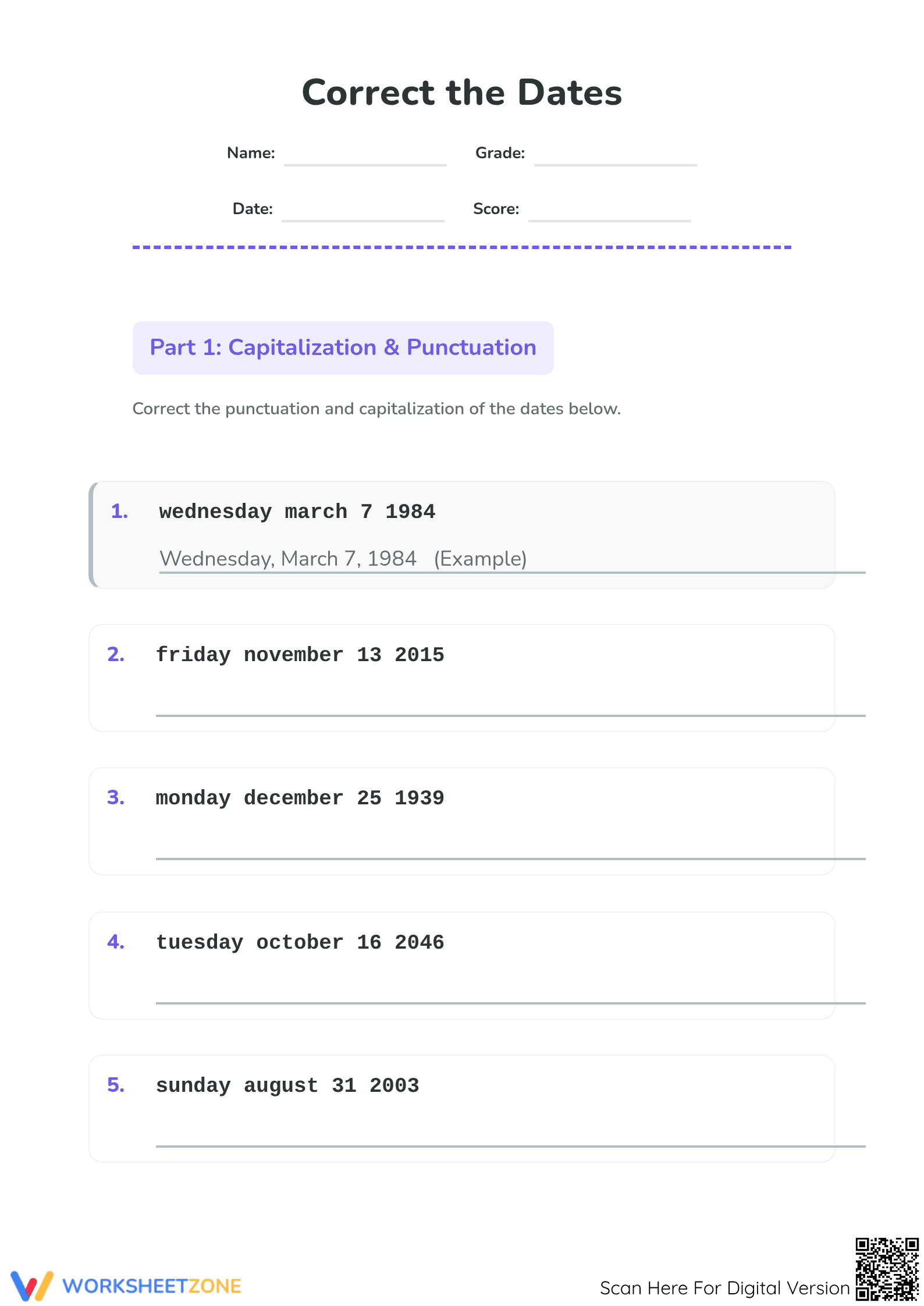
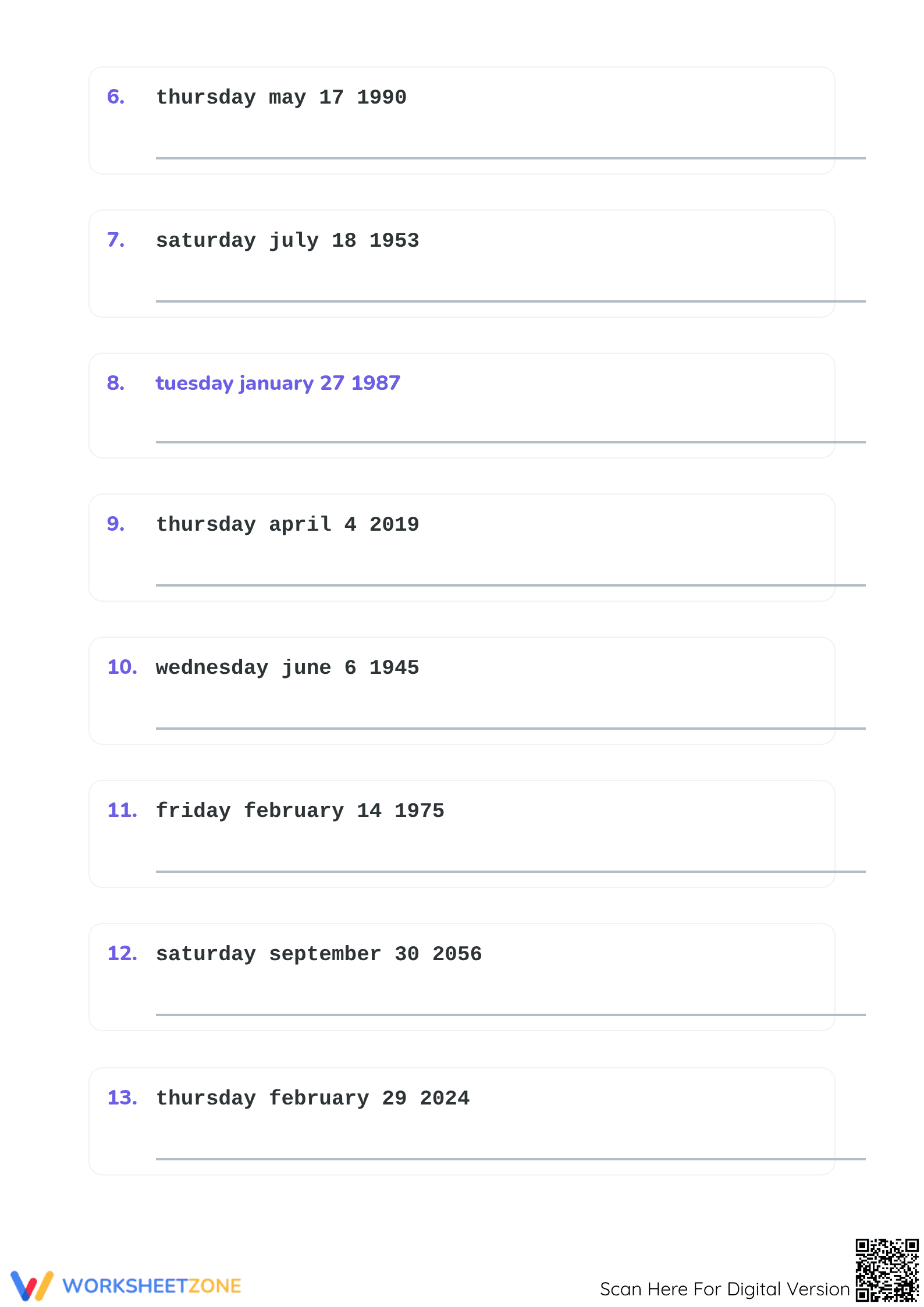
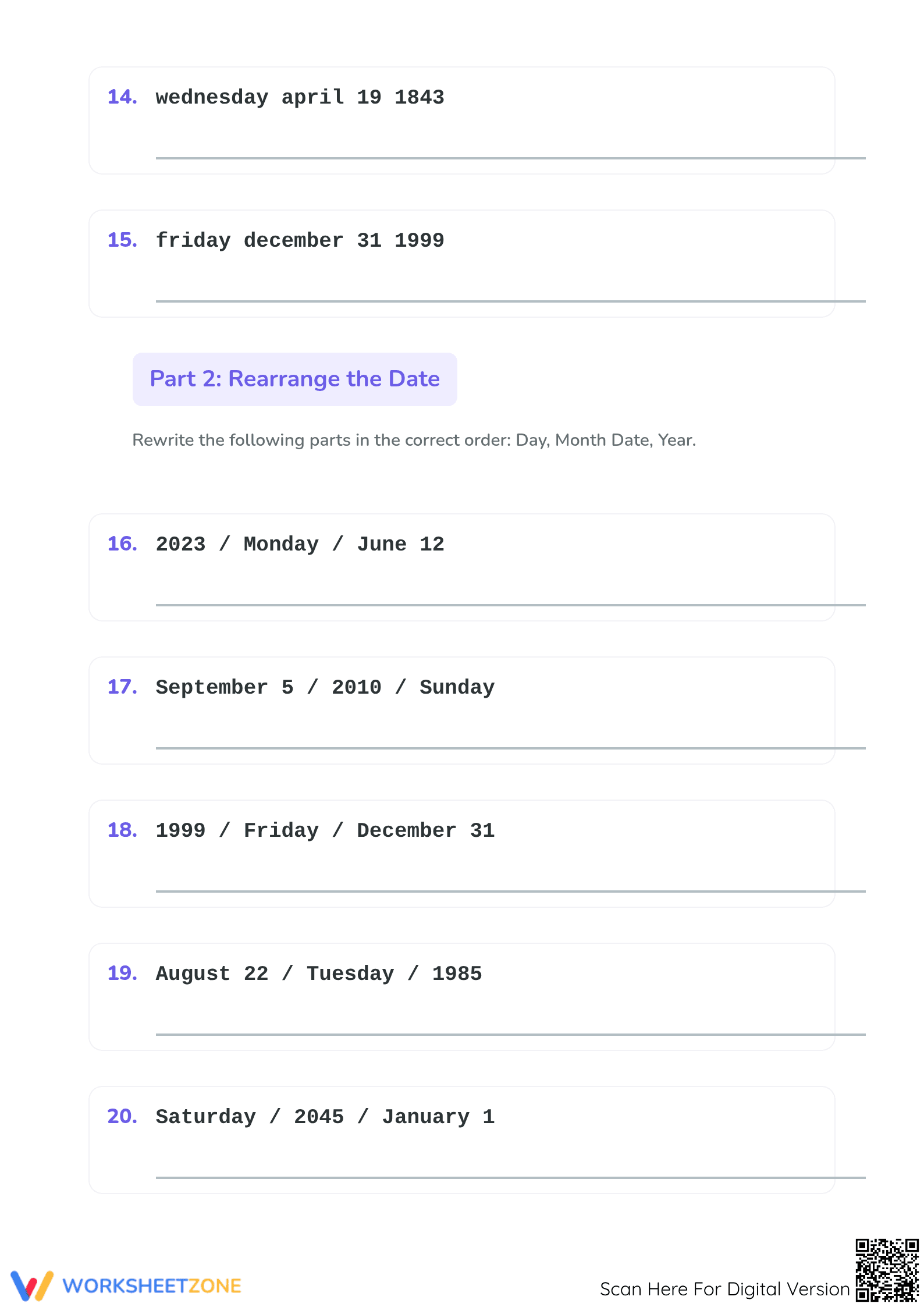
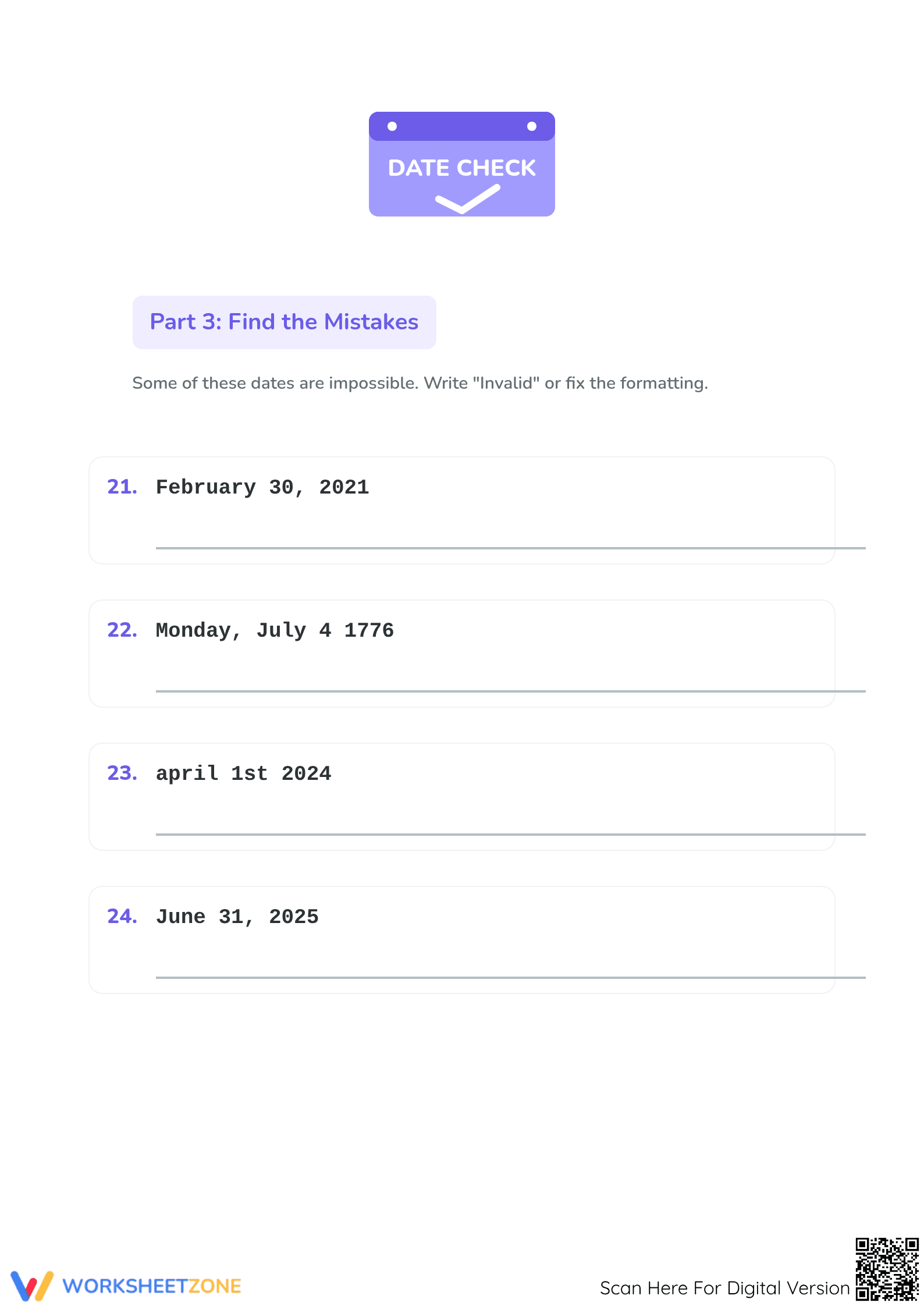
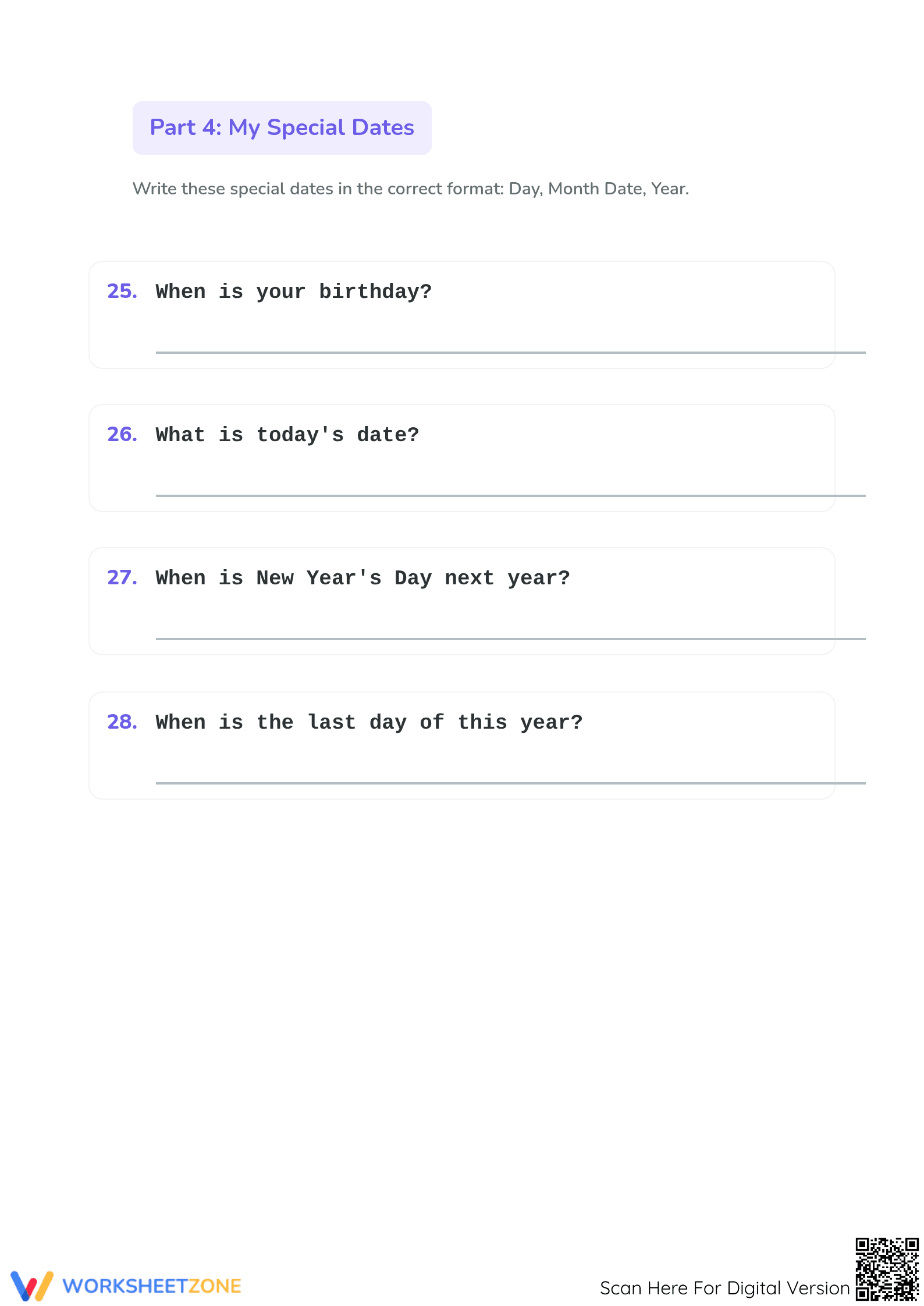
The comprehensive 5-page PDF contains four distinct sections designed to build formatting fluency. Part 1 focuses on capitalization and punctuation across 15 items, while Part 2 challenges students to rearrange date components into the standard Day-Month-Date-Year sequence. Part 3 introduces a logical check for impossible dates, and Part 4 provides personal application through open-ended prompts that require real-world temporal awareness.
- Guided Practice: The worksheet opens with a clear example, showing students how to convert "wednesday march 7 1984" into its correctly punctuated and capitalized form. This model ensures that students understand the expected syntax before moving to the 14 remaining capitalization tasks.
- Supported Practice: Part 2 provides component segments that students must reorder, reinforcing the structural hierarchy of time measurement. These 5 tasks force students to process the relationship between the day of the week, the month, and the specific year.
- Independent Practice: The "Find the Mistakes" section requires students to identify impossible dates like "February 30," demanding higher-order logical reasoning alongside mechanical accuracy. This section features 4 problems that test conceptual understanding of calendar length.
This sequence follows a gradual-release model, moving from identifying visual errors to evaluating conceptual calendar constraints. By the final section, students are applying these rules to their own personal milestones, such as their birthdays.
The primary focus is CCSS.ELA-LITERACY.L.2.2.C, which requires students to use commas correctly in dates. The worksheet also supports measurement standards by requiring students to understand the cyclical nature of months and days. Both standard codes can be copied directly into lesson plans, IEP goals, or district curriculum mapping tools to track student progress in technical writing.
Deploy this resource during the independent practice phase of a lesson on calendar skills. Teachers can observe students during Part 3 to see if they recognize the specific number of days in each month, which serves as an excellent formative assessment for time-related math standards. Expect most students to complete the 28 tasks within 25 minutes, though the personal application section may prompt productive class discussion.
This is ideal for second-grade students mastering formal writing conventions or first-grade students ready for an advanced challenge. It pairs naturally with a classroom calendar or a direct instruction lesson on capitalization. The scaffolded reordering tasks provide excellent support for English Language Learners who are learning standard US date conventions for the first time.
According to a ScienceDirect TpT Analysis, structured practice in conventions like date formatting significantly improves overall student writing stamina and technical accuracy in early elementary grades. The L.2.2.C standard emphasizes the importance of mechanics in professional and academic communication. By requiring students to not only correct punctuation but also to evaluate the validity of a date (such as identifying that February 30 is invalid), this worksheet moves beyond rote memorization into the application of logical understanding. This dual-focus approach ensures that learners understand the reason behind formatting rules. Fisher & Frey (2014) highlight that such integrated practice is essential for mastery in complex information-processing tasks. This worksheet provides the exact type of high-repetition, low-stakes environment needed for students to internalize these rules before applying them to more complex essay writing or data recording in science and math contexts where precision is non-negotiable.


