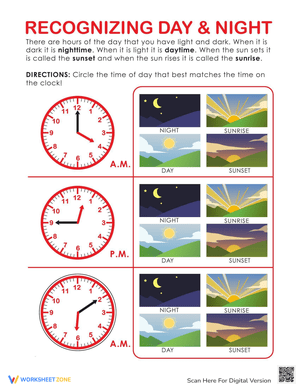
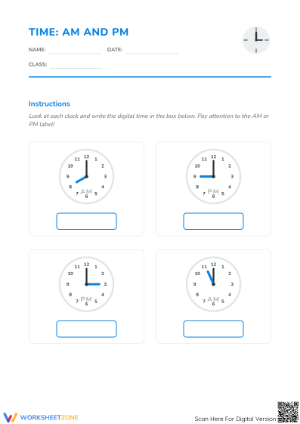
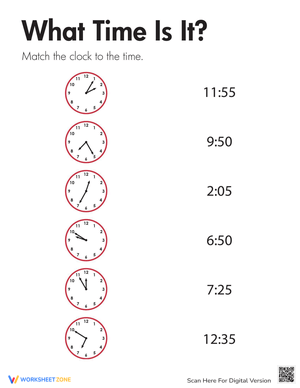
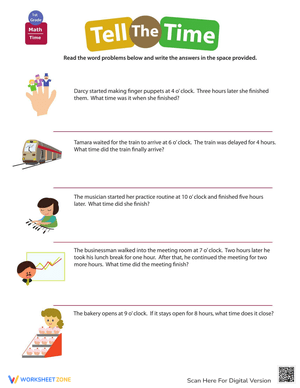
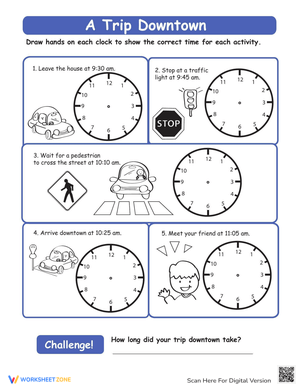
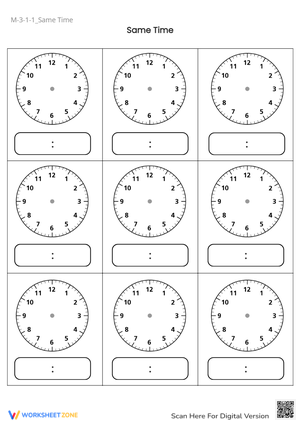
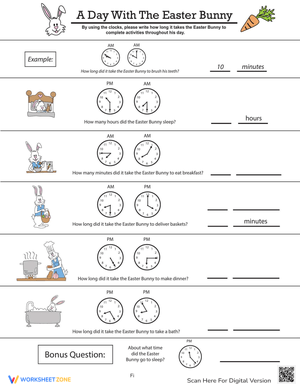
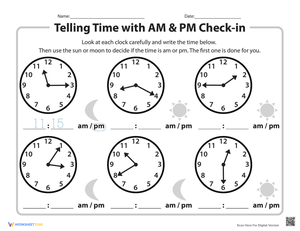
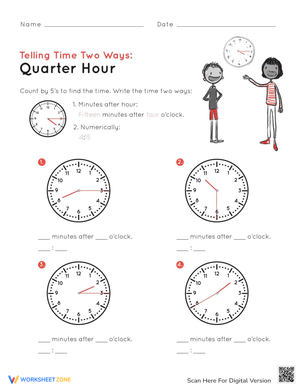
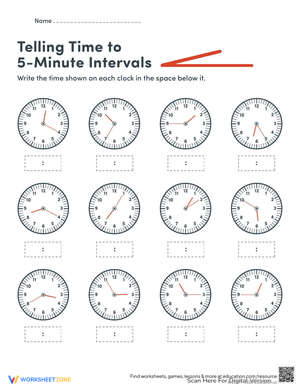
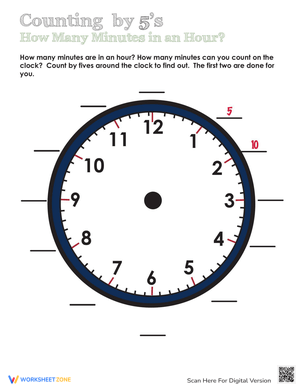
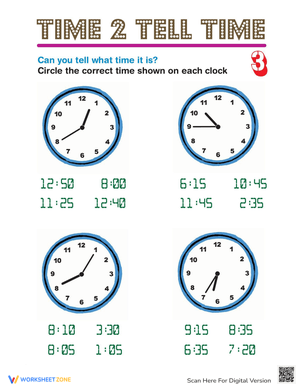
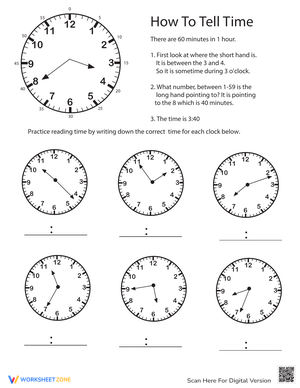
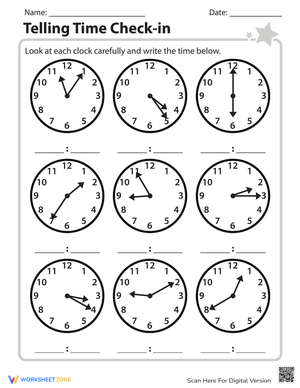
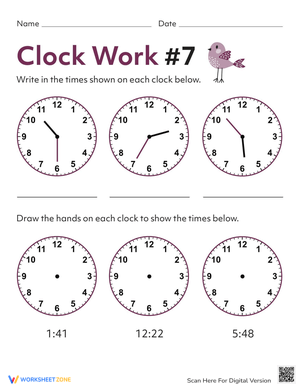
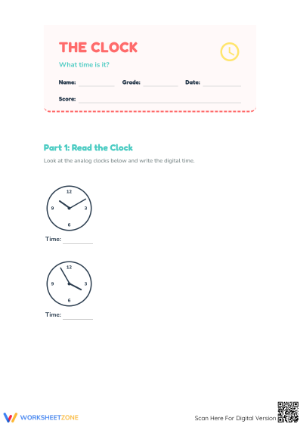
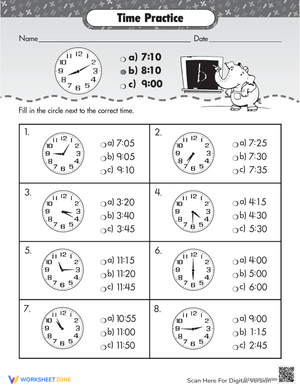
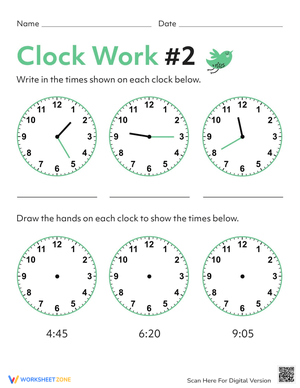
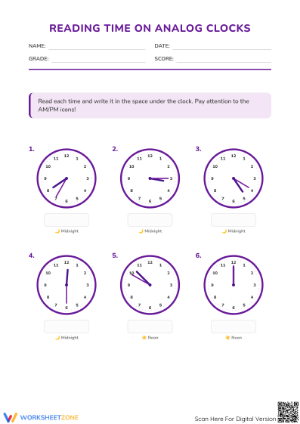
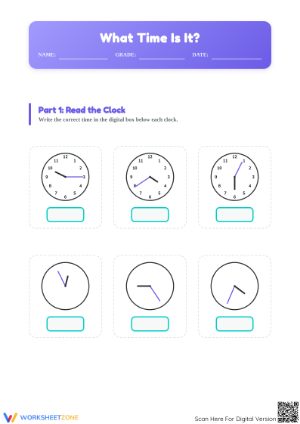
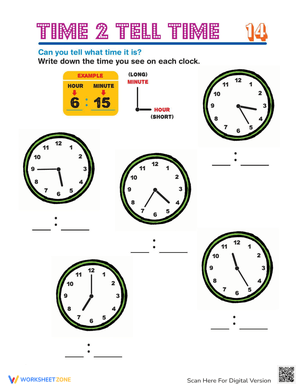
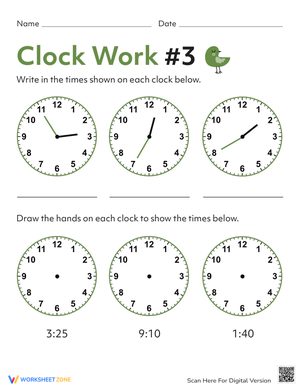
These time to the nearest 5 minutes worksheets give 2nd and 3rd grade teachers a ready-to-use practice set for one of the most visually demanding skills in early measurement — reading an analog clock when the minute hand lands somewhere other than a landmark position. Each page focuses on the skip-counting relationship between the clock's numbered positions and the minute values they represent, which is the conceptual bridge students most often need explicit practice building.
Where This Skill Sits in the Progression
The move to five-minute intervals is harder than it looks from the outside. In 1st grade, students learn to read the hour hand and recognize whole and half hours — positions where the minute hand is unambiguous. Quarter hours stretch that, but still offer four predictable landmarks. Five-minute reading requires students to track all twelve positions and attach a skip-counted value to each one, while simultaneously interpreting an hour hand that now sits noticeably between two numbers. Those two demands hit at the same time, and that's where the errors start.
Common Core 2.MD.C.7 places this skill in second grade, and 3.MD.A.1 picks it back up in third as the foundation for elapsed-time problems. A student who reads 4:50 as 4:10 — misreading the minute hand's position as the number it's near rather than counting around from 12 — cannot calculate elapsed time reliably. The practice pages in this set address both the isolated reading skill and the counting process that supports it.
The Specific Skills on Each Page
Across the set, students work with four task formats, each targeting a different aspect of clock fluency:
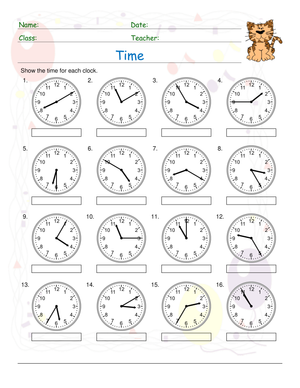
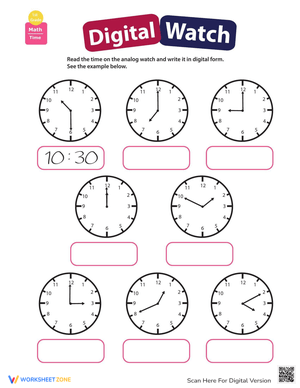
- Read and record: An analog clock displays a set time and students write the digital form. These build left-to-right fluency — seeing the clock, processing the hands, translating to numerals.
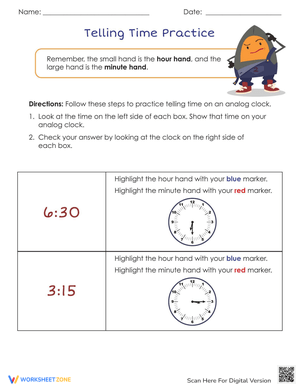
- Draw the hands: A digital time is given and students draw both hands on a blank clock face. This reverses the task and exposes gaps that reading-only practice misses — students who can read 7:35 often draw the minute hand at the 7 instead of the 7th skip-counted position.
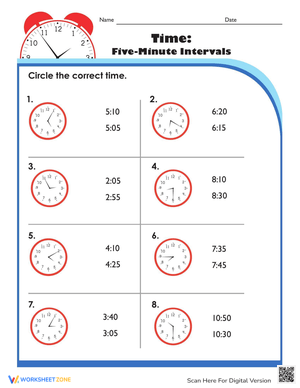
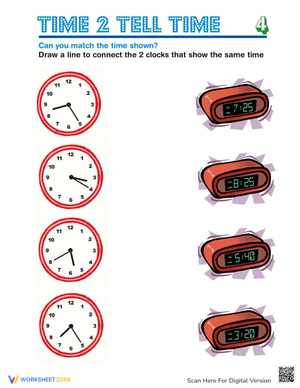
- Analog-to-digital matching: Students match a set of clocks to a list of times, which introduces the need to hold multiple readings in working memory at once.
- Sequential difficulty within pages: Each page opens with times that fall near familiar landmarks (3:00, 6:30, 9:15) before moving into the positions students consistently find harder — :05, :50, and :55, where the minute hand sits close to 12 and students second-guess their count.
Why the Skip-Counting Connection Matters Instructionally
Most second graders who struggle with five-minute intervals are not confused about the clock — they're still building skip-counting automaticity. They can produce the sequence 5, 10, 15 … 55 when prompted, but they lose their place when they have to start counting from a mid-clock position rather than from the top. A student reading a clock showing 8:40 often counts correctly up to the 7 and then loses one interval, landing on 8:35.
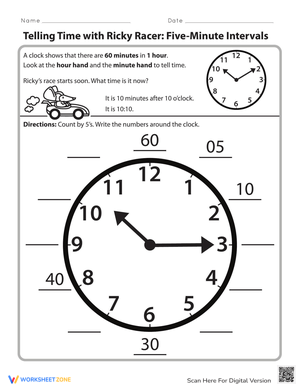
The worksheets support this by including a numbered practice track on introductory pages — twelve blanks arranged in a circle where students fill in the minute values before reading any clocks at all. Once that outer ring is internalized, students stop restarting from 12 on every problem. The habit that replaces it — locating the minute hand, anchoring to the nearest quarter, counting forward or back — develops naturally after enough distributed practice.
How These Pages Fit Into the School Day
The most reliable use we see in second grade classrooms is as a Monday warm-up during the measurement unit — four to six clocks on a half-sheet, completed in the first five minutes of math while attendance and announcements run. It costs almost no instructional time and provides the repetition that makes five-minute reading automatic rather than effortful.
Math centers are another natural home. A laminated page at the clock station, used with a dry-erase marker, can run the same five or six problems for two weeks across rotations without reprinting. Pair the sheet with a student manipulative clock and the task sharpens: the student reads the printed clock, sets their own clock to match, and then writes the time. That kinesthetic step reduces the most persistent error in this age group — confusing the hands — because students physically feel the difference in length as they position them.
For homework, a single page of eight problems sends home well. The analog format is legible at home printer resolution, parents can check it against the answer key, and it takes under ten minutes for most students at this stage.
Patterns You'll Recognize in Student Work
A few errors appear reliably enough that it's worth knowing to watch for them before returning a set of completed pages.
The most common: students read the number the minute hand is nearest to rather than counting from 12 to determine the interval. A clock showing 4:50 gets recorded as 4:10, because the minute hand is near the 10 and the student stops there. This error appears most often when the minute hand falls in the right half of the clock face (between 6 and 12 going clockwise).
A second pattern involves the hour hand on times like :35 through :55, where the hour hand is pressing close to the next number. Students who haven't been explicitly told that the hour hand moves continuously — not in jumps — will record 5:50 as 6:50 because the hand looks closer to the 6 than the 5. The draw-the-hands tasks on these pages make this visible before a unit assessment does.
Adjusting the Pages for Different Learners
For students still consolidating skip-counting, the introductory pages include clocks with minute markers labeled in multiples of 5 around the outer ring. Pull those pages first and hold the unlabeled versions until the skip-counting sequence is fluent. Color-coding the hands — even just having students trace the minute hand in one color before recording — slows the reading process enough to interrupt the guess-and-record habit some students develop.
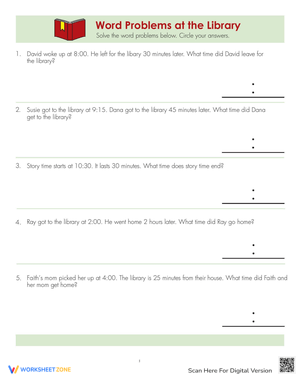
For students who read five-minute times accurately but quickly, the extension pages add a second step: after recording the time shown, students write what time it will be 20 minutes later. This is a direct on-ramp to the elapsed-time work in 3rd grade and challenges students without requiring a separate worksheet set. A few pages also include clocks with no printed numbers — just tick marks — which require students to rely entirely on hand position and committed skip-counting rather than using the numbers as a crutch.
Frequently Asked Questions
1. Is this skill assessed on state standardized tests?
In states using Common Core-aligned assessments, time to the nearest five minutes appears on 2nd grade math assessments under the Measurement and Data domain. Third grade assessments address elapsed time, which presupposes accurate five-minute reading. Students who haven't automatized the skill by the test window typically run out of time on elapsed-time items even when they understand the concept, because they're spending cognitive effort on the clock reading itself.
2. How do I know whether a student needs to revisit half-hour work before using these pages?
A two-minute informal check works well: show the student four clocks — one at the hour, one at the half hour, one at a quarter hour, and one at a five-minute interval — and ask them to read each aloud. If the hour and half-hour readings are uncertain or slow, the five-minute pages will frustrate more than they build. The skill progression is genuine; skipping rungs costs more time than revisiting them.
3. How many problems per page is appropriate for this age?
Six to ten clock problems is the right range for grades 2–3 used as practice. Fewer than six doesn't provide enough repetition within a single sitting; more than ten produces fatigue errors in the final problems that look like misconceptions but aren't. For warm-up use, four to six is enough to generate useful data without consuming the lesson.













 Interactive Worksheet Maker
 Quiz Maker
 Word Search Maker
 Crossword Puzzle Maker
 Word Scramble Generator
 Sentence Scramble Generator
 Handwriting Worksheet Generator
 Name Tracing Generator
 Fill In The Blank Generator