


























Views
Downloads


Grade 3 Reading Calendar Month Challenge: Essential Worksheet
Paste this activity's link or code into your existing LMS (Google Classroom, Canvas, Teams, Schoology, Moodle, etc.).
Students can open and work on the activity right away, with no student login required.
You'll still be able to track student progress and results from your teacher account.
Students master the practical skill of calendar navigation and interval calculation through this comprehensive Month Challenge activity. This worksheet requires learners to analyze multiple months to solve complex date-based word problems, ensuring they can translate visual calendar data into mathematical solutions. Students will identify specific holidays, calculate elapsed days, and perform date-logic operations with high accuracy.
At a Glance
- Grade: 3 · Subject: Math
- Standard:
CCSS.MATH.CONTENT.3.MD.A.1— Solve word problems involving addition and subtraction of time intervals- Skill Focus: Calendar analysis and date calculation
- Format: 5 pages · 20 problems · Answer key included · PDF
- Best For: Independent math centers or assessment
- Time: 30–45 minutes
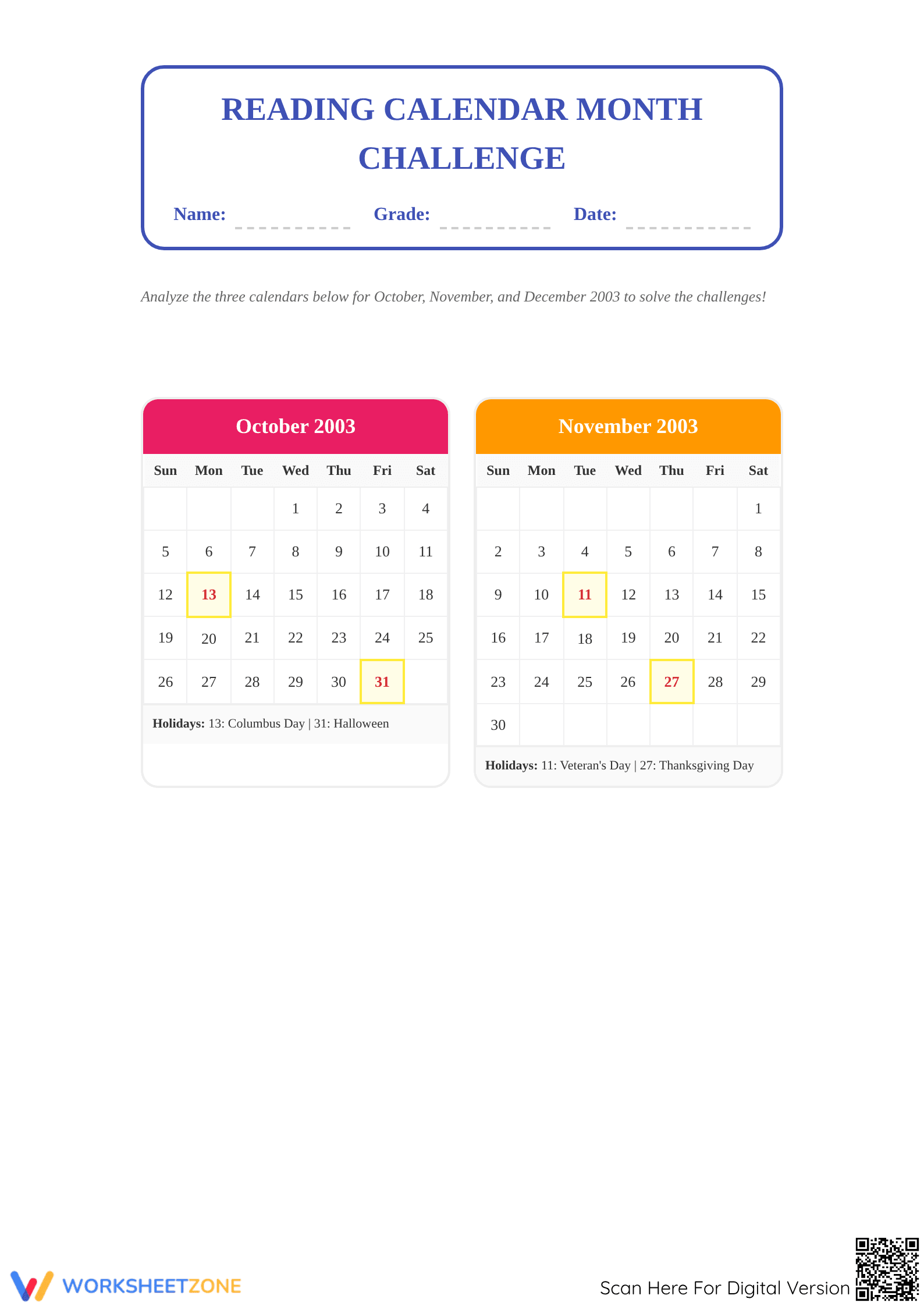
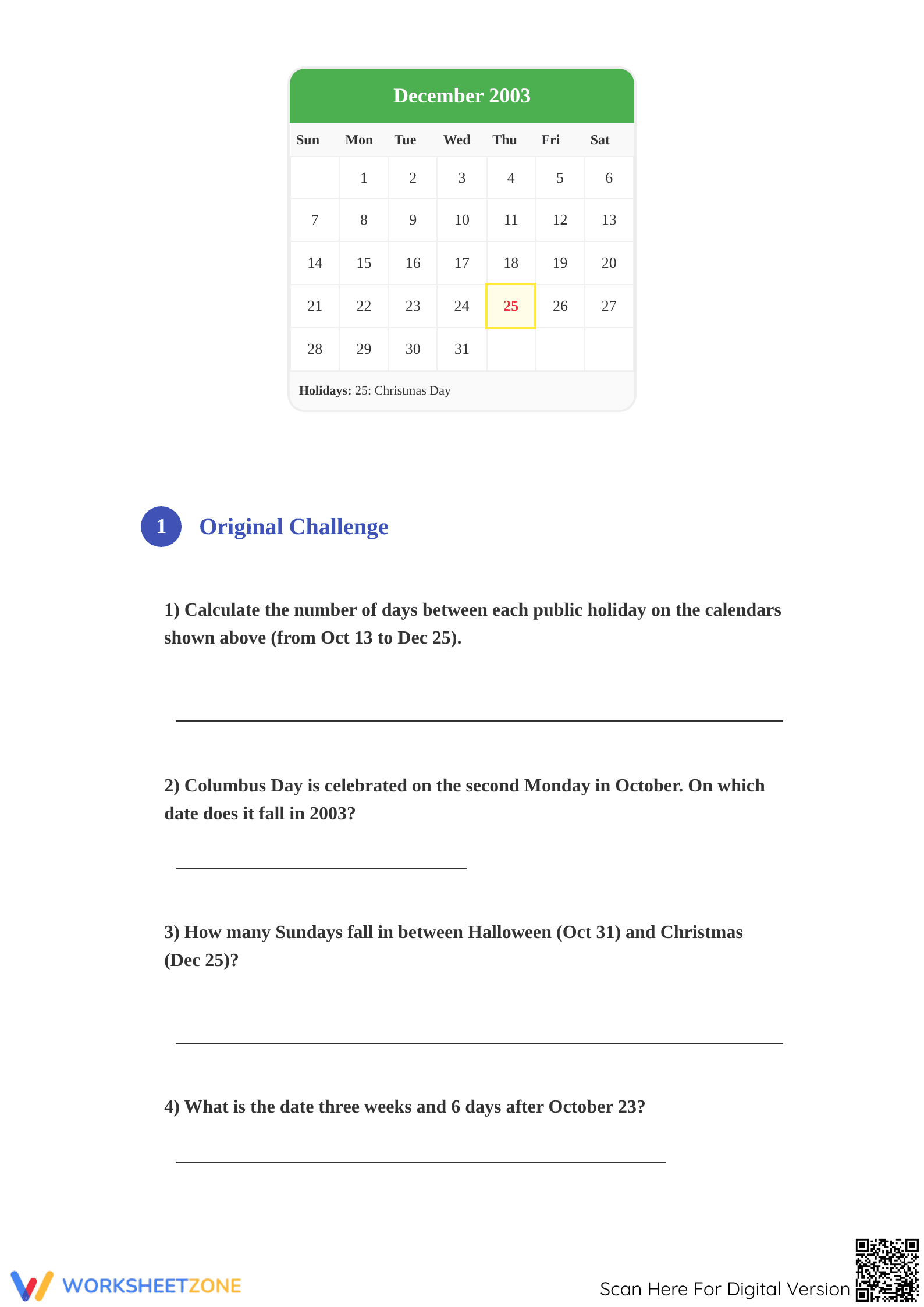
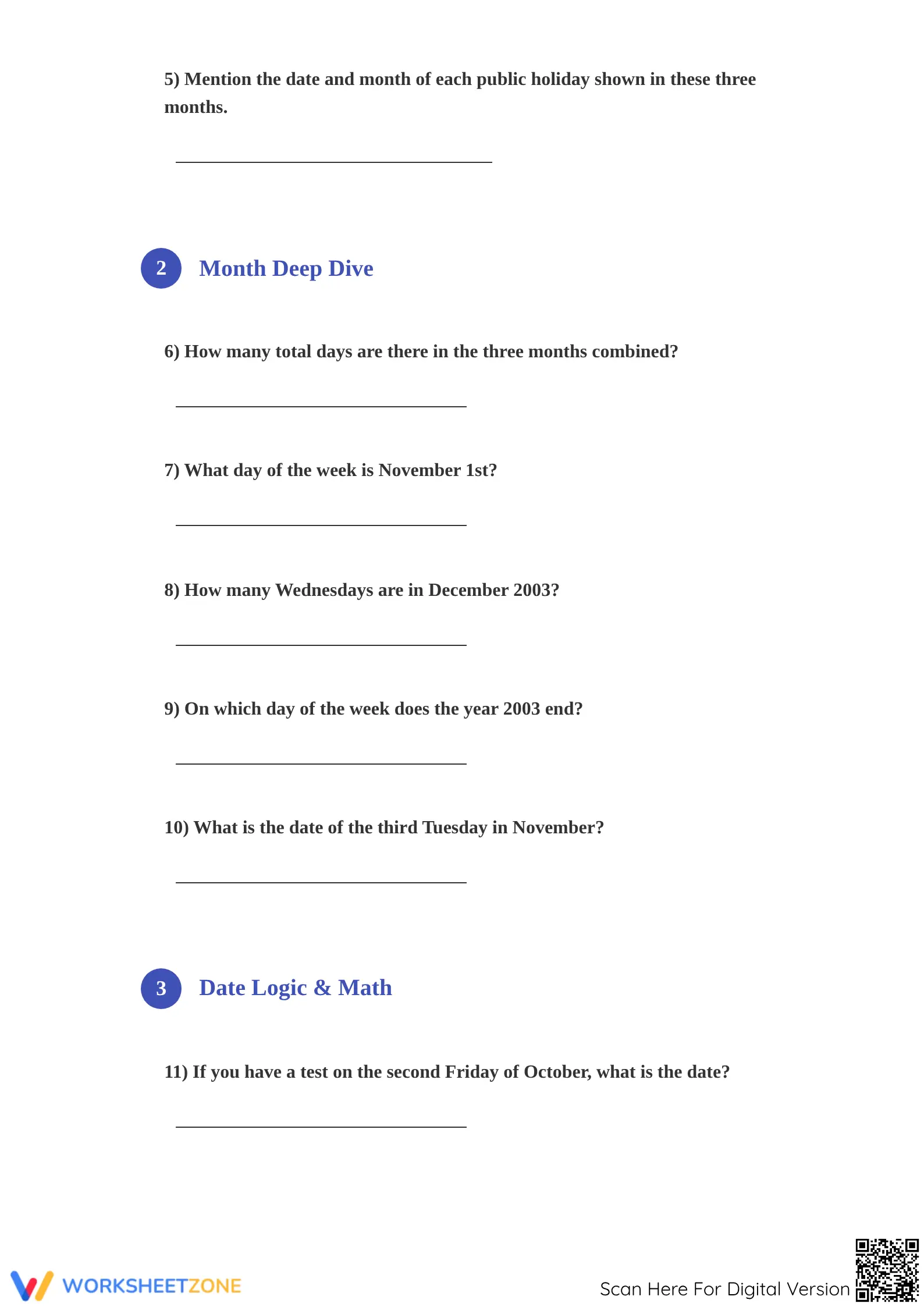
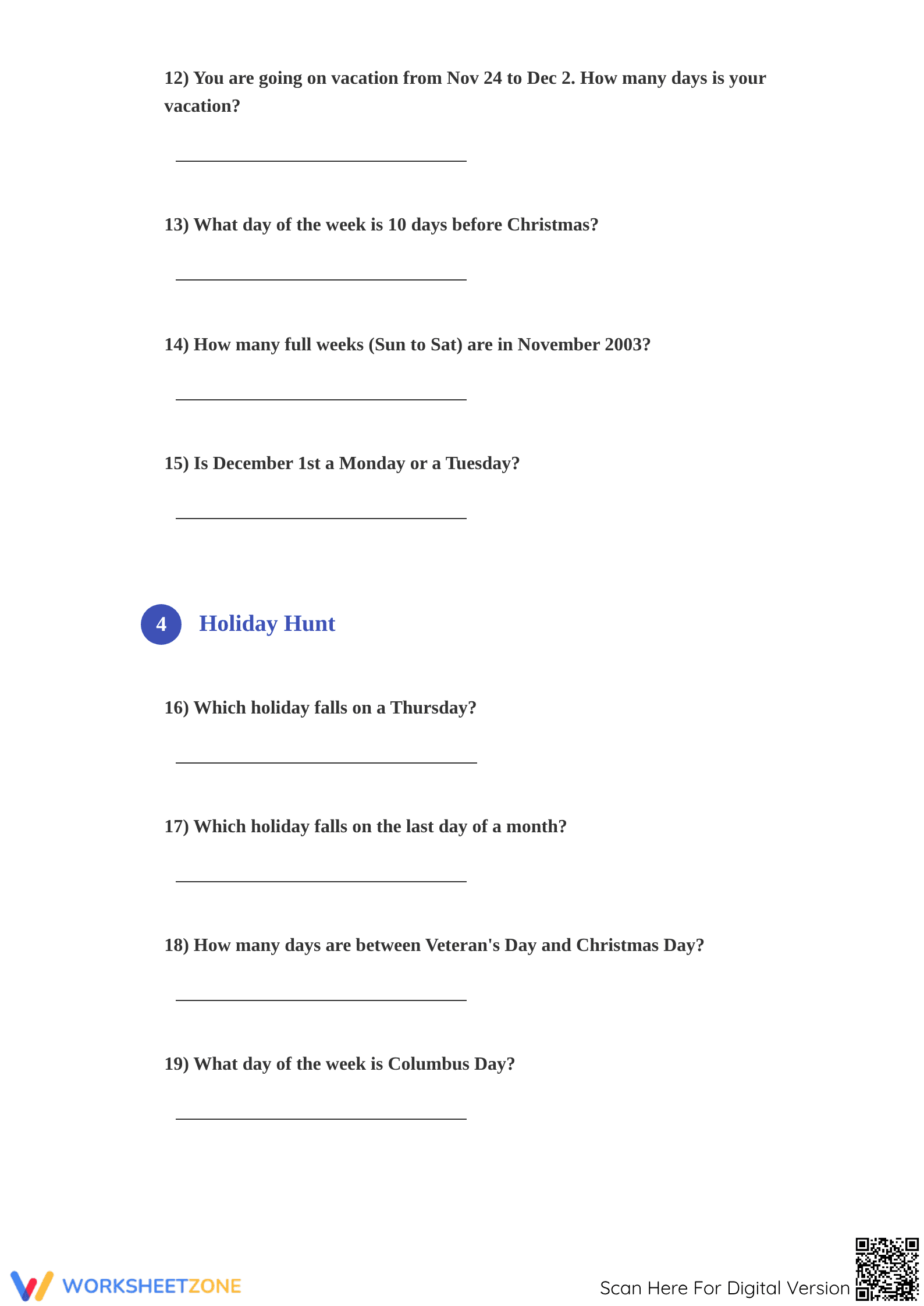
This 5-page PDF contains 20 challenges organized into four sections: Original Challenge, Month Deep Dive, Date Logic, and Holiday Hunt. The layout features high-resolution calendars for October, November, and December 2003, providing a consistent data set for all calculations. A comprehensive answer key is included to facilitate rapid grading and provide students with immediate feedback on their progress.
The zero-prep design allows teachers to implement this activity in under two minutes. First, print the 5-page challenge set for the class. Second, distribute the worksheets—no additional manipulatives are required as the calendars are embedded on the first page. Third, review the answers using the provided key, which can also be projected for whole-class self-correction. This structure makes the resource an ideal emergency sub plan or fast-finisher task.
This resource aligns to CCSS.MATH.CONTENT.3.MD.A.1, focusing on solving word problems involving time intervals. Students demonstrate mastery by calculating days between dates and identifying day-of-the-week patterns across a three-month span. Supporting standard CCSS.ELA-LITERACY.RI.3.1 is also addressed as students must refer explicitly to the calendar text to answer specific questions. Both standard codes can be copied directly into lesson plans or curriculum mapping tools.
Use this worksheet as a summative assessment after a unit on measurement and time. It provides a rigorous test of a student's ability to apply basic addition and subtraction to a real-world calendar context. For a formative approach, observe students during the date logic section to see if they utilize counting on strategies or 7-day multiplication patterns. Completion typically takes 40 minutes for on-grade learners.
The challenge is designed for Grade 3 students but provides excellent review for Grade 4 or enrichment for Grade 2. It is particularly effective for learners who benefit from visual anchors, as the embedded calendars provide a concrete reference for every problem. This resource pairs naturally with a classroom wall calendar or a direct instruction lesson on elapsed time calculations.
Research from the NAEP (2024) indicates that students who engage in regular real-world measurement tasks, such as calendar analysis, show significantly higher retention of elapsed-time concepts compared to those who only use abstract number lines. This Reading Calendar Month Challenge addresses critical cognitive gaps by requiring students to synthesize visual data across three distinct time frames. By solving 20 varied problems that range from simple date identification to complex interval calculations under the standard CCSS.MATH.CONTENT.3.MD.A.1, students build the mental schema necessary for advanced scheduling and daily time management. The multi-page format encourages sustained attention to detail, a core requirement for proficiency in the Measurement and Data domain. Educational analysts emphasize that such structured practice is essential for moving students from rote memorization of months to the functional application of time-based logic in everyday situations, providing a robust foundation for upper-elementary mathematics and logistical literacy required for future academic success.


