


























Views
Downloads
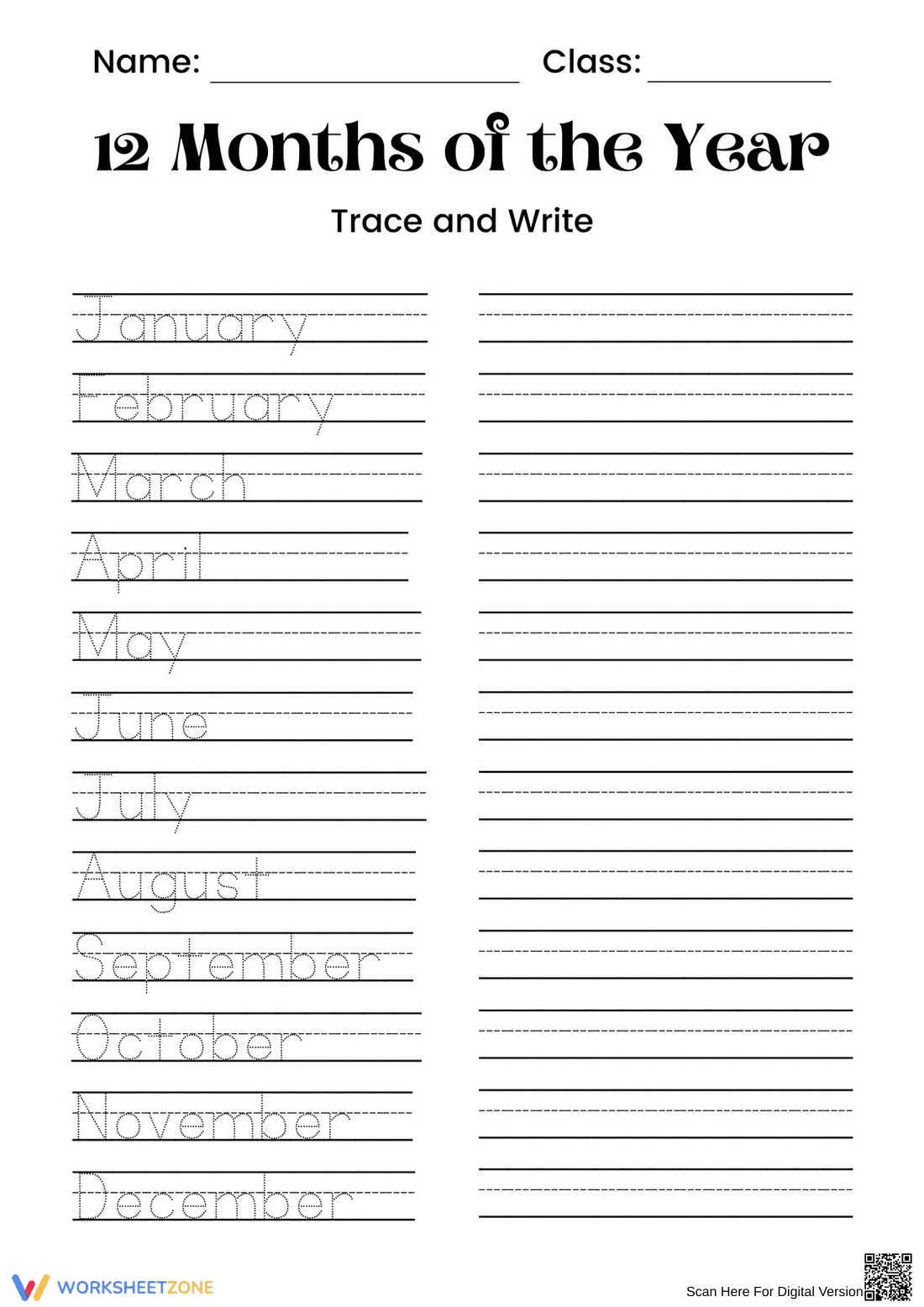

Months of the Year Tracing Worksheet | Essential Grade K
Paste this activity's link or code into your existing LMS (Google Classroom, Canvas, Teams, Schoology, Moodle, etc.).
Students can open and work on the activity right away, with no student login required.
You'll still be able to track student progress and results from your teacher account.
This Kindergarten months of the year worksheet provides a structured way for students to master the spelling and sequence of the calendar. By combining tracing with independent writing, learners build the muscle memory needed for fluent handwriting while reinforcing chronological vocabulary. It is an ideal resource for morning work or literacy centers.
At a Glance
- Grade: Kindergarten · Subject: ELA
- Standard:
CCSS.ELA-LITERACY.L.K.1.A— Print many upper- and lowercase letters correctly during writing tasks- Skill Focus: Handwriting & Calendar Vocabulary
- Format: 1 page · 24 tasks · Answer key included · PDF
- Best For: Morning work and fine motor practice
- Time: 15–20 minutes
The worksheet features a clean, black-and-white design optimized for easy printing. It contains 12 rows, one for each month from January to December. Each row includes a dotted-line tracing prompt to guide letter formation and a corresponding blank line for independent practice. This single-page PDF ensures students practice both uppercase and lowercase letters in a meaningful context.
Teachers can integrate this resource into their daily routine in under 2 minutes. First, print the single-page PDF for the entire class (30 seconds). Second, distribute the sheets during a calendar math or ELA block (30 seconds). Third, review the work by having students read the months aloud to check for recognition (1 minute). This zero-prep design makes it a perfect sub plan or morning work option.
This resource aligns with `CCSS.ELA-LITERACY.L.K.1.A`, which requires students to print many upper- and lowercase letters. It also supports vocabulary development related to time and sequences. Both standard codes can be copied directly into lesson plans, IEP goals, or district curriculum mapping tools.
Use this worksheet during the "You Do" phase of a handwriting lesson to assess letter formation. It also serves as an effective formative assessment tool; observe students as they transition from the traced model to the blank line to identify specific letter-spacing or size issues. Expect completion within 15 to 20 minutes depending on fine motor proficiency.
This is designed for Kindergarten students but is also appropriate for Grade 1 students needing remedial handwriting support or English Language Learners (ELLs) building basic vocabulary. It pairs naturally with a classroom calendar anchor chart or a "Months of the Year" song during circle time.
Research from Fisher & Frey (2014) emphasizes the importance of the gradual release of responsibility, which this worksheet facilitates through its "trace then write" structure. By providing a scaffolded model (tracing) immediately followed by independent application (writing), students are more likely to retain correct spelling and letter formation compared to unguided practice. This alignment with `CCSS.ELA-LITERACY.L.K.1.A` ensures that students are meeting foundational literacy benchmarks required for early elementary success. The 24 distinct tasks provide sufficient repetition to build automaticity without causing cognitive fatigue in young learners. According to NAEP data, early mastery of handwriting is a significant predictor of later writing fluency and academic achievement. This printable PDF offers a high-utility, evidence-based approach to calendar literacy that fits into any early childhood curriculum.


