


























Views
Downloads
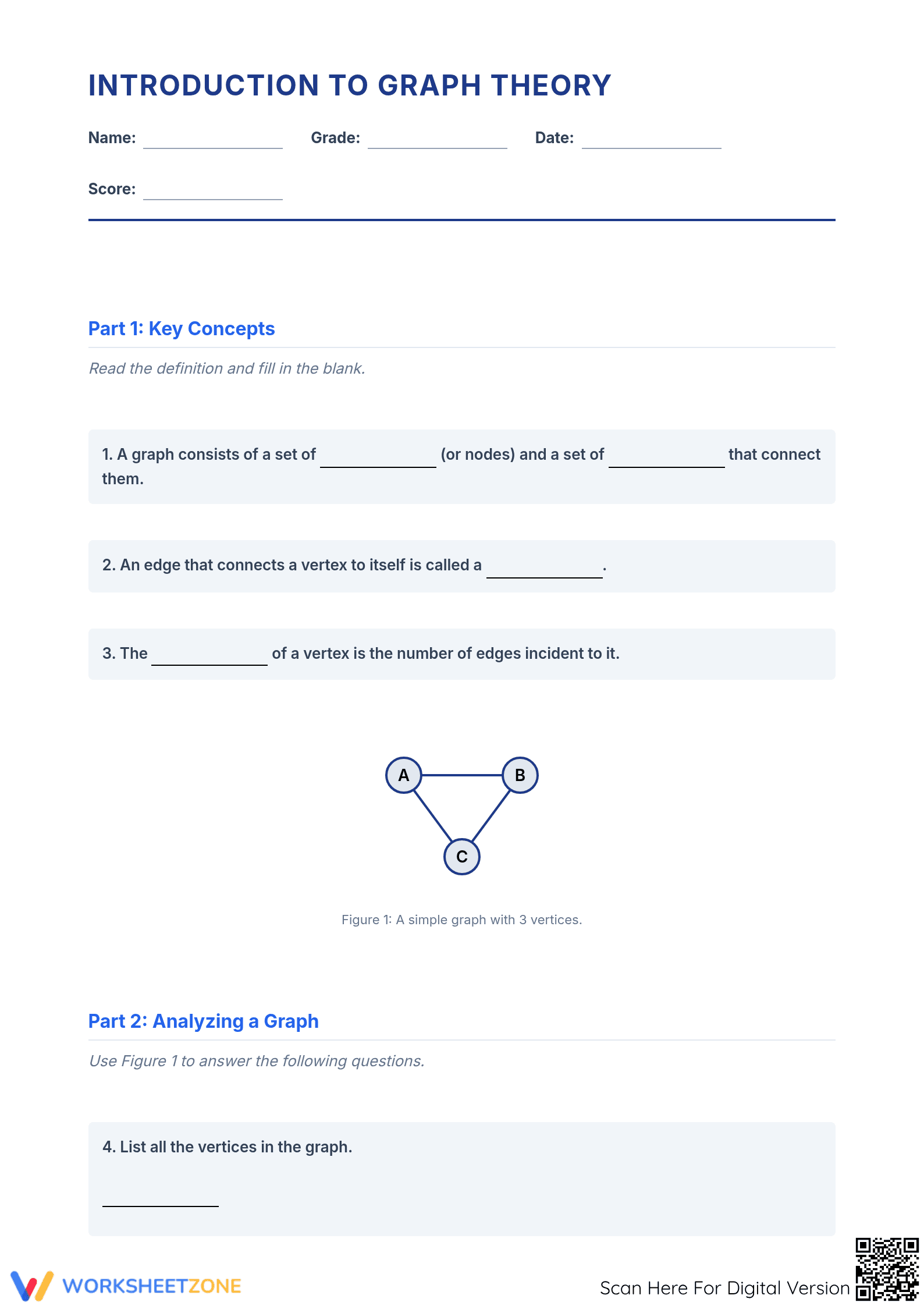


Printable Introduction to Graph Theory Worksheet | Grade 9
Paste this activity's link or code into your existing LMS (Google Classroom, Canvas, Teams, Schoology, Moodle, etc.).
Students can open and work on the activity right away, with no student login required.
You'll still be able to track student progress and results from your teacher account.
This Introduction to Graph Theory worksheet provides secondary students with a structured foundation in discrete mathematics. By focusing on fundamental terminology and visual analysis, the resource ensures learners can accurately identify and describe the components of a mathematical graph, facilitating a smooth transition into more complex networking and algorithmic concepts.
At a Glance
- Grade: 9 · Subject: Math
- Standard:
CCSS.MATH.CONTENT.HSG.MG.A.1— Use geometric shapes and their properties to describe objects accurately- Skill Focus: Graph components (vertices, edges, loops, degrees)
- Format: 2 pages · 6 problems · Answer key included · PDF
- Best For: Initial skill introduction and vocabulary reinforcement
- Time: 15–20 minutes
The worksheet is organized into two distinct phases to support student understanding. Part 1 focuses on key concepts through fill-in-the-blank definitions, covering vertices, edges, loops, and the degree of a vertex. Part 2 transitions to practical application, requiring students to analyze a provided simple graph diagram to list specific vertices, calculate vertex degrees, and determine graph connectivity. This 2-page PDF includes a comprehensive answer key for efficient grading or self-correction.
Skill Progression
- Guided Practice: Students encounter 3 foundational definitions with scaffolded prompts to establish the core vocabulary of graph theory.
- Supported Practice: Learners interact with a visual model (Figure 1), translating abstract definitions into concrete observations by listing specific graph elements.
- Independent Practice: The final tasks require higher-order analysis, where students must calculate properties (degree) and evaluate the global state of the graph (connectivity) without direct cues.
This structure follows the gradual-release model, moving from linguistic comprehension to mathematical application.
Standards Alignment
The primary alignment is to `HSG-MG.A.1`, which focuses on using geometric shapes, their measures, and their properties to describe objects. While graph theory is often categorized under discrete math, it functions as a critical application of modeling and spatial reasoning at the high school level. The worksheet also supports standards related to mathematical modeling and abstract reasoning. Both standard codes can be copied directly into lesson plans, IEP goals, or district curriculum mapping tools.
How to Use It
This resource is best utilized during the "Explore" phase of a lesson on discrete mathematics or networking. Assign the worksheet after a brief direct instruction session on graph components to provide immediate formative feedback. Teachers should circulate during Part 2, observing if students correctly count edges for vertex degrees, particularly noting if any confusion arises between nodes and vertices. Expected completion time is 15 to 20 minutes.
Who It's For
This worksheet is designed for Grade 7-9 students beginning their study of Algebra or specialized Math electives. It is particularly effective for visual learners who benefit from seeing the relationship between definitions and diagrams. It pairs naturally with an introductory slide deck or an interactive whiteboard demonstration where students can draw their own graphs before completing the independent tasks.
According to research from ScienceDirect TpT Analysis, the use of visual mapping and discrete modeling in early secondary math significantly improves long-term retention of abstract algebraic concepts. This Introduction to Graph Theory worksheet aligns with the recommendations of Fisher & Frey (2014) regarding the importance of establishing technical vocabulary early in the instructional cycle. By providing 6 targeted tasks that bridge the gap between definition and diagrammatic analysis, the resource helps students master the core skills required by standard HSG-MG.A.1. The inclusion of a clear answer key supports the iterative feedback loops necessary for student growth in mathematical reasoning. Educators can utilize these findings to justify the integration of graph theory into broader geometric modeling units, ensuring students are prepared for the increasing demands of modern STEM curricula.


