


























0
Views
0
Downloads

0.0
0
Save
0 Likes
Share
Introduction to Graph Theory Worksheet
0 Views
0 Downloads
Paste this activity's link or code into your existing LMS (Google Classroom, Canvas, Teams, Schoology, Moodle, etc.).
Students can open and work on the activity right away, with no student login required.
You'll still be able to track student progress and results from your teacher account.
Information
Description
What It Is:
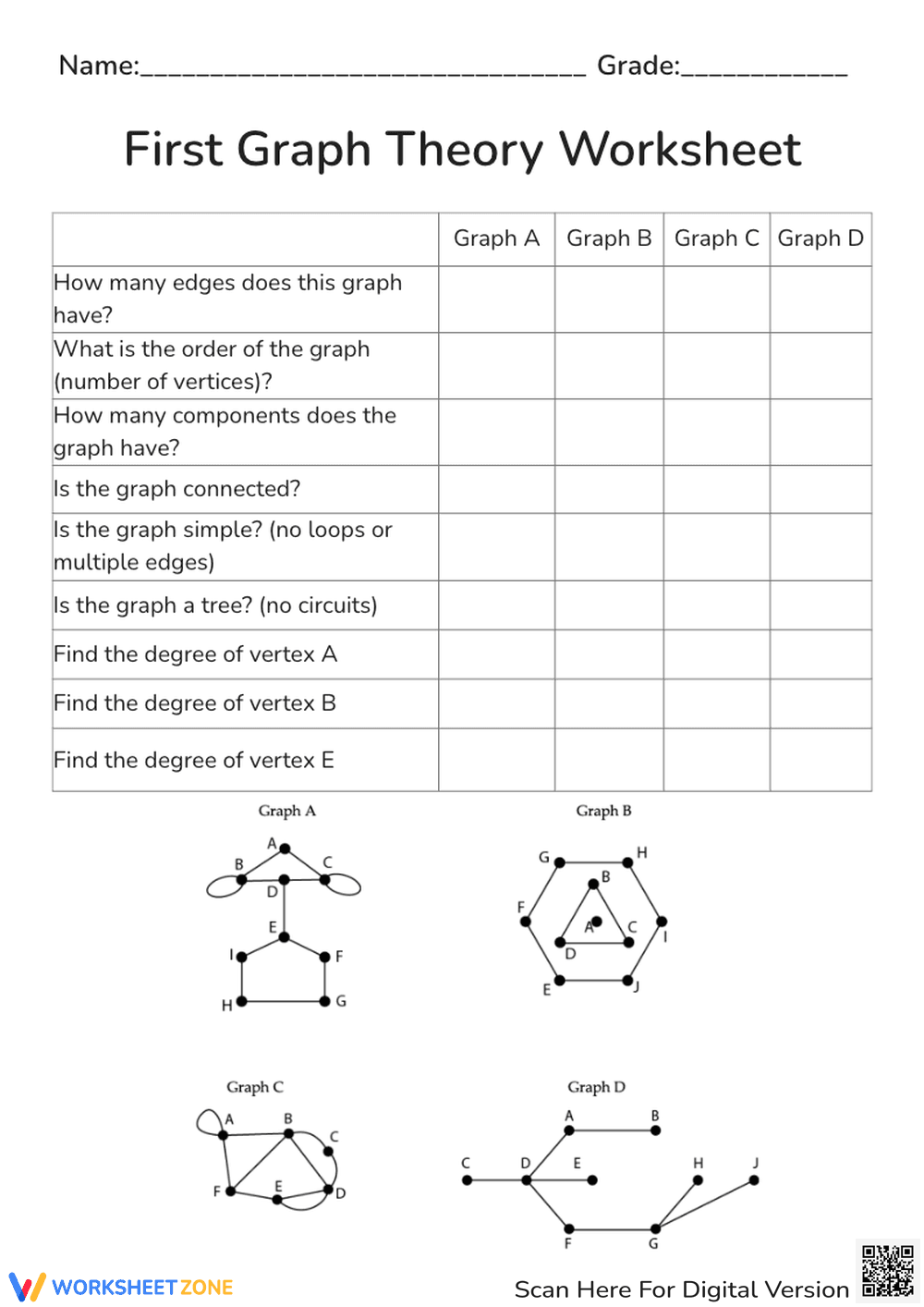
This is a 'First Graph Theory Worksheet' featuring a table with questions about four different graphs (Graph A, Graph B, Graph C, and Graph D). The questions include: How many edges does the graph have? What is the order of the graph (number of vertices)? How many components does the graph have? Is the graph connected? Is the graph simple (no loops or multiple edges)? Is the graph a tree (no circuits)? Find the degree of vertex A, B, and E. The worksheet provides visual representations of each graph (A, B, C, and D) with labeled vertices (A, B, C, D, E, F, G, H, I, J). Graph A has a loop and multiple edges.
Grade Level Suitability:
This worksheet is suitable for high school and early college levels (Grades 9-14). The concepts of graph theory, including edges, vertices, components, connectivity, simple graphs, trees, and degree of vertices, are typically introduced at these levels.
Why Use It:
This worksheet helps students learn and practice fundamental concepts in graph theory. It reinforces their understanding of key definitions and provides hands-on experience in analyzing and characterizing different types of graphs. It also develops critical thinking and problem-solving skills related to graph properties.
How to Use It:
Students should examine each graph (A, B, C, and D) and answer the questions in the corresponding columns. They need to count the edges and vertices, determine the number of components, assess connectivity and simplicity, identify if the graph is a tree, and find the degree of specific vertices (A, B, and E) in each graph.
Target Users:
The target users are high school students, college students, and educators who are learning or teaching introductory graph theory concepts. It is beneficial for anyone needing to practice identifying and analyzing basic graph properties.
This is a 'First Graph Theory Worksheet' featuring a table with questions about four different graphs (Graph A, Graph B, Graph C, and Graph D). The questions include: How many edges does the graph have? What is the order of the graph (number of vertices)? How many components does the graph have? Is the graph connected? Is the graph simple (no loops or multiple edges)? Is the graph a tree (no circuits)? Find the degree of vertex A, B, and E. The worksheet provides visual representations of each graph (A, B, C, and D) with labeled vertices (A, B, C, D, E, F, G, H, I, J). Graph A has a loop and multiple edges.
Grade Level Suitability:
This worksheet is suitable for high school and early college levels (Grades 9-14). The concepts of graph theory, including edges, vertices, components, connectivity, simple graphs, trees, and degree of vertices, are typically introduced at these levels.
Why Use It:
This worksheet helps students learn and practice fundamental concepts in graph theory. It reinforces their understanding of key definitions and provides hands-on experience in analyzing and characterizing different types of graphs. It also develops critical thinking and problem-solving skills related to graph properties.
How to Use It:
Students should examine each graph (A, B, C, and D) and answer the questions in the corresponding columns. They need to count the edges and vertices, determine the number of components, assess connectivity and simplicity, identify if the graph is a tree, and find the degree of specific vertices (A, B, and E) in each graph.
Target Users:
The target users are high school students, college students, and educators who are learning or teaching introductory graph theory concepts. It is beneficial for anyone needing to practice identifying and analyzing basic graph properties.


