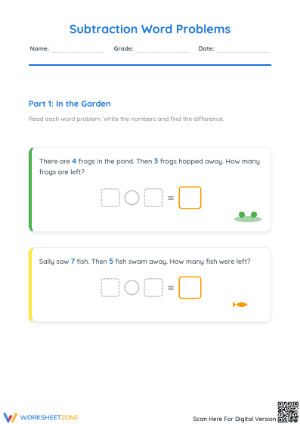
These kindergarten subtraction worksheets give students a clear visual path into taking away before a written equation means anything to them. Each worksheet keeps numbers small — within 5 or within 10 — and relies on pictures, cross-outs, and ten frames rather than text-heavy directions. Teachers get a set that moves from concrete picture problems to simple written equations, matching how most kindergarten programs sequence the concept across the year.
The Specific Skills Each Worksheet Builds
The set addresses four formats, each targeting a stage in how kindergarteners develop subtraction understanding:
- Picture cross-out problems: Students count a group of drawn objects, cross out the number being taken away, and record what remains. This is usually the first format students can do independently, because crossing out mirrors what "take away" means physically.
- Count-and-compare images: A before-and-after picture shows a full group and then the same group with some removed. Students identify how many were taken and how many are left — building vocabulary alongside number recognition.
- Ten-frame subtraction: Filled dots sit in a structured grid; students remove a given number and count what's left. The frame helps students see how quantities relate inside 10 more reliably than scattered pictures do.
- Equations with picture support: Problems such as 8 - 3 = __ appear beside a small image. Students connect written symbols to the action they've already been practicing with objects and pictures.
The within-5 and within-10 problems appear on separate worksheets rather than mixed together. That separation matters: mixed-range kindergarten subtraction worksheets make it harder to see exactly where a student's counting accuracy breaks down. Keeping the ranges distinct lets teachers assign based on what each student actually needs.
Mistakes Students Make That These Worksheets Help You Catch
The most persistent problem in early subtraction is the recount error. A student crosses out 3 objects from a group of 6, then sweeps their finger back to the start and counts all 6 again — crossed-out marks included — and writes "6" as the answer. They understand "take away" loosely but haven't yet separated the act of removing from the act of counting what remains. Picture cross-out worksheets make this visible immediately, because you can watch exactly where the finger goes.
A second error surfaces once students encounter written equations. Asked to solve 5 - 2 = __, many kindergarteners write "2" — the last number they heard or saw. They're treating subtraction as a pattern-matching exercise rather than a take-away action. No amount of correction lands until they build a few problems with counters and then look at the equation alongside the physical model. Worksheets that pair equations with a small picture push back on this directly, because the visual answer and the written answer have to match.
Subtracting zero also trips students up more than teachers expect. When 4 - 0 = __ appears, many students feel compelled to cross something out. They'll mark one object, count three, and write "3." The idea that removing nothing leaves everything unchanged is genuinely counterintuitive for five-year-olds and almost always needs to be discussed out loud before students encounter it in writing.
Fitting These Worksheets Into Your Daily Planning
During morning work, a short picture cross-out worksheet — four to six problems — functions as a calm independent task while attendance is taken. Students who already know the concept can work alone; students newer to it can have counters at their seat or get a quick check-in before they start.
In math centers, these worksheets pair well with small manipulatives: linking cubes, two-color counters, or mini erasers. The routine that works best is act out, then record — students build the starting amount, remove the subtracted number physically, count what's left, and then write the answer. Without that hands-on step first, some students will copy what they see on the worksheet without attaching meaning to it.
For small-group time, working through one worksheet together gives the teacher something useful to listen for: whether students count all, count back from the larger number, or recognize small differences by sight. Those distinctions tell you where direct instruction needs to go next. For send-home review, kindergarten subtraction worksheets built around pictures travel better than equation-only formats — a parent can support the task without needing a math explanation, and the visual tells students what to do even if they've forgotten verbal directions.
Adjusting These Worksheets Across Different Student Levels
Students who haven't yet secured one-to-one correspondence — where each count word matches exactly one object — will miscalculate even simple problems. For these students, pair each worksheet with concrete objects and count together before asking for written answers. The worksheet records the thinking; the objects do the actual math for now.
Students who are solid within 5 but not yet within 10 should stay on within-5 worksheets until they can explain what happened in a problem, not just produce a number. "I had 5, I crossed out 2, and 3 are left" is a stronger readiness signal than getting the answer right once. Verbal explanation shows the student understands what changed — a correct numeral alone doesn't.
For students already moving toward fluency, mixing in equation-only problems alongside picture-based worksheets builds independence. Some teachers at this level also ask students to draw a quick sketch above each equation before writing the answer — a small step that keeps meaning attached to the symbols and shows exactly how a student is thinking through each problem.
Standard Alignment
These worksheets address CCSS.MATH.CONTENT.K.OA.A.1 and K.OA.A.2. K.OA.A.1 asks students to represent addition and subtraction using objects, fingers, drawings, and equations — which is what the picture and ten-frame formats directly support. K.OA.A.2 moves into solving addition and subtraction word problems within 10, which the count-and-compare worksheets address once initial understanding is in place. In most kindergarten programs, formal subtraction instruction begins in the second quarter, after students have spent time on addition and counting through 10. This set fits that timeline without requiring adjustment.
Frequently Asked Questions
Should kindergarteners learn addition before subtraction?
Most programs introduce addition first, and the sequence makes sense — students build understanding of quantity through combining before they take away. That said, kindergarteners can begin subtraction without waiting for addition mastery. The key is making sure students have a working mental model of what numbers mean before the take-away action is introduced.
How many problems should each worksheet include?
Four to eight problems is a reasonable range for most of the year. Longer worksheets increase the chance that students rush or lose track of the task. A shorter worksheet finished with care tells a teacher more than a longer one completed in a hurry.
What's the best way to use these worksheets in a small group?
Have each student work through the worksheet while you watch and listen. Ask: "How many did you start with? How many did you take away? How many are left?" Those three questions reveal whether a student is actually using the subtraction structure or just writing numbers that look plausible. The conversation is often more informative than the written answer.
Can these worksheets be sent home for family practice?
Picture-based kindergarten subtraction worksheets go home well. A parent or older sibling can support the task without a math background — the cross-out format makes the expectation visual. Equation-only formats are harder to support at home. If you're sending work home, include a brief note on the worksheet itself: something like "cross out 2 apples, count what's left, write the number."
















 Interactive Worksheet Maker
 Quiz Maker
 Word Search Maker
 Crossword Puzzle Maker
 Word Scramble Generator
 Sentence Scramble Generator
 Handwriting Worksheet Generator
 Name Tracing Generator
 Fill In The Blank Generator