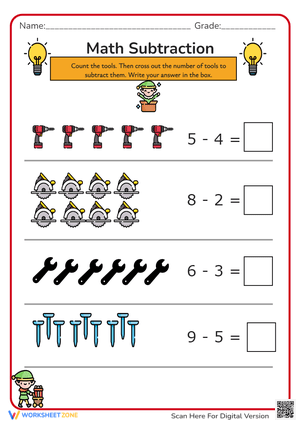
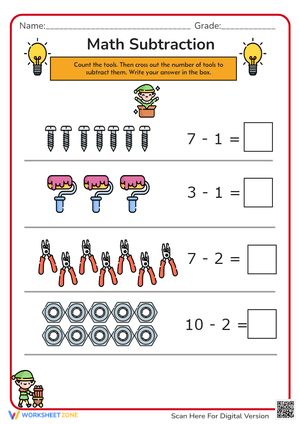
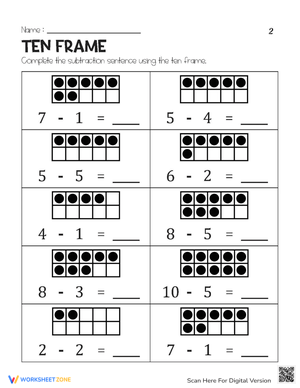
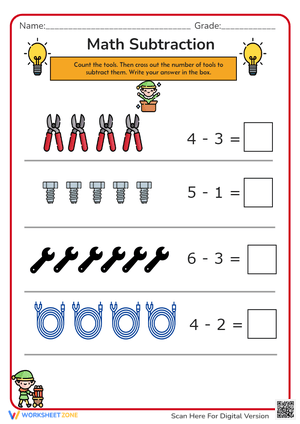
These subtraction strategies printable worksheets for kindergarten build on four visual methods — cross-out pictures, ten-frame marking, number line hopping, and student-generated drawings — giving teachers ready practice materials that cover the full K.OA.A scope within 10. Each worksheet focuses on one method at a time, which matters for five- and six-year-olds who need to consolidate an approach before mixing strategies.
The Four Strategies Covered Across the Set
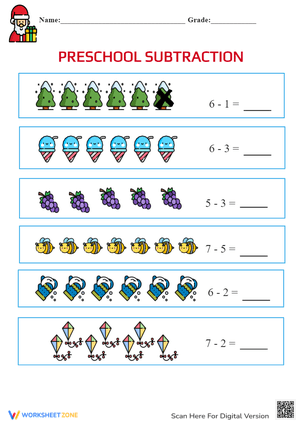
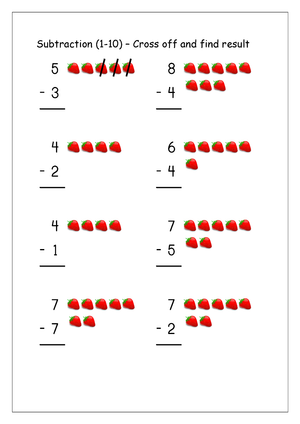
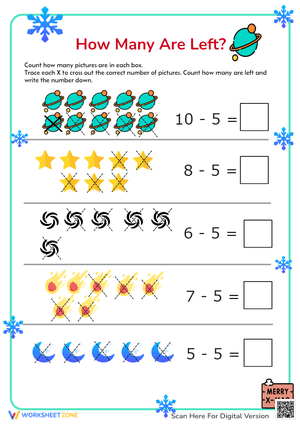
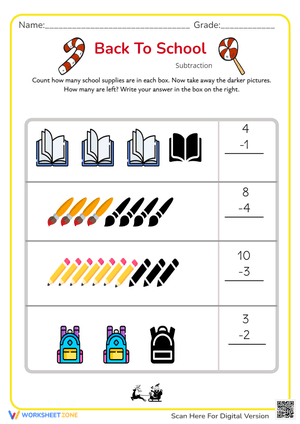
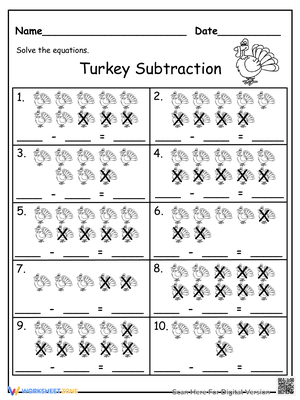
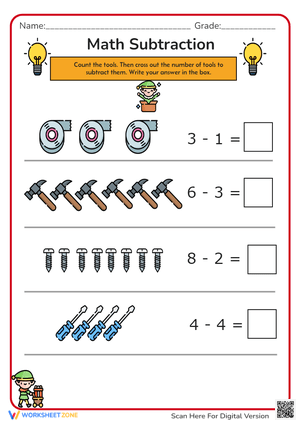
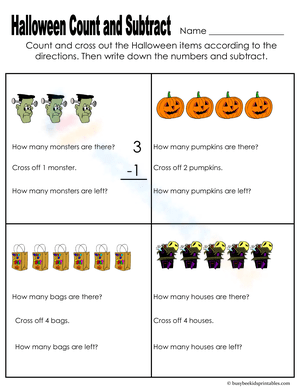
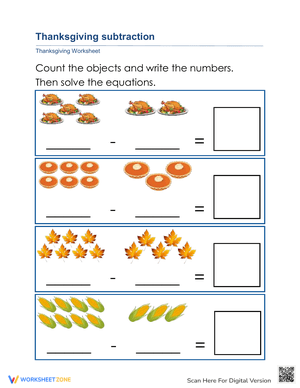
Cross-out worksheets are typically where this sequence begins. Students look at a row of pictures — fish, apples, stars — mark through the number being subtracted, then count the unmarked images and write the difference. The action mirrors what students have done physically with manipulatives, so the transfer to paper feels intuitive rather than arbitrary.
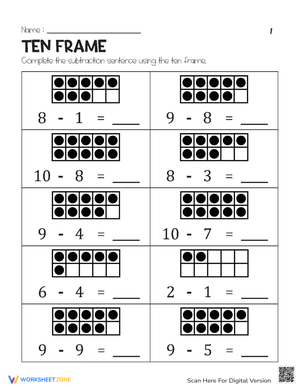
Ten-frame worksheets use the spatial structure of the frame to help students see quantities at a glance. A frame might show seven filled dots; the student marks through three and counts the four that remain. The grid prevents the visual noise of unorganized arrays, which helps students who struggle to track their count across a scattered picture field.
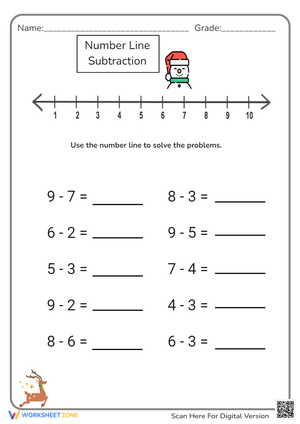
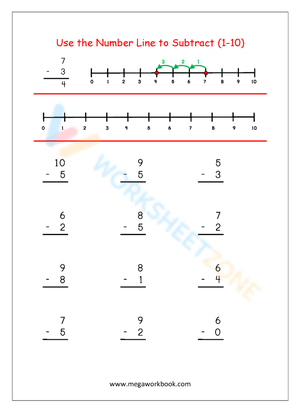
Number line worksheets label a sequence from 0 to 10 and ask students to mark a starting number, then hop left by the subtracted amount. Drawing-pictures worksheets reverse the process: students receive a bare equation and generate their own representation before solving. That last format reveals more about actual understanding than any other type in the set, because there is no printed visual to lean on — the student has to produce the representation entirely.
Frequent Student Errors Worth Watching For
The number line produces the most consistent mistake, and it is a precise one: students count the starting position as the first hop. A child solving 8 − 2 places a finger on 8, counts "one" at 8, moves to 7 counting "two," and writes 7. The process looks correct from across a classroom — two hops, an answer recorded — but the student moved from the wrong starting point. Watching one rotation of center work with number line worksheets usually surfaces this in two or three students per class.
Ten-frame errors look different. Some students shade the number being subtracted — the subtrahend — rather than crossing out that many of the filled dots. For 7 − 3, they shade three empty boxes instead of marking through three of the seven filled dots. The frame ends up showing 10 marked cells and no clear answer. This is a representation-reading issue, not a number concept issue, and it corrects quickly once a teacher places a correct and incorrect example side by side before the work period starts.
On cross-out worksheets, a quieter error shows up: students cross out the right number of pictures but then recount the crossed-out images along with the remaining ones. The concept that "crossed out" means "gone from the count" hasn't fully landed. Narrating that step explicitly during the opening model — "those are gone, we skip them" — before students work independently moves most of them past it within a session or two.
Standard Alignment
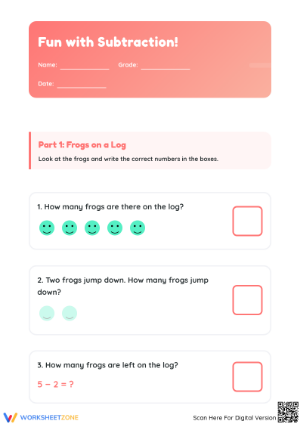
CCSS.MATH.CONTENT.K.OA.A.1 asks kindergarteners to represent addition and subtraction using objects, fingers, drawings, sounds, acting-out situations, verbal explanations, expressions, and equations. The four methods in this set address several of those representations within a single standard — cross-out pictures and ten frames cover object and drawing representations, number lines provide a symbolic spatial model, and the drawing-pictures format asks students to generate their own. K.OA.A.2 is also supported: worksheets that embed short story contexts (six birds on a branch, two fly away) ask students to solve subtraction problems set in real-world situations, which matches the language of K.OA.A.2 directly. In most district pacing guides, K.OA instruction runs from late fall through spring, so this set stays relevant across a long stretch of the year rather than during one narrow unit.
Building These Worksheets Into Your Lesson-Planning Week
The most effective entry point for each new strategy is a short whole-group model — eight minutes or less — where the teacher works through two problems on a whiteboard or under a document camera, narrating every step aloud. Students then move to the corresponding worksheet at their seat or center. Keeping the worksheet task identical to what was just modeled focuses the cognitive load on the strategy itself, not on decoding a new format.
Math center rotations are where subtraction strategies printable worksheets for kindergarten get the most mileage. Set up three or four stations, each featuring a different strategy, and rotate groups across four days. The spacing between visits to each station gives students time to consolidate one method before seeing it again. Pairing each worksheet station with a physical tool — linking cubes next to the cross-out worksheets, small counters beside the ten-frame materials — lets students check paper answers against concrete results at no additional prep cost.
Friday review blocks work well for a ten-minute whole-group debrief. Show a completed problem under the document camera — one correct, one with a common error — and ask the class to decide which student got it right and why. That discussion surfaces the number line counting mistake and the ten-frame shading confusion before students carry those errors into the following week.
Adjusting the Worksheets for a Range of Learners
Students who are still building one-to-one correspondence benefit from cross-out worksheets with large, well-spaced images and no more than six objects per problem. Working in a small group, the teacher can model the cross-out motion slowly, then ask students to mirror it on their own worksheet before counting aloud together. That guided practice within a small-group setting removes the pressure of a full center rotation before a student is ready.
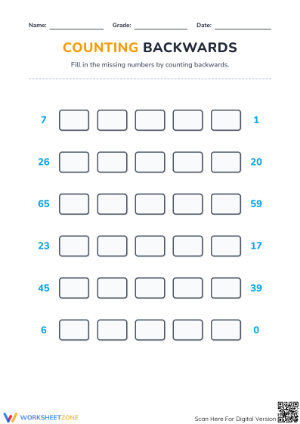
For students moving quickly through picture-based tasks, the number line and drawing-pictures worksheets push toward more abstract thinking. Ask these students to write the equation after completing each hop, then cover the number line and try to recall the answer. Even at kindergarten level, that retrieval step starts building fact fluency alongside strategy work.
When managing both groups simultaneously, the ten-frame worksheet often works best as the middle-road assignment: its structure is more organized than random pictures but more concrete than a number line. Students who need more time with visual supports find the frame steadying, while the teacher runs a small group through number line instruction nearby. Using subtraction strategies printable worksheets for kindergarten this way — one worksheet per station, each targeting a different level of abstraction — lets a class move at two different paces without requiring two separate lesson plans.
Frequently Asked Questions
Which worksheet should a teacher introduce first in the sequence?
Start with the cross-out pictures worksheet. It is the most direct paper equivalent of removing objects from a physical group, so students who have been using counters and cubes recognize the action and transition without much reorientation. After two or three days of cross-out practice, introduce the ten-frame worksheet, then number lines. The drawing-pictures worksheet layers in once students are comfortable generating their own representations rather than reading printed ones.
How do completed worksheets inform small-group instruction?
Collected worksheets show exactly which strategy a student can execute independently and which ones still need teacher support. Look for patterns across problems rather than just tallying right and wrong answers: a student who consistently lands one number too high on number line hops has a specific procedural fix to make, while a student who shades the wrong cells on ten frames needs a different conversation entirely. Two or three worksheets collected at different points in the unit give a quick snapshot of how strategy use develops over time.
What is the right number of problems per worksheet for this age?
Eight to twelve problems fits a 15-to-20-minute work period without exhausting kindergarten attention spans. These subtraction strategies printable worksheets for kindergarten stay within that range, which makes each one usable as a complete center task rather than something that runs short and leaves students without a next step. Students who finish early can use the drawing-pictures format as an open-ended extension, generating self-made subtraction problems for as long as time allows.
Do students still need manipulatives once worksheets are introduced?
Keeping manipulatives available at each station matters more than requiring students to use them. A child who freezes on a number line problem can restart with linking cubes, count back physically, and then transfer the result to the page. That recovery path prevents the kind of sustained frustration that shuts down effort entirely. Once a student consistently solves a strategy type without reaching for objects, the manipulatives can simply stay on the table unused — there is no need to remove them as a formal announcement of progress.













 Interactive Worksheet Maker
 Quiz Maker
 Word Search Maker
 Crossword Puzzle Maker
 Word Scramble Generator
 Sentence Scramble Generator
 Handwriting Worksheet Generator
 Name Tracing Generator
 Fill In The Blank Generator