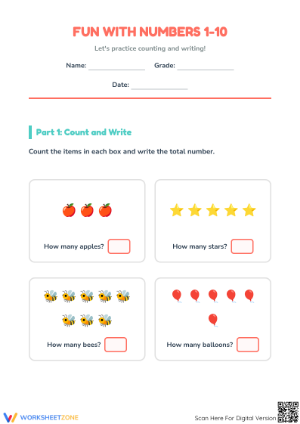
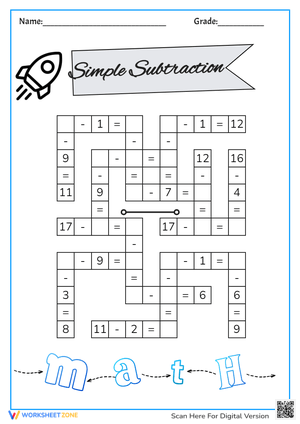
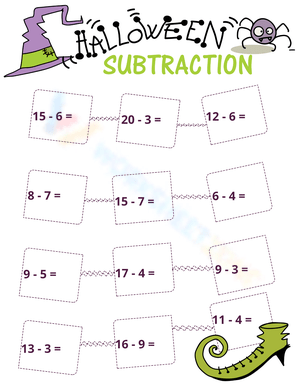
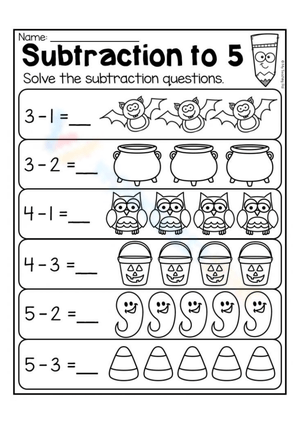
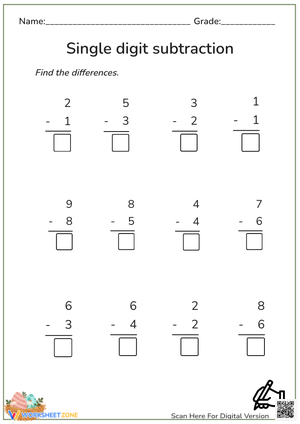
Kindergarten subtraction facts printable worksheets give teachers a structured, low-prep way to build the take-away concept long before students are ready to work purely with symbols. At this stage, the work is visual: children cross out drawn objects, count what remains, and begin attaching those actions to simple equations. A well-built set moves from picture problems within 5 to mixed practice within 10, giving teachers a logical progression that matches where five-year-olds actually are.
The Specific Skills These Worksheets Target
Each worksheet in the set focuses on one aspect of early subtraction rather than mixing everything at once. The formats students encounter across the collection include:
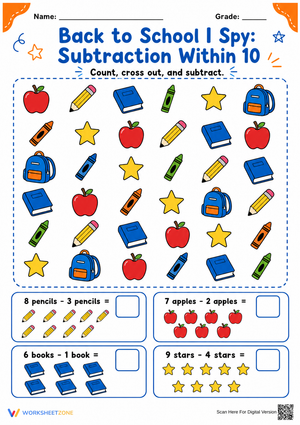
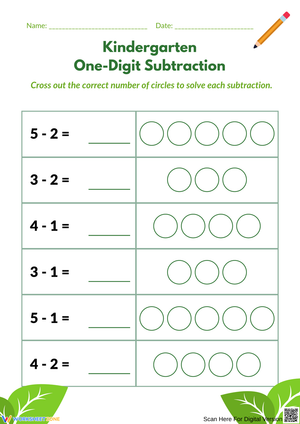
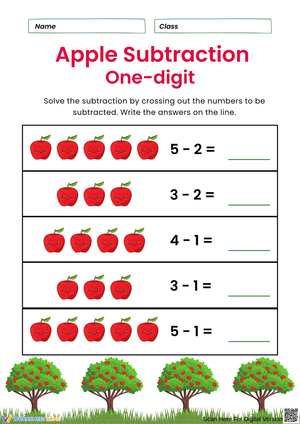
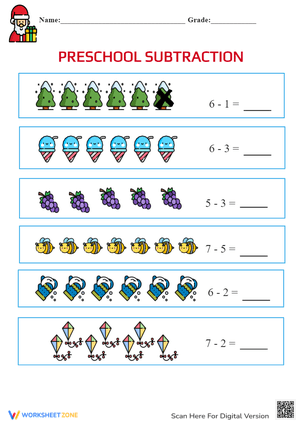
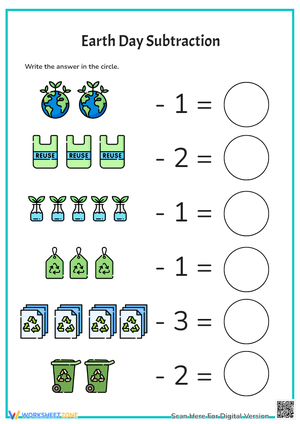
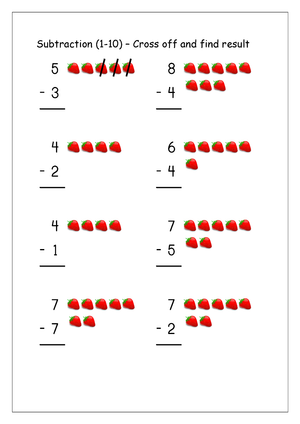
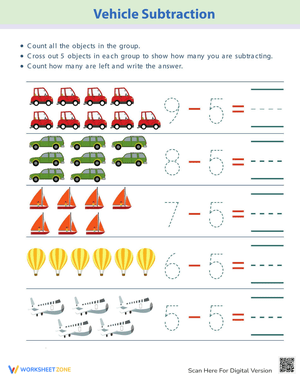
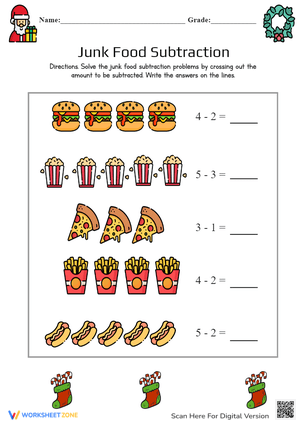
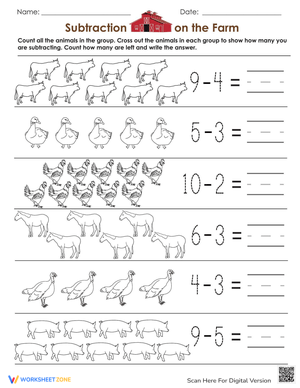
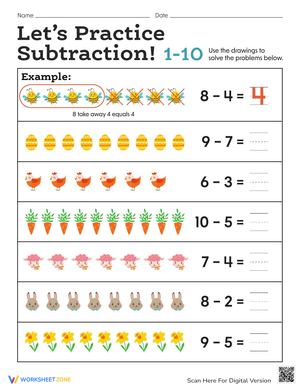
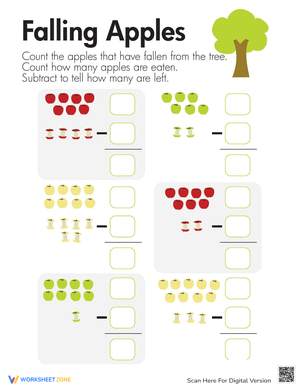
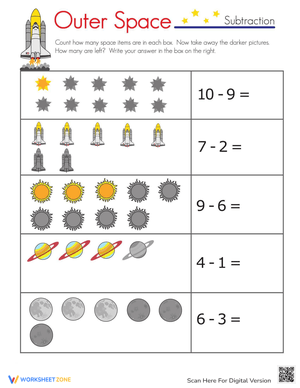
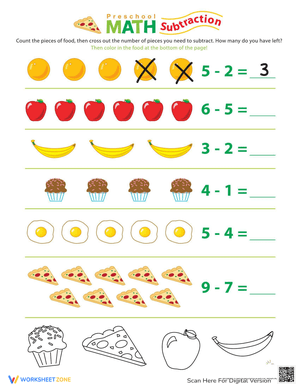
- Picture cross-out subtraction: A group of drawn objects — animals, shapes, fruit — with a written equation below. Students cross out the number being removed and count what's left.
- Within 5 fact practice: Smaller quantities with strong visual support, appropriate for students meeting subtraction for the first time.
- Ten-frame subtraction: Students see a partially filled ten-frame and determine how many dots remain after some are removed.
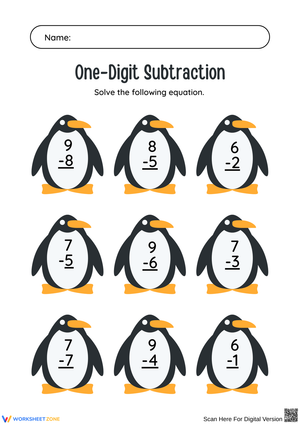
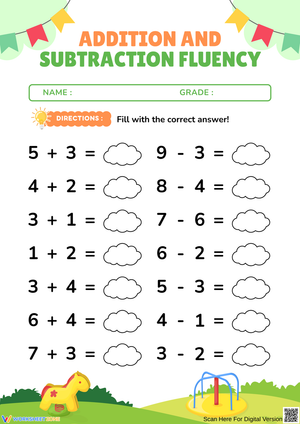
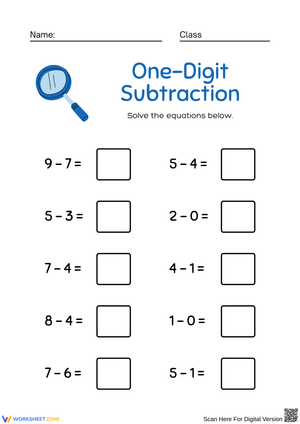
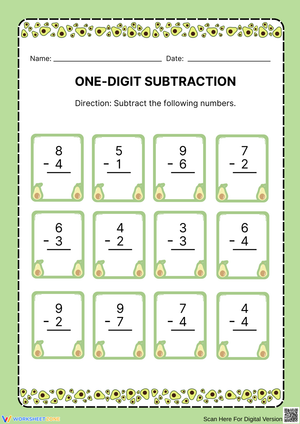
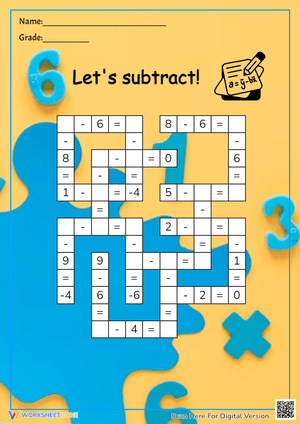
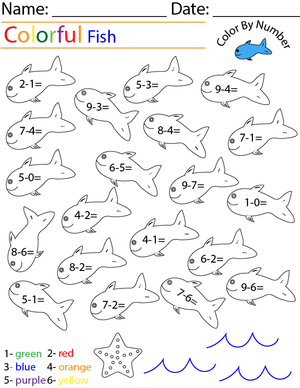
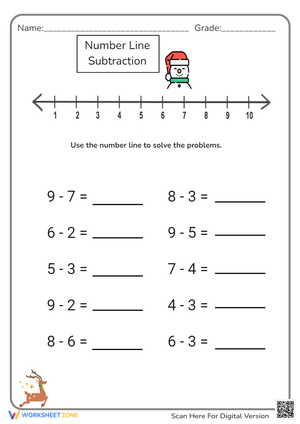
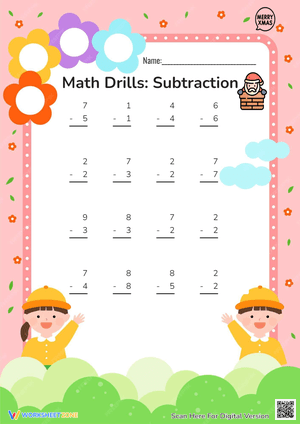
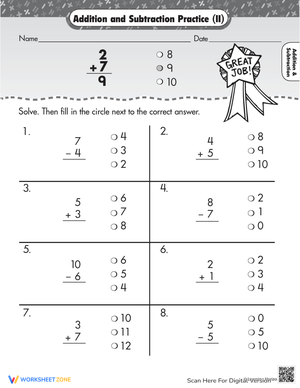
- Within 10 equations with picture support: As students grow more confident, each worksheet pairs a simple number sentence (7 − 3 = __) with a matching picture model rather than requiring abstract recall.
- Simple take-away story situations: One-sentence problems that connect subtraction to everyday language ("There were 6 frogs. 2 jumped away. How many are left?").
Keeping task types predictable within a single worksheet matters at this age. Kindergarteners spend real cognitive energy on the physical act of marking and counting. When the format stays consistent, students can focus on the math rather than re-reading directions for every new item.
Mistakes Students Make That These Worksheets Help Surface
The error we see most often with picture subtraction is recounting the whole group after crossing out instead of counting only what remains. A student who starts with 5 birds, crosses out 2, and then recounts all 5 marks — both crossed-out and remaining — will write 5 as the answer. Crossing out doesn't yet signal "those don't count" to them. Modeling with a finger physically covering the crossed-out objects and counting only what's visible corrects this faster than repeated verbal reminders.
A second pattern surfaces with within-5 facts students seem to know until the order shifts. A child who answers 5 − 2 correctly may write 2 for 5 − 3 because "3 is the bigger number I crossed out, so I write 3." They're recording the removed quantity rather than the remaining quantity. Catching this on a worksheet is genuinely useful — it surfaces a reasoning gap that oral practice alone tends to hide, and it gives teachers a concrete starting point for the next small-group session.
How to Work These Worksheets Into Your Teaching Week
Morning work is the most natural fit. A subtraction worksheet with six to eight picture problems takes most Kindergarteners about five to eight minutes, which lands cleanly before morning meeting or the calendar routine. Keep a consistent tub or folder so students know exactly what to pull out — subtraction practice becomes far more efficient once the launch is automatic and no one is asking where to find the work.
Small-group time is where these worksheets earn their keep. Run a group of four students through the first two problems together at a kidney table, prompting with "How many did we start with?" and "Touch the ones that are left," then release them to finish independently. That gives the teacher three minutes of close observation before circulating. The rhythm is hard to replicate with purely oral or manipulative-based tasks.
For sub plans and homework folders, kindergarten subtraction facts printable worksheets are particularly reliable because the picture support carries almost all the instruction. A family member or substitute can look at the worksheet and immediately understand what the student is supposed to do, without needing a written paragraph of directions alongside it.
Standard Alignment
These worksheets address CCSS.MATH.CONTENT.K.OA.A.1, which asks students to represent addition and subtraction with objects, fingers, drawings, acting-out situations, verbal explanations, expressions, and equations. The picture cross-out format directly targets the "drawings" and "acting out" representations the standard names. K.OA.A.2 is addressed through within-10 fact practice — students solve addition and subtraction word problems and add or subtract within 10. In classroom terms, K.OA.A.1 work typically begins midway through the year after students are secure with counting and number comparison; K.OA.A.2 extends into the spring trimester as fluency within 5 is established.
Adjusting the Set for a Range of Learners
Kindergarten subtraction facts printable worksheets are not one-size-fits-all, and the most useful move a teacher can make before distributing is to sort the set into three groupings: pictures with large objects and no written equation, pictures paired with a matching equation, and equations with only minimal picture support. That sorting lets teachers hand out different worksheets to different students without making a production of it — same topic, different entry point, no disruption to the room.
Students who still need hands-on support can place counters directly on top of the printed objects before crossing out. This adds the physical action of removal they still need while keeping the worksheet useful. Students working toward early fluency can solve each problem and then write the matching equation on the back — a small extension that deepens the connection between picture and symbolic notation without requiring a separate printable.
Avoid assigning within-10 worksheets to students who haven't consolidated within-5 facts yet. Moving too quickly to larger numbers tends to produce guessing rather than reasoning, and the worksheets lose their diagnostic value when students are too far out of their depth to show what they actually know.
Frequently Asked Questions
What subtraction facts should Kindergarteners work on first?
Start within 5. Students need to understand the take-away action with quantities they can visualize and track before larger numbers come in. Facts within 5 using picture support give students the chance to build that understanding rather than memorize isolated answers.
How many problems should a Kindergarten subtraction worksheet include?
Six to ten problems is the right range for independent practice. More than that tends to produce fatigue and off-task behavior, especially past the midpoint. A shorter set with clear problems gives teachers more honest information about what students actually understand.
Do these worksheets work without prior manipulative experience?
They work best after students have physically removed objects from a group at least a few times. The cross-out format is a record of the action of taking away — if students haven't done that action with real objects first, the picture problems can feel arbitrary. A five-minute lesson with counters before the first worksheet makes a real difference in how students approach the problems.
Can I use these worksheets for informal assessment?
Yes, with a simple adjustment. Remove counters and other classroom tools and ask students to work independently. Choose a worksheet with clean spacing and no decorative imagery that might pull attention away from the math. The number of items answered correctly matters, but so do the specific error types — a student writing the removed quantity instead of the remaining quantity needs a different follow-up than a student who miscounts. Kindergarten subtraction facts printable worksheets used this way can replace a separate assessment task entirely, since the format is already familiar to students and they're not managing anything new.













 Interactive Worksheet Maker
 Quiz Maker
 Word Search Maker
 Crossword Puzzle Maker
 Word Scramble Generator
 Sentence Scramble Generator
 Handwriting Worksheet Generator
 Name Tracing Generator
 Fill In The Blank Generator