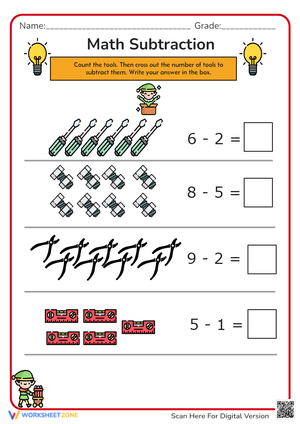
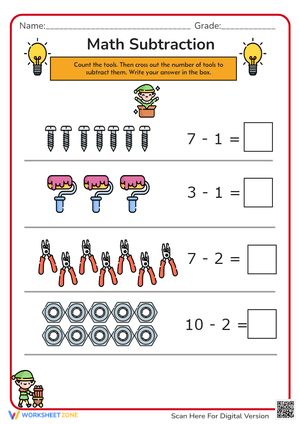
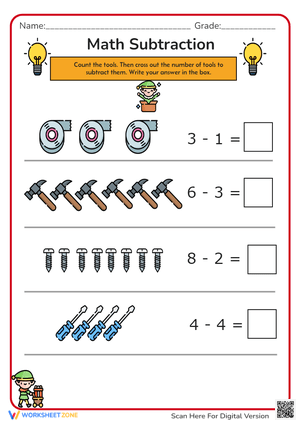
Single digit subtraction printable worksheets for kindergarten give teachers a set of ready-to-use resources that match the actual sequence of early subtraction instruction — not a single jump to equations, but a layered path from pictures to notation. The set includes cross-out picture worksheets, ten frame models, count-and-write tasks, and equation practice that still carries visual support throughout. Each worksheet stays within ten, the earliest work within five, and the layouts are clean enough that a kindergartner can follow the task after one quick model from the teacher.
What's Inside the Set
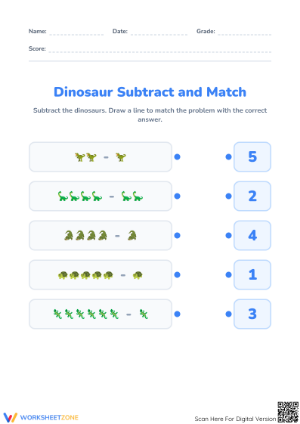
Each worksheet targets one clear format so students can focus on the math rather than decoding new directions every time. The formats across the set cover the range teachers actually need:
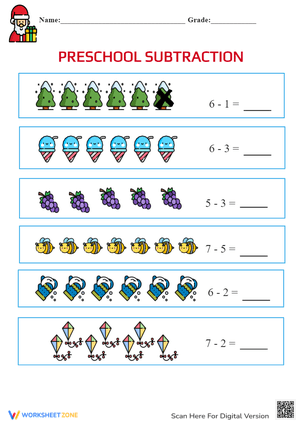
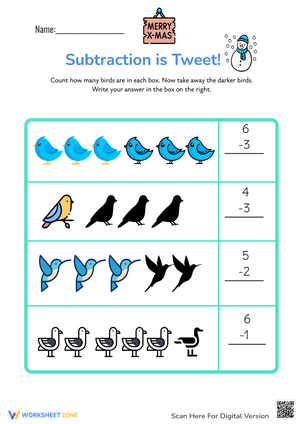
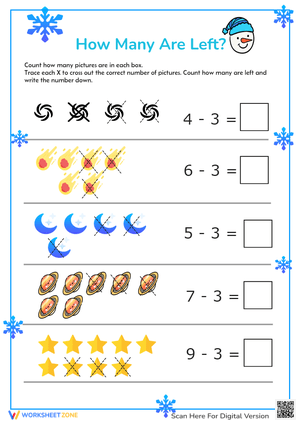
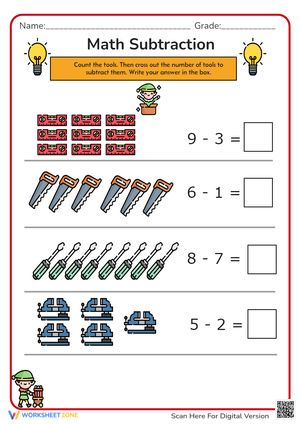
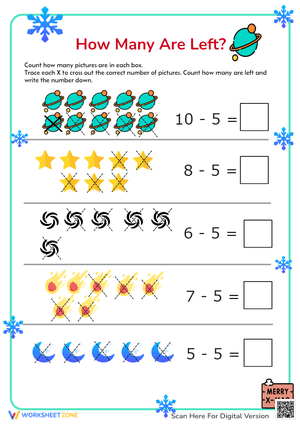
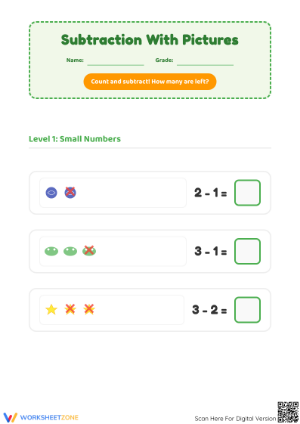
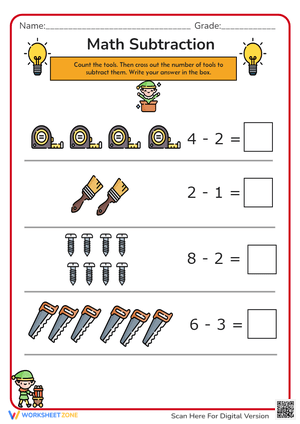
- Cross-out picture worksheets: Students count a group of objects, cross out the quantity being removed, and write how many remain. The pictures are large and well-spaced — typically six problems per worksheet — which keeps the task manageable for five-year-olds still developing pencil control alongside number sense.
- Ten frame subtraction: Filled frames show the starting quantity, and students mark or shade the take-away amount before recording the difference. These worksheets work well after students have handled physical ten frames; without that prior experience, the format often adds confusion rather than removing it.
- Count-and-subtract tasks: Students begin with a picture model and complete the matching equation below it. This format bridges the pictorial and abstract stages of the concrete-pictorial-abstract (CPA) progression — students can still see the picture but are being asked to record a number sentence.
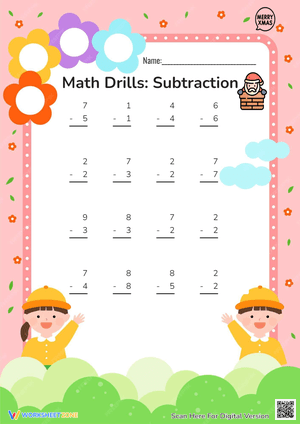
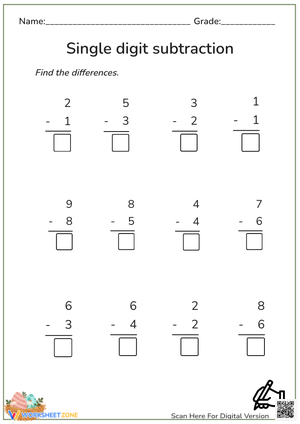
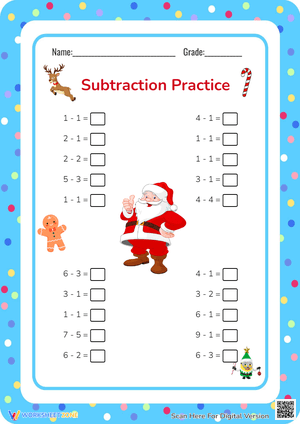
- Equation worksheets within five: Simple horizontal or vertical equations with a blank for the answer. These belong later in the sequence, after students have shown they can solve picture problems accurately.
- Color-and-solve worksheets: Students solve a subtraction problem and color the matching section. The coloring step keeps engagement up without shifting the skill target.
Within each format, the set moves from facts within five to facts within ten. That isn't just a scope decision — it reflects a real difference in how students manage counting. Within five, kindergartners can track the full set on one hand. Once quantities climb toward nine or ten, students who haven't internalized smaller facts start to lose accuracy, and the error shows up fast in written work.
Frequent Student Errors Worth Watching For
The most common and least obvious error on cross-out picture worksheets: students count the marks they drew instead of the objects that remain. On a problem showing six strawberries with two crossed out, a child who draws the X marks carefully may then count those two marks and write "2" as the answer. They completed every visible step correctly — counted the set, made the marks — but the final count went to the wrong group. Catching this early means watching where students point, not just what they write on the worksheet.
A second pattern appears when students move from picture tasks to equations. A child who can say "five take away three is two" while looking at a picture will sometimes freeze when the same problem appears as 5 − 3 = ___. The oral fluency is real; the issue is that written notation carries a different cognitive load. Including visual support on every equation worksheet addresses this directly — a picture or ten frame stays next to the number sentence until students show they no longer need it.
Single digit subtraction printable worksheets for kindergarten also surface a subtler issue: students who recount everything from the beginning instead of counting only what remains. After crossing out two strawberries from a group of six, some children restart from the first object — including the crossed-out ones — and land on "six" rather than "four." Teaching students to anchor a finger on the first uncrossed object and count forward from there, rather than restarting from the left side of the row, usually corrects this within a few sessions.
How to Build These Worksheets Into Your Lesson Plans
During a whole-group mini-lesson, projecting one problem from a cross-out worksheet while students use counters at their seats keeps the worksheet connected to the hands-on work. Students are doing the same math in two modes simultaneously — the worksheet provides the structure, the counters carry the thinking. This pairing is especially useful when you want students to start moving from acting out subtraction to recording what happened.
In math centers, pair each worksheet with a small container of manipulatives. Students place a counter on each picture, remove the take-away quantity, and count what's left before writing the answer. That physical step matters for students not yet secure with the picture model alone. For independent practice — the ten minutes while the teacher pulls a small group — choose the format students have already seen modeled at least twice. Unfamiliar worksheet layouts during independent time produce anxiety and off-task behavior more reliably than they produce math practice.
For substitute days or the stretch after a scheduled activity runs short, the black-and-white cross-out worksheets function as genuine no-prep options. They don't require any introduction beyond "count, cross out, count what's left, write the number" — which a substitute can read from the board. That same simplicity makes them useful for homework: the directions mirror the classroom routine, so families can support the work without needing to understand the underlying lesson plan.
Adjusting Each Worksheet for the Range of Learners in the Room
Students who are still working on number recognition within five need the cross-out picture worksheets from the earliest part of the set, with counters available and a sentence frame posted nearby: Start with ___. Take away ___. ___ are left. Covering all problems except one at a time also helps — the full worksheet can overwhelm students who are just learning to hold the subtraction idea in working memory while also managing pencil control.
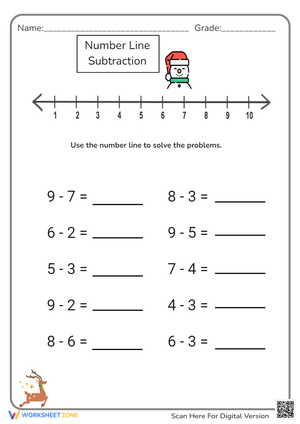
For students with fine-motor delays, prioritize worksheets where the response is circling an answer rather than writing a numeral. The subtraction thinking is the same; the physical demand is lower. A number line taped to the desk gives students a pointing option when counting small objects feels unsteady.
Students who are moving faster can work from within-ten equation worksheets, attempt missing-number problems where the equation reads 7 − ___ = 4, or draw their own picture problems and then write the matching number sentence beneath them. These extensions stay within the same skill target without introducing a new concept before classmates are ready.
Single digit subtraction printable worksheets for kindergarten sort cleanly into groups for data tracking: within-five picture worksheets for students in early instruction, within-ten picture worksheets for students approaching grade-level expectations, and equation-based worksheets for students who have already demonstrated accuracy with picture models. Labeling a folder for each group saves time during intervention blocks and keeps materials organized when multiple adults are pulling students throughout the day.
Standard Alignment
CCSS.MATH.CONTENT.K.OA.A.1 asks kindergartners to represent addition and subtraction with objects, fingers, mental images, drawings, sounds, acting out situations, verbal explanations, expressions, or equations. The cross-out picture and ten frame worksheets directly address the drawing and equation strands of that standard. CCSS.MATH.CONTENT.K.OA.A.2 extends that work by asking students to solve addition and subtraction word problems within ten using objects or drawings — the count-and-subtract format in this set supports that standard by connecting a picture context to a written equation and asking students to record the result.
In most kindergarten pacing guides, subtraction within five appears in the second quarter and subtraction within ten lands in the third. The worksheets in this set are organized to match that sequence: within-five formats come first, within-ten formats follow, and equation-only worksheets appear at the end of each group after the picture-supported versions.
Frequently Asked Questions
How many problems should be on a kindergarten subtraction worksheet?
Four to eight problems per worksheet is the range that works best. A worksheet with twelve or more items looks manageable to an adult but overwhelms most five-year-olds, especially early in the year when one-to-one counting and pencil control are still developing alongside each other. Teachers can cover part of a worksheet with a blank sheet of paper to reduce the visible items for students who need it.
When should students move from picture-based worksheets to equation worksheets?
When a student can look at a cross-out picture, explain what happened in their own words, and write the correct answer with accuracy across several problems, they are ready for equations with visual support. Accuracy on picture problems alone doesn't guarantee they can handle a bare equation — single digit subtraction printable worksheets for kindergarten in this set keep a picture or ten frame alongside every equation until students show they no longer glance at it before answering.
Can these worksheets be used for quick formative assessment?
A short four- to six-problem worksheet works well as a quick formative check. Choose a format students have already practiced, give no verbal support during the task, and watch how students count: do they point to individual pictures? Recount the crossed-out items? Restart from the beginning every time? The written answer tells you whether they got it right; watching the counting behavior tells you why.
What manipulatives pair well with these worksheets?
Two-color counters, linking cubes, and small plain erasers all work with the cross-out picture worksheets. Students place a counter on each object, remove the take-away quantity, and count what remains before recording the answer. Ten frame worksheets pair best with small circular counters that fit the frame spaces. Avoid manipulatives that are visually interesting enough to become toys — themed erasers shaped like animals pull more attention than the math during independent work.













 Interactive Worksheet Maker
 Quiz Maker
 Word Search Maker
 Crossword Puzzle Maker
 Word Scramble Generator
 Sentence Scramble Generator
 Handwriting Worksheet Generator
 Name Tracing Generator
 Fill In The Blank Generator