These kindergarten addition and counting on printable worksheets resources target the single most important shift in early math: the moment a student stops recounting every object from one and starts holding the larger addend in mind while counting forward. The set delivers several distinct formats — number line hops, dot-pattern prompts, hidden-addend boxes, and equation-writing tasks — each giving teachers direct evidence of where each child stands in making that transition.
What These Worksheets Ask Students to Do
Each worksheet in the set builds a specific piece of the counting-on skill rather than drilling the same problem type repeatedly. Students work across these formats:
- Circle the larger addend first: Before solving, students identify and circle the bigger number. This single step makes the strategy visible and correctable — if a student circles the smaller number, the misconception surfaces immediately.
- Number line hops: Students place a pencil on the starting number and draw arcs for each hop forward, externalizing the counting sequence so the process, not just the answer, is on the worksheet.
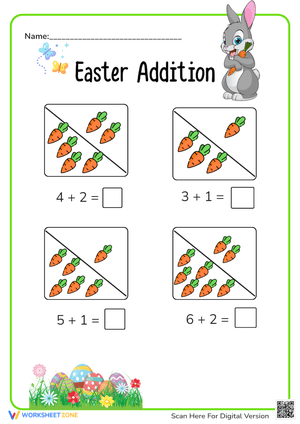
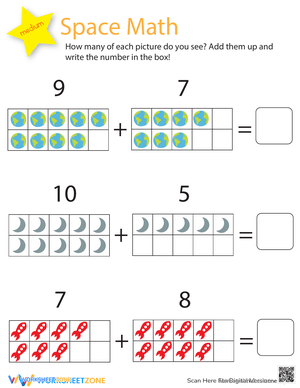
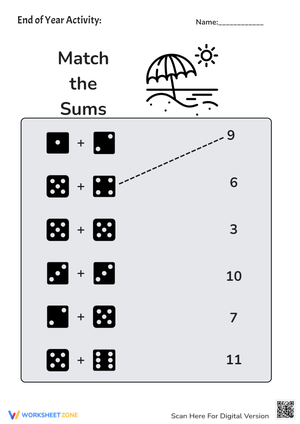
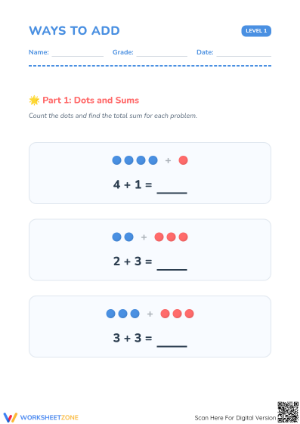
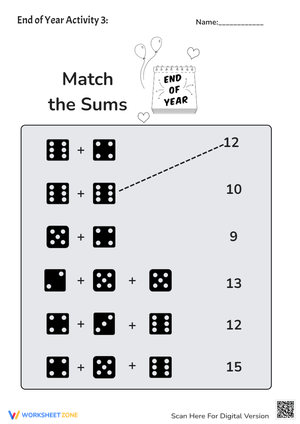
- Dot and domino prompts: Familiar dot arrangements let students recognize the first quantity without counting it, so full attention goes toward counting the second group forward.
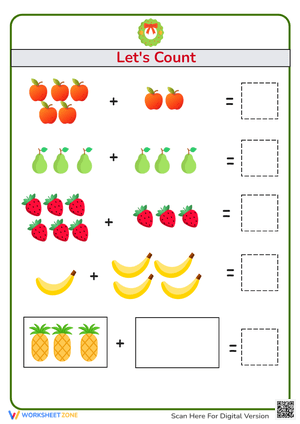
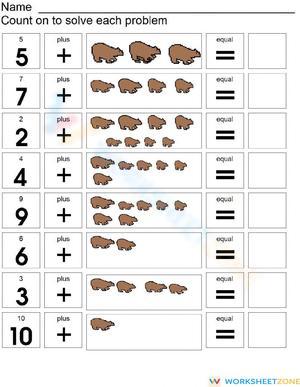
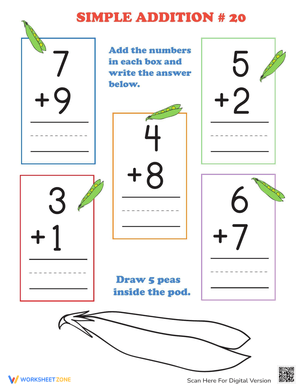
- Hidden-addend boxes: A number inside a box sits alongside a small group of drawn objects. Students must start counting from the boxed number — there is nothing to recount from one, so counting on is the only available path.
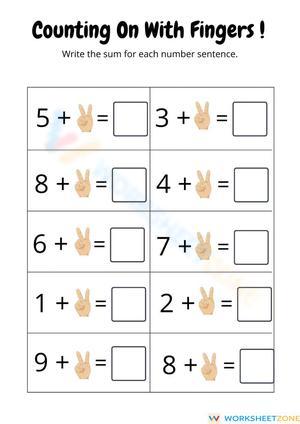
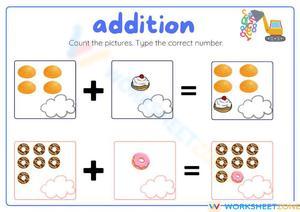
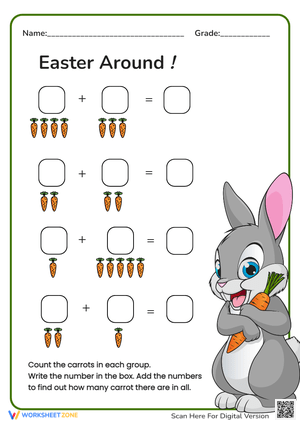
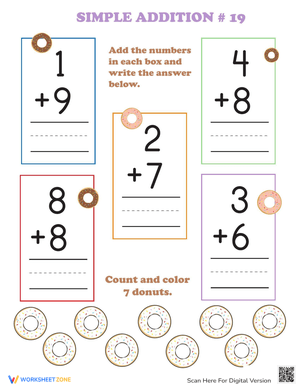
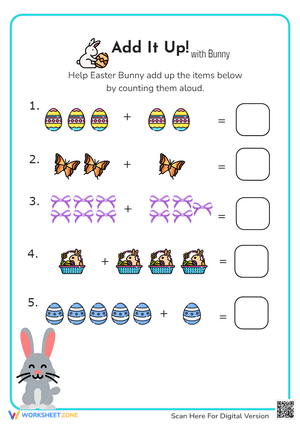
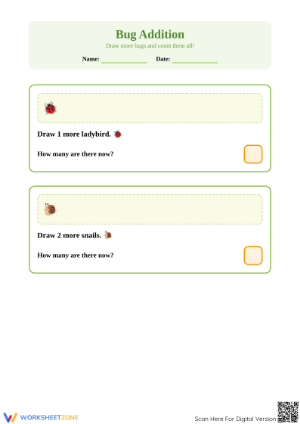
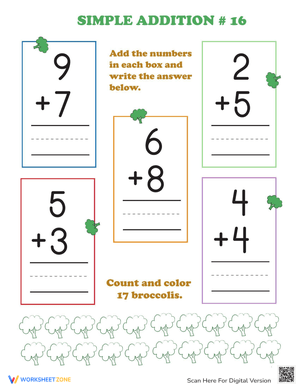
- Equation writing from pictures: Students identify two quantities in a scene, write the addition sentence, and solve it by counting on, connecting the symbolic and concrete simultaneously.
Mistakes Students Make That These Worksheets Help You Catch
The error that appears most consistently in student work isn't counting all — it's starting from the wrong addend. A student solving 3 + 7 reads left to right, starts at three, and counts on seven more hops. The answer is still correct, because addition is commutative, but seven hops is the harder path, and that student hasn't internalized the strategy. The circle-the-larger-number prompts make the choice explicit rather than invisible — if a student circles the 3 in 3 + 7, the misconception shows up before any counting even begins.
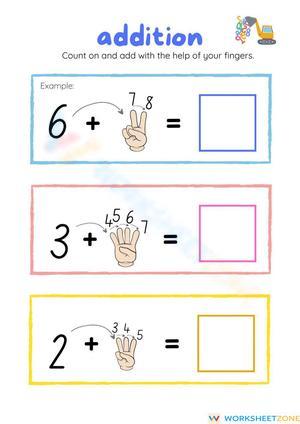
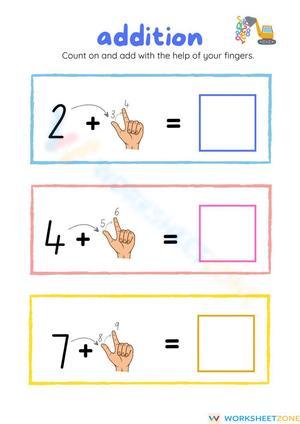
A second pattern produces genuinely wrong answers: students who count the starting number as the first hop. Solving 6 + 3, they say "six" and then count "six, seven, eight," treating that initial six as a step forward and landing on 8 instead of 9. The fist-to-finger method addresses this directly — the closed fist represents the starting addend, fingers open only for new counts, and there is a physical record of exactly how many numbers were said forward. Teaching this alongside the worksheets gives students an error-check they can run themselves without waiting to be corrected.
How to Build These Worksheets Into Your Lesson Plans
The most useful placement is the first seven to ten minutes of math block, before whole-group instruction. Students retrieve the strategy from the previous day, and you get an immediate read on retention. A child still counting from one during the warm-up gets pulled to your small group that day instead of you discovering the gap midway through an independent work period.
During guided math rotations, these kindergarten addition and counting on printable worksheets work well at the independent station precisely because the instructions are mostly visual. Once you've modeled the fist-to-finger sequence two or three times whole-group, most students can navigate a new worksheet format without additional direction — which means a genuinely uninterrupted small-group session for you rather than constant fielding of procedural questions from across the room.
Standard Alignment
These worksheets address two kindergarten standards that overlap in practice. CCSS.MATH.CONTENT.K.OA.A.2 asks students to add and subtract within ten using objects, drawings, and equations — the hidden-addend and equation-writing worksheets map to this directly. Underlying that, CCSS.MATH.CONTENT.K.CC.A.2 requires students to count forward beginning from any given number within the known sequence, which is the mechanical foundation counting on depends on entirely. A student who hesitates at "what number comes after 7?" needs more K.CC.A.2 work before the K.OA.A.2 tasks here pay off. Both standards appear on most state kindergarten math assessments and feed directly into first-grade addition fact work, so the fluency built here compounds over time.
Differentiating These Worksheets Across Ability Levels
For students still shaky on the forward counting sequence, use worksheets with sums of five or less and leave the larger addend already circled. The task narrows to one job: count forward from that number. Reducing surrounding decisions lets the strategy itself become the focus rather than the peripheral work of reading a problem and choosing a starting point.
Students who have the strategy down but need more challenge get the hidden-addend and equation-writing worksheets with sums up to twelve. Removing the number line from those worksheets is the fastest way to raise the ceiling — students who relied on the visual track now maintain the count mentally, which is the bridge toward true addition fact fluency. For kindergarten addition and counting on printable worksheets to serve a mixed-ability room well, keep three difficulty levels accessible during rotations so grouping can shift without interrupting the whole class.
Frequently Asked Questions
How do I know when a student is ready to start counting on?
The clearest signal is fluent forward counting from a given number. Ask the student to begin counting at 6 and keep going — if they hesitate, restart from one, or need to whisper-count from the beginning to locate their place, they need more K.CC.A.2 practice before these worksheets pay off. Students who begin at any number without backing up are ready to apply that skill to addition.
Why do students keep reverting to counting all even after the strategy has been introduced?
Counting all is the strategy they trust under pressure. When a problem feels harder — larger numbers, an unfamiliar format, a noisier room — students fall back on the method that has never failed them. Reverting isn't a sign the student didn't learn; it means the newer strategy isn't automatic yet. Consistent daily practice, especially in low-stakes warm-up slots, builds the repetition that makes counting on the default rather than the deliberate choice.
Do these worksheets hold up as homework assignments?
They work well as homework, with one caveat: send a brief note home explaining the strategy. Many parents will see a child starting from the larger number and assume they're doing it wrong — they redirect the child to count from one, which directly undoes the classroom instruction. A two-sentence explanation of counting on, sent alongside these kindergarten addition and counting on printable worksheets, prevents most of that friction before it starts.













 Interactive Worksheet Maker
 Quiz Maker
 Word Search Maker
 Crossword Puzzle Maker
 Word Scramble Generator
 Sentence Scramble Generator
 Handwriting Worksheet Generator
 Name Tracing Generator
 Fill In The Blank Generator