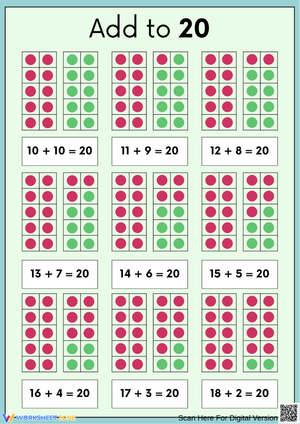
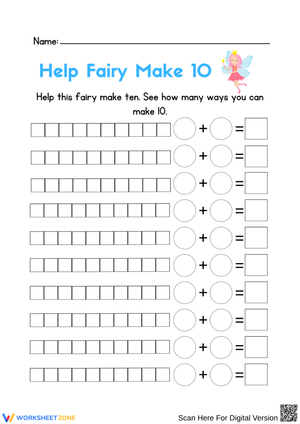
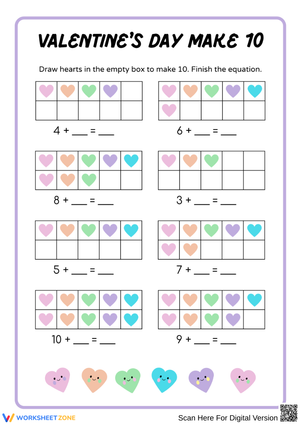
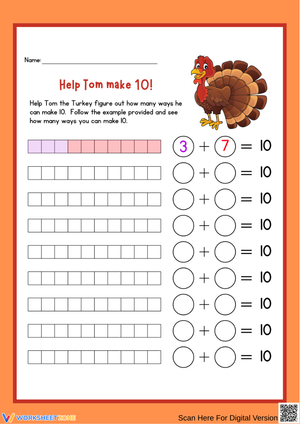
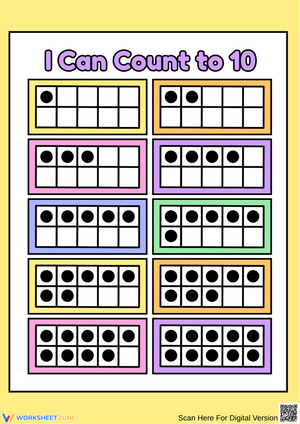
These addition and ten frames worksheets for kindergarten give teachers a ready set of structured practice resources for the exact developmental window when students are moving from one-by-one counting toward recognizing composed quantities. The worksheets cover sums within 10, missing addend problems, and double ten-frame tasks for teen numbers — formats that stay manageable for five-year-olds while building the number sense they need heading into first grade.
The Specific Skills Targeted
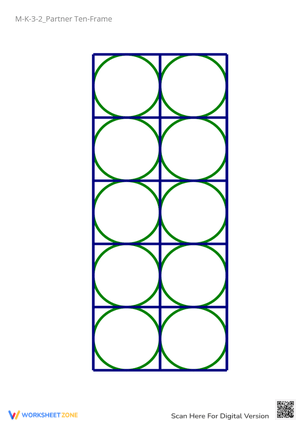
Ten frames work because the 2-by-5 grid locks the "five-anchor" into every problem. Students who work through this set learn to see a full top row and immediately register five — not count five individual dots — which is subitizing at its most basic level. That recognition then extends to combinations: a full top row with two dots below becomes "five and two more," and that phrasing matters more than many teachers realize early in the year.
The set includes five distinct activity types:
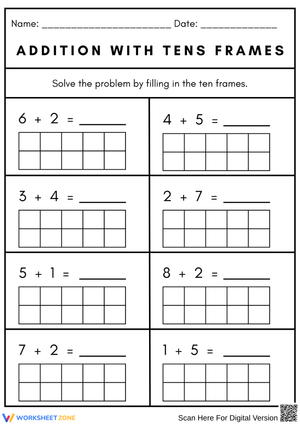
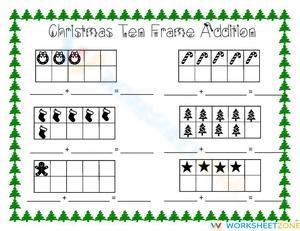
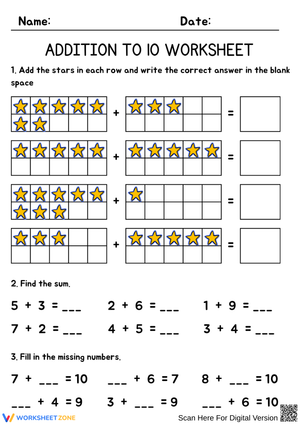
- Single ten-frame addition: Two colors of dots fill a single frame; students write the equation and sum. The colors separate the addends visually so students can read the addition story off the grid before touching a pencil.
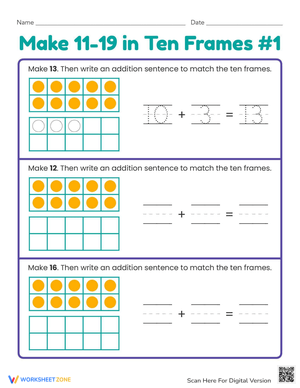
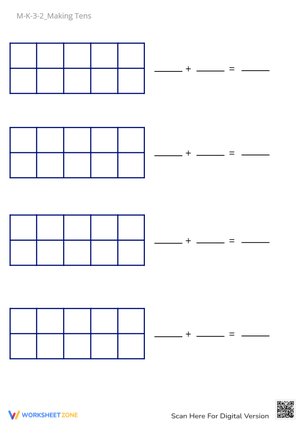
- Making ten: A partial frame appears alongside a number; students draw the remaining dots and complete the equation. This is the direct practice path for K.OA.A.4.
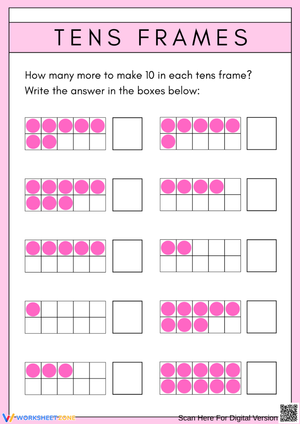
- Missing addend tasks: Students see a completed sum and one addend already marked on the frame, then determine the second. The empty boxes carry the answer — students just need to count those rather than the filled ones, which is where the real instructional challenge lives.
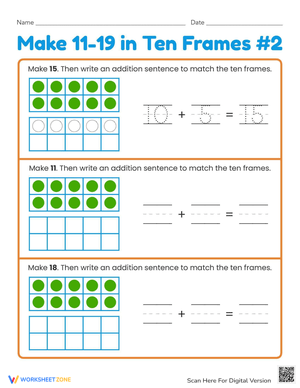
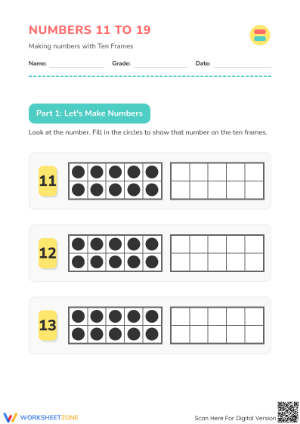
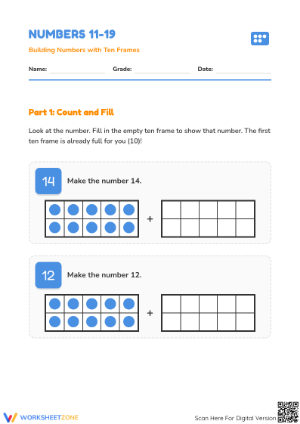
- Double ten frames for teen numbers: A full first frame (representing 10) pairs with a partially filled second frame; students record the teen number the pair shows. This plants the ten-as-a-unit concept before formal place value instruction begins.
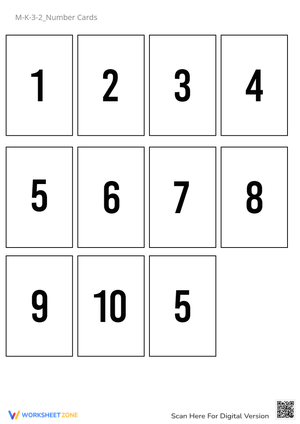
- Cut-and-sort matching: Students cut out equation cards and place them beside the matching frame image, which adds a fine-motor element and forces deliberate visual comparison rather than fast guessing.
Standard Alignment
The primary standard these worksheets address is K.OA.A.4 — "for any number from 1 to 9, find the number that makes 10 when added to the given number." The making-ten and missing-addend worksheets hit this directly. Single-frame addition tasks cover K.OA.A.2 (solve addition problems within 10 using objects, drawings, and equations), and the double ten-frame work connects to K.NBT.A.1 (compose and decompose numbers from 11 to 19 into ten ones and some further ones). Teachers reaching for addition and ten frames worksheets for kindergarten in the weeks before a K.OA.A.4 benchmark check will find the making-ten format gives students exactly the visual rehearsal that standard expects — not abstract fact drilling, but practiced reasoning with the grid itself.
Frequent Student Errors Worth Watching For
The most reliable error in missing-addend tasks is counting the filled boxes to find the second addend rather than the empty ones. If a frame shows 6 dots and the target is 10, a surprising number of kindergartners write "6 + 6 = 10" because they recount the given quantity. That mismatch — the equation doesn't balance — opens a direct conversation about what the empty spaces mean in context, and it's far easier to catch and correct on a worksheet than to diagnose later from a number-line error in first grade.
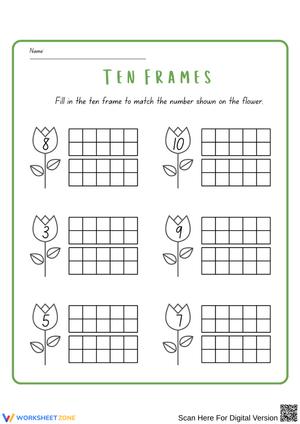
A second pattern worth watching: when students draw their own dots to complete a frame, many fill column-by-column going downward rather than row-by-row across. A frame filled that way shows six dots as a full left column and one dot at the bottom right, which looks nothing like the standard five-and-one pattern. Correcting that directionality early — before it becomes muscle memory — saves real reteaching time come January, when students are being asked to subitize quickly rather than construct the pattern from scratch.
Fitting These Worksheets Into Your Lesson Planning
The most effective sequence is whole-group introduction first: project a ten frame, model filling it left-to-right across the top row before moving to the bottom, work through two or three examples together, then distribute the printed worksheet for independent or partner practice. That structure keeps cognitive load manageable — students are not handling both the grid mechanics and the math at the same time. By the time they sit down with paper, the grid is already familiar.
For math centers, slip each worksheet into a clear dry-erase sleeve. Students place two-color counters on the frame first, confirm the arrangement, then draw dots and write the equation in marker. That concrete-before-pencil sequence cuts errors noticeably in the first week of a unit. The missing-addend and making-ten formats work particularly well as a Tuesday or Wednesday center after a Monday whole-group introduction — by Friday, most students are ready to complete the same type directly on paper without the counters, which gives a clean formative read on who still needs support. Weaving addition and ten frames worksheets for kindergarten into a Monday morning warm-up rotation, even for just a few minutes, also keeps the visual model active across a unit rather than concentrated in a single block.
Adjusting the Set for a Range of Learner Readiness
Students who are not yet reliably counting to 10 need physical counters on the desk while working. Pair them with a partner for the cut-and-sort matching worksheet before moving them to any task that requires writing equations independently. The double ten-frame worksheets are too abstract at that stage — hold those back until single-frame totals feel automatic.
For students already comfortable with sums within 10, the missing-addend and making-ten worksheets offer the right stretch without abandoning the ten-frame structure. Ask them to write two equations for each frame — the standard order and the turned-around version (4 + 6 = 10 and 6 + 4 = 10) — which builds an intuition for the commutative property without naming it formally. The double ten-frame worksheets also extend naturally into a brief oral explanation: "What does the full frame tell you? What does the second frame tell you?" Verbalizing that distinction is more demanding than it appears on paper, and it moves students toward the kind of number talk that first-grade teachers appreciate having already in place.
Frequently Asked Questions
Should students use physical counters alongside these worksheets, or work directly on the printed frame?
Both, in sequence. Early in a unit, counters on the printed frame come first — students place two-color counters, confirm the arrangement, then draw. Once that routine feels reliable, they move to working directly on paper. Skipping the counter step too early is the most common reason students start making consistent errors on missing-addend problems mid-unit.
Are these worksheets useful for first-grade intervention students who missed this content?
Addition and ten frames worksheets for kindergarten work well in first-grade small-group intervention because the visual model is immediately readable — no prior ten-frame exposure is required to understand what the grid means. A 15-minute pull-out session using the single-frame addition and making-ten worksheets, run twice a week for three to four weeks, gives most students the foundation they need to meet the K.OA.A.4 expectation before first-grade addition strategies build further on top of it.
What order should the different worksheet types be introduced?
Start with single-frame addition using two distinct dot colors. Once students write equations from those reliably, move to the making-ten format. Missing-addend tasks come third because they require students to reason about what is absent rather than what is present — a harder cognitive shift than it sounds. Double ten-frame worksheets come last and are appropriate once students recognize a full frame as ten without recounting the individual dots.













 Interactive Worksheet Maker
 Quiz Maker
 Word Search Maker
 Crossword Puzzle Maker
 Word Scramble Generator
 Sentence Scramble Generator
 Handwriting Worksheet Generator
 Name Tracing Generator
 Fill In The Blank Generator