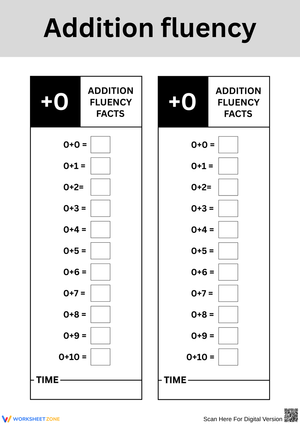
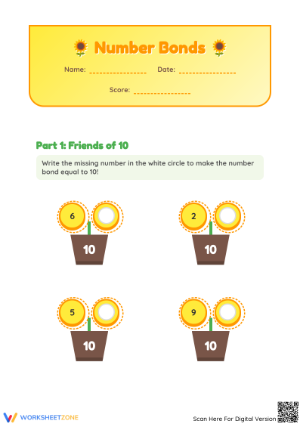
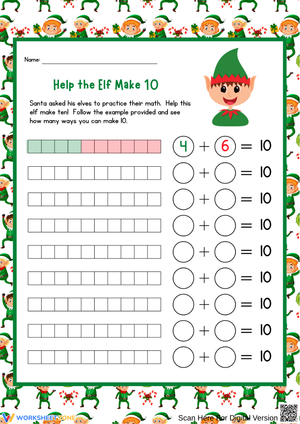
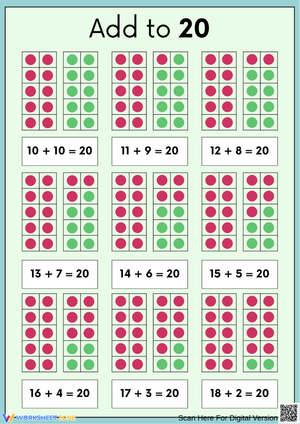
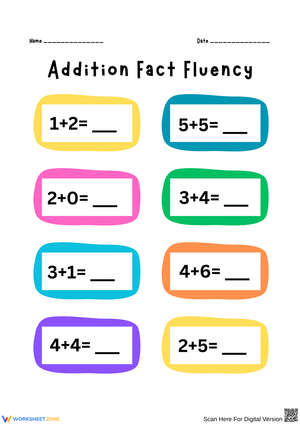
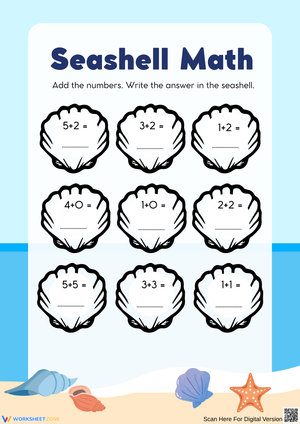
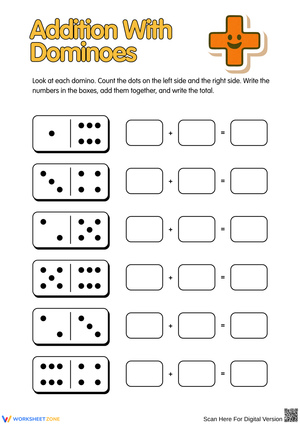
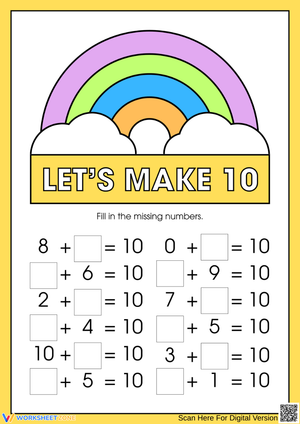
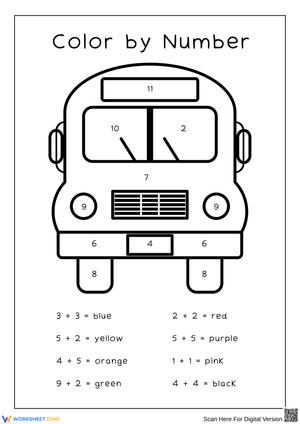
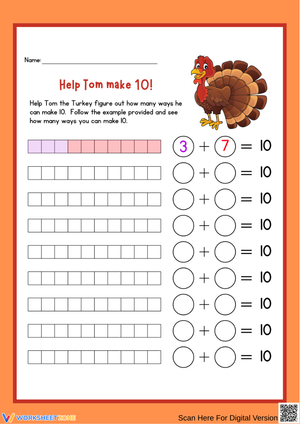
These kindergarten addition worksheets give teachers five practice formats — picture addition, ten-frame work, number line jumps, vertical equation writing, and cut-and-paste problems — spaced and printed for five-year-old handwriting. The set stays within sums to 10, moving from picture-heavy problems where students count drawn objects toward equations where students write answers without any visual backup. Print them for morning warm-up, slide them into dry-erase sleeves for center rotations, or send them home — the format holds up across all three uses.
What the Set Covers
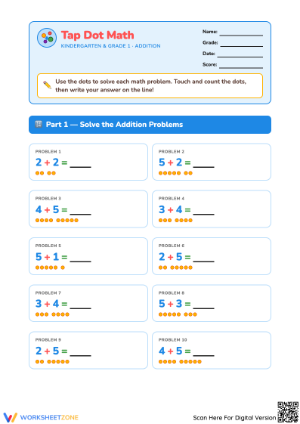
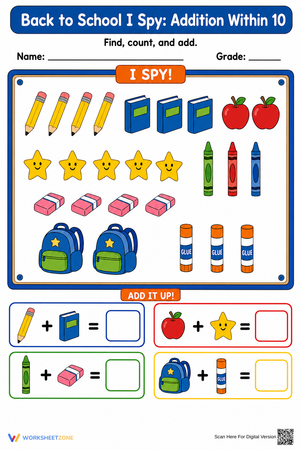
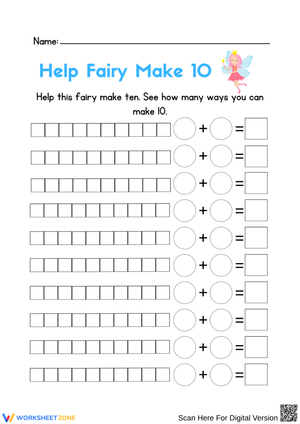
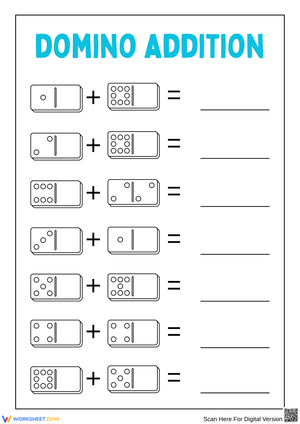
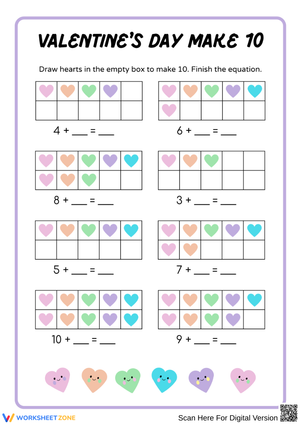
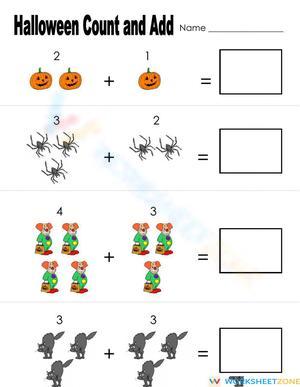
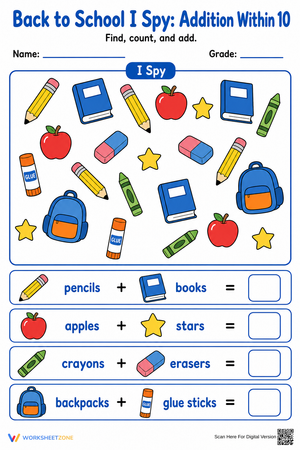
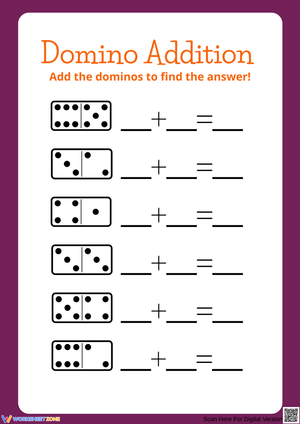
Picture addition opens the sequence because five-year-olds need to see what "plus" means before the symbol carries any weight. Each picture addition worksheet shows two clearly separated groups of objects — never overlapping, each group labeled with a numeral — so students count, record both parts, and write the total. A kindergarten addition worksheets featuring ten-frame practice adds a different layer: a 2-by-5 grid makes five visible without counting. Students who work regularly with ten-frames start seeing 7 as "a full row and two more" rather than counting from 1, which is the mental move that directly supports place-value work in first grade.
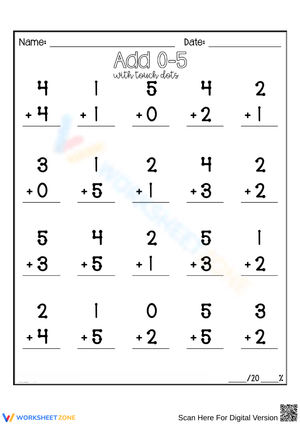
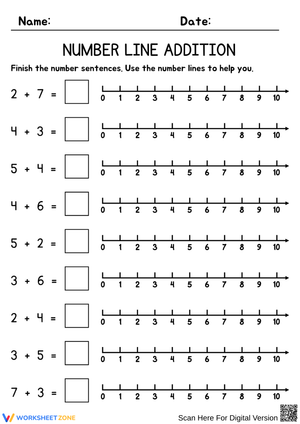
Number line worksheets teach the counting-on strategy through a physical path — students circle the starting number and draw arcs forward, one per jump, landing on the sum. Vertical equation worksheets run alongside horizontal practice because, while nearly all kindergarten addition appears horizontal, early familiarity with the stacked format removes a layer of confusion when regrouping arrives in second grade. The cut-and-paste worksheets close the progression; students solve a problem and match it to the correct sum card, stringing together three steps — reading the equation, computing, and confirming — in one focused task.
Student Mistakes That Deserve Direct Attention
The most frequent picture-addition error isn't miscounting — it's that students count accurately and then write both addends instead of the sum. A child who correctly tallies three fish and two fish, arriving at five, will write "32" in the answer box. They've recorded the two parts rather than the total. This confusion clears once teachers draw explicit attention to the answer box as belonging to a different question than the numbers students started with.
On number line worksheets, students reliably start at zero instead of at the first addend. For 4 + 3, they land on 7, which looks correct — but only because they counted 4 jumps from zero and then 3 more. They haven't used the equation's structure; they've simply counted forward seven times. Asking a student to place their finger directly on the 4 before making any marks is the fastest way to determine whether they're tracking the starting addend or counting everything from scratch.
Ten-frame worksheets surface a subtler problem. Students fill the frame correctly, count correctly, and arrive at the right answer — then recount from 1 the next time. The ten-frame's point is to let students see 6 rather than count 6 individual dots. When recounting persists, the two-color approach interrupts it: students color three boxes in one crayon and four in another, keeping the two groups visually distinct even after they stop actively attending to the grid. That separation is what moves students from counting toward subitizing.
How to Work These Worksheets Into Your Weekly Plans
Picture addition worksheets belong at the front of a unit — the first few days when the plus sign is new and students need a concrete anchor for what combining means. Once most students can count two groups and record a total without confusion, move ten-frame and number line worksheets into center rotations so students who've internalized counting-on aren't idling while others catch up. Hold vertical equation worksheets for the last week, after horizontal format is solid, so the layout shift doesn't land on top of still-forming number sense.
For math centers, sliding worksheets into clear plastic sleeves with dry-erase markers lets four students rotate through the same material in a single thirty-minute block. Pair any picture addition or ten-frame worksheet with two-color counters; students build the equation on the paper before writing the answer, giving themselves a physical confirmation rather than a guess. Cut-and-paste worksheets are better reserved for small-group instruction — when students pick a sum card to match an equation, you can see in real time whether they're computing or estimating, and that distinction is worth observing directly.
Standard Alignment
The worksheets address CCSS.MATH.CONTENT.K.OA.A.1, which asks students to represent addition using objects, drawings, and equations, and CCSS.MATH.CONTENT.K.OA.A.2, which requires solving addition situations and computing within 10. Picture addition and cut-and-paste formats fulfill K.OA.A.1 directly — students represent a joining situation before computing abstractly. Ten-frame work also connects to CCSS.MATH.CONTENT.K.NBT.A.1: understanding that teen numbers consist of a ten and some ones only makes sense when students already treat 10 as a complete unit rather than a count of ten separate objects, and ten-frame practice builds exactly that foundation.
Adjusting the Worksheets Across Ability Levels
Students still developing one-to-one correspondence — who can count to 10 but lose track mid-sequence — need picture addition worksheets where objects are arranged in a row rather than scattered across the page. A kindergarten addition worksheets with row-aligned objects gives these students a clear left-to-right path and cuts double-counting errors significantly. Keep physical counters available so they can touch each drawn image while tallying.
Students ready to move past pictures benefit from number line and vertical equation worksheets with no drawn objects — just numerals and symbols. For the furthest-along students, ask them to write a related fact on the back of a completed worksheet: if the front shows 4 + 3 = 7, they write 3 + 4 = 7 or name a subtraction sentence that uses the same three numbers. That extension fits inside a single worksheet without additional printing, and it quickly reveals whether students understand commutativity or are treating each equation as an isolated fact.
Frequently Asked Questions
When should students move from picture support to equations without pictures?
Watch for students who stop looking at the drawn objects entirely — who see "3 + 4" and write "7" before their eyes reach the pictures. That behavior signals that the visual support has become unnecessary, and it's time to shift to worksheets without it. Most kindergartners reach this point with sums to 5 before they reach it with sums to 10, so the transition typically happens by sum range rather than as a sudden whole-class shift.
How many problems per session can a kindergartner genuinely work through?
In a 10-to-15-minute focused independent practice block, six to eight problems is a realistic ceiling. Past that point, errors increase not because students have forgotten the math but because attention has drifted — and it becomes difficult to distinguish tired compliance from actual confusion. Four or five well-chosen problems produce enough formative information to plan the next lesson without pushing into numbers 9 and 10 that no one is truly attending to.
What if a student solves addition correctly but can't yet write numerals legibly?
Give students dot stamps, stickers, or small counters to mark answers instead of writing numerals, or have them point to the correct number on a posted number strip while you record it. The mathematical work — joining two groups and identifying the total — stays fully intact even when pencil control isn't there yet. Separating the writing task from the computation task also prevents students from experiencing numeral-formation struggles as math failure, which is a meaningful distinction to preserve at this age.
How do these worksheets pair with the manipulatives already in my classroom?
Set the manipulatives directly on the worksheet. For picture addition, students place one counter on each drawn object, then sweep both groups to the center to count the total — the paper becomes a work surface rather than a separate task. For ten-frame work, students place counters in the grid boxes and then record what they've built. A kindergarten addition worksheets used this way functions as a recording sheet for hands-on math rather than a standalone paper-and-pencil task, which is the concrete-to-representational sequence that K.OA standards are built around.













 Interactive Worksheet Maker
 Quiz Maker
 Word Search Maker
 Crossword Puzzle Maker
 Word Scramble Generator
 Sentence Scramble Generator
 Handwriting Worksheet Generator
 Name Tracing Generator
 Fill In The Blank Generator